



• Latest
  • All
  • How To
Microsoft's Majorana 1 Quantum Computing Processor

Microsoft May Have Just Cracked the Code for Practical Quantum Computing

October 24, 2025
KRA Customs

KRA Introduces Blockchain Platform to Reduce Port Delays and Paperwork

July 31, 2026
Anne Kinuthia-Otieno

Visa Names Anne Kinuthia-Otieno as Head of East Africa

July 31, 2026
Safaricom CEO, Dr. Peter Ndegwa

Safaricom Pays Out Record KES 80.13 Billion to Shareholders

July 31, 2026
Swooni

Swooni: The App That Helps Couples Build Stronger Relationships One Minute at a Time

July 31, 2026
DHgate Tablet Cases deals
IEBC Defends Election Bill but Leaves Questions Over Live Results Feed Unanswered

IEBC Defends Election Bill but Leaves Questions Over Live Results Feed Unanswered

July 31, 2026
Kenya Power token

Kenya Power Token Purchases Fail Across Kenya Hours After Nationwide Blackout

July 30, 2026
Microsoft Copilot

Microsoft to Merge Copilot, GitHub Copilot, and AI Agents Into One App

July 30, 2026
Senate Bill Seeks to End IEBC Polling Station Livestreams for 2027 Elections

Senate Bill Seeks to End IEBC Polling Station Livestreams for 2027 Elections

July 29, 2026
Cars in port awaiting clearing

Court Gives Car Dealers 60 More Days Before NTSA Can Seize Unregistered Vehicles

July 29, 2026
Meta CEO Mark Zuckerberg

Meta Is Selling an Open AI Future. There’s Just One Problem

July 29, 2026
Moto Nzuri

Moto Nzuri, the New Bioethanol ATM Picking Up Where KOKO Left Off

July 29, 2026
Gmail Logo

How to Change Gmail’s Undo Send Window From 5 Seconds to 30 Seconds

July 29, 2026
Techweez | Tech News, Reviews, Deals, Tips and How To
  • News
  • Entertainment
  • Reviews
  • Features
  • Editorial
No Result
View All Result
Techweez | Tech News, Reviews, Deals, Tips and How To
  • News
  • Entertainment
  • Reviews
  • Features
  • Editorial
No Result
View All Result
Techweez | Tech News, Reviews, Deals, Tips and How To
No Result
View All Result

Microsoft May Have Just Cracked the Code for Practical Quantum Computing

Caleb Sama by Caleb Sama
October 24, 2025
in News
Reading Time: 4 mins read
273
0
Microsoft's Majorana 1 Quantum Computing Processor

After 17 years of relentless research in quantum computing, Microsoft has achieved what many thought impossible: they’ve created a quantum processor that could potentially pack a million qubits (quantum bits) onto a chip roughly the size of your computer’s CPU.

This breakthrough, announced alongside their new Majorana 1 processor, isn’t just another incremental step in quantum computing—it’s a fundamental reinvention of how quantum computers might work.

Okay, Can Someone Please Dumb This Down?

Well, if you read the paper that Microsoft published, it all sounds very complex (which it is) for someone without a background in physics and computing. The basic gist, though, revolves around a particle that spent 86 years as a theoretical curiosity.

In 1937, physicist Ettore Majorana described a peculiar particle that could be its own antiparticle (simply meaning it has no distinct counterpart with opposite properties). Now, Microsoft has not only found a way to observe these hard-to-find Majorana particles but has also figured out how to control them to create more stable quantum bits, or qubits.

Wait, What Are Qubits?

Qubits, or quantum bits, are the building blocks of quantum computers. Regular computers use classical bits, which can be either 0 or 1, to process data. A qubit, however, is like a magical coin that can be both heads and tails at the same time, instead of just one or the other.

.

This special ability helps quantum computers solve problems much faster than regular computers. Qubits can also be linked together, so changing one instantly affects the other, no matter how far apart they are.

However, qubits are very unstable. They are sensitive to tiny changes in temperature, noise, and even small vibrations. This can cause them to lose their special quantum state quickly, a problem called decoherence.
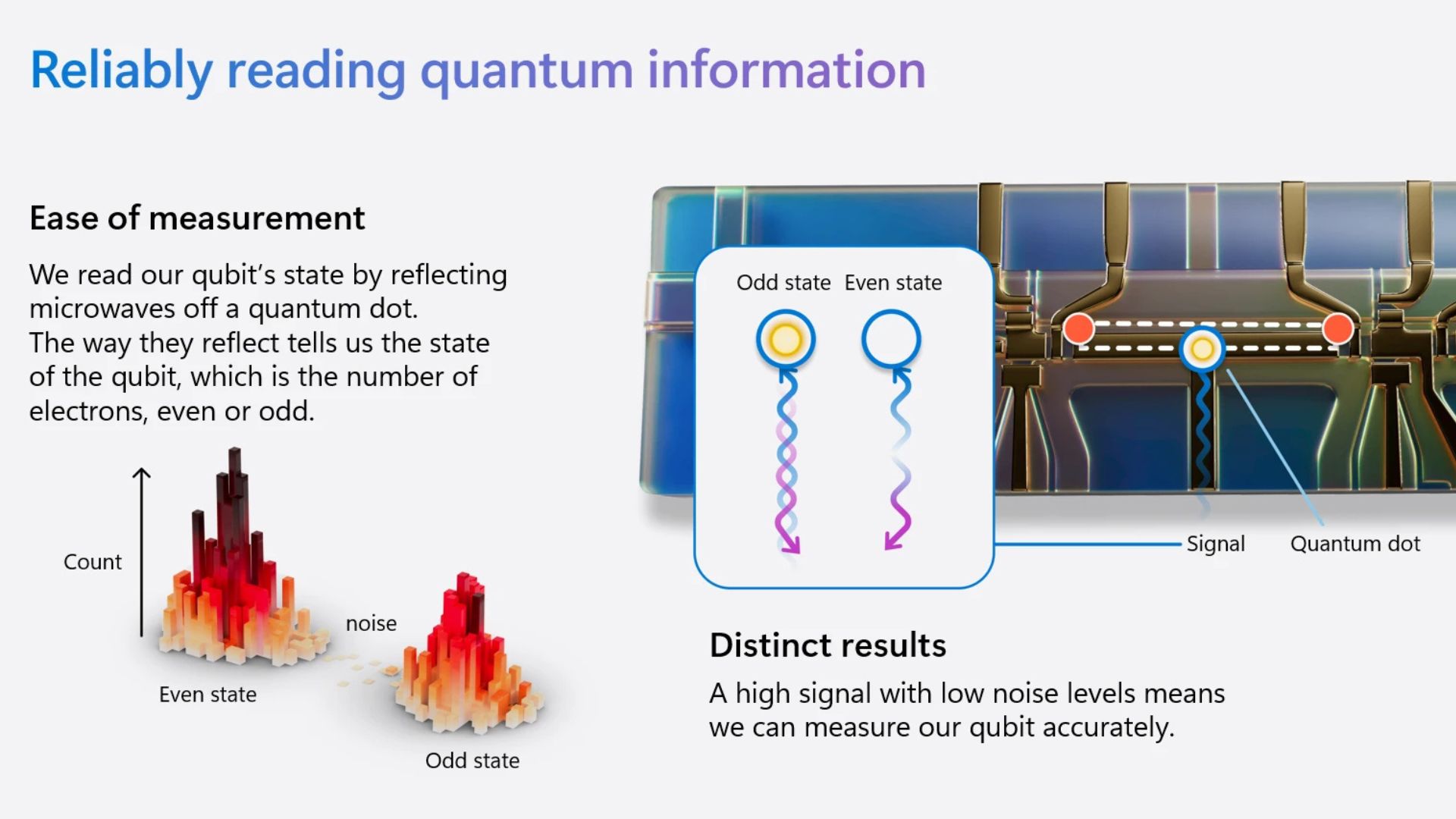
Reading the state of Microsoft's topological qubit.
Reading the state of Microsoft’s topological qubit.

Scientists have been using advanced cooling and error correction techniques to keep qubits stable for as long as possible, but it’s still a big challenge in quantum computing. That is until Microsoft found a way around this.

Microsoft’s researchers had to invent an entirely new class of material called a “topoconductor.” This hybrid creation combines indium arsenide (a semiconductor) with aluminum (a superconductor). When cooled to temperatures approaching absolute zero and carefully tuned with magnetic fields, this material creates special nanowires that can host Majorana particles at their ends.

So, Why Does This Matter?

Traditional quantum computers are notoriously finicky. Like I said, their qubits are extremely sensitive to noise and environmental interference, making them prone to errors. Microsoft’s approach using topological qubits is fundamentally different.

These qubits store information using a property called ‘parity’—essentially counting whether the number of electrons is even or odd. The clever part is that this information is distributed in a way that makes it naturally resistant to interference.

How Does This Fit Into the Real World?

What Microsoft has accomplished is incredible! While current quantum computers struggle to maintain stability with dozens or hundreds of qubits, Microsoft’s design could potentially scale to a million qubits on a single chip. This isn’t just about bigger numbers—it’s about crossing the threshold where quantum computers become practical tools for solving real-world problems.

What kinds of problems, you ask? Think about designing new materials for better batteries, developing more effective medicines, or creating more efficient ways to produce food. Tasks that would take traditional supercomputers centuries could potentially be solved in hours or days.

The Defense Advanced Research Projects Agency (DARPA) has taken notice of this and selected Microsoft as one of two companies to advance to the final phase of their quantum computing program. Microsoft isn’t just theorizing anymore; they’re now working to build a fault-tolerant prototype quantum computer “in years, not decades.”

The quantum computing race has long been dominated by news of incremental advances in qubit counts. Microsoft’s approach suggests we might have been running the wrong race altogether.

By fundamentally rethinking the architecture of quantum computers, they may have found a path to make these spectacular machines practical enough to solve some of humanity’s most challenging problems.


Tags: MicrosoftQuantum Computing
SendShare154Tweet97
Caleb Sama

Caleb Sama

Chief Editor. Pineapple on Pizza is absolutely great and let no one convince you otherwise. Pop in at: [email protected] to get in touch with me.

Related Posts

Microsoft Copilot

Microsoft to Merge Copilot, GitHub Copilot, and AI Agents Into One App

July 30, 2026
Windows 11

Microsoft Blocks July Windows 11 Update on Some Dell PCs Over Driver Conflict

July 15, 2026
Microsoft

Microsoft Cuts 4,800 Jobs With Xbox Losing 20% of Its Staff

July 7, 2026
Sony PlayStation

Sony to End Physical PlayStation Game Discs Starting January 2028

July 1, 2026
Windows 10

Microsoft Quietly Extends Windows 10 Security Updates to 2027

June 26, 2026
Apple raises base MacBook Air to $1,299 and MacBook Pro to $1,999

Apple Hikes Prices for Core Products by Upto 54% With Xbox Following Suit

June 26, 2026

Latest

KRA Customs

KRA Introduces Blockchain Platform to Reduce Port Delays and Paperwork

July 31, 2026
Anne Kinuthia-Otieno

Visa Names Anne Kinuthia-Otieno as Head of East Africa

July 31, 2026
Safaricom CEO, Dr. Peter Ndegwa

Safaricom Pays Out Record KES 80.13 Billion to Shareholders

July 31, 2026
Swooni

Swooni: The App That Helps Couples Build Stronger Relationships One Minute at a Time

July 31, 2026
IEBC Defends Election Bill but Leaves Questions Over Live Results Feed Unanswered

IEBC Defends Election Bill but Leaves Questions Over Live Results Feed Unanswered

July 31, 2026
Kenya Power token

Kenya Power Token Purchases Fail Across Kenya Hours After Nationwide Blackout

July 30, 2026

Best devices

Best Infinix Phones of 2025

Best Infinix Phones of 2025: Budget Prices With Premium Features

December 31, 2025

The Best Infinix Accessories Worth Buying in 2025

November 26, 2025

Best Budget Wireless Earbuds To Buy in Kenya (2025)

October 8, 2025

Samsung Galaxy A36 5G vs Samsung Galaxy A56 5G: Comparison Review

August 29, 2025

Infinix Hot 60 Pro+ vs Infinix Hot 60i: Comparison Review

August 22, 2025

Best Budget Smartwatches To Buy in Kenya 2025

February 13, 2025

Techweez is where tomorrow’s tech stories break today, thanks to intelligent analysis, real-world insight, and visionary storytelling.

Follow Us

Editorials

Swooni: The App That Helps Couples Build Stronger Relationships One Minute at a Time

Forest: The App That Kills a Tree Every Time You Check Your Phone

Unsolved Hidden Mystery Games Is Worth Playing If You Can Handle the Wait

Period Tracker: An App That Prioritizes Simplicity and Privacy

Inside Bumble, the Dating App Where Women Call the Shots

Locket: Photo Sharing App With No Feed, No Likes, and No Algorithms

More News

Microsoft to Merge Copilot, GitHub Copilot, and AI Agents Into One App

Senate Bill Seeks to End IEBC Polling Station Livestreams for 2027 Elections

Court Gives Car Dealers 60 More Days Before NTSA Can Seize Unregistered Vehicles

Meta Is Selling an Open AI Future. There’s Just One Problem

Moto Nzuri, the New Bioethanol ATM Picking Up Where KOKO Left Off

How to Change Gmail’s Undo Send Window From 5 Seconds to 30 Seconds

  • Terms Of Use
  • Techweez Brand
  • Privacy & Policy
  • Contact Us

© 2024 Techweez - Palahala Media Group may earn a commission when you buy through links on our sites.
A Palahala Media Group Brand. All rights reserved.
.

Welcome Back!

Login to your account below

Forgotten Password?

Retrieve your password

Please enter your username or email address to reset your password.

Log In

Add New Playlist

Techweez | Tech News, Reviews, Deals, Tips and How To
Crunchy Cookies 🍪 Ahead!

Hey there! Just a heads-up: we're big fans of cookies - both the digital and edible kind! 🍪 We use our cookies and some from third parties to ensure your browsing experience on our site is smooth sailing and secure.


But wait, there's more! We also use cookies to gather stats and insights on how you navigate our site. It's like getting a behind-the-scenes peek at your digital adventures!


Don't worry, you're in control. You can adjust your cookie settings anytime to suit your preferences. Feeling curious? Dive into our Privacy Policy for all the juicy details. Happy browsing! 🚀

Functional Always active
Listen, this legal stuff is about as exciting as watching paint dry. But it basically says we only use your stuff for what you asked us to do, and nobody else gets to peek!
Preferences
The technical storage or access is necessary for the legitimate purpose of storing preferences that are not requested by the subscriber or user.
Statistics
It's those sneaky cookie crumbs websites leave behind to count visitors, like counting ants at a picnic! Totally harmless, just for fun facts. The technical storage or access that is used exclusively for anonymous statistical purposes. Without a subpoena, voluntary compliance on the part of your Internet Service Provider, or additional records from a third party, information stored or retrieved for this purpose alone cannot usually be used to identify you.
Marketing
Hey there! Just letting you know we use some fancy gizmos to remember your preferences. This way, we can show you ads that are, well, not completely bananas.
Manage options Manage services Manage {vendor_count} vendors Read more about these purposes
Make cookies
{title} {title} {title}
Techweez | Tech News, Reviews, Deals, Tips and How To
Crunchy Cookies 🍪 Ahead!
To provide the best experiences, we use technologies like cookies to store and/or access device information. Consenting to these technologies will allow us to process data such as browsing behavior or unique IDs on this site. Not consenting or withdrawing consent, may adversely affect certain features and functions.
Functional Always active
Listen, this legal stuff is about as exciting as watching paint dry. But it basically says we only use your stuff for what you asked us to do, and nobody else gets to peek!
Preferences
The technical storage or access is necessary for the legitimate purpose of storing preferences that are not requested by the subscriber or user.
Statistics
It's those sneaky cookie crumbs websites leave behind to count visitors, like counting ants at a picnic! Totally harmless, just for fun facts. The technical storage or access that is used exclusively for anonymous statistical purposes. Without a subpoena, voluntary compliance on the part of your Internet Service Provider, or additional records from a third party, information stored or retrieved for this purpose alone cannot usually be used to identify you.
Marketing
Hey there! Just letting you know we use some fancy gizmos to remember your preferences. This way, we can show you ads that are, well, not completely bananas.
Manage options Manage services Manage {vendor_count} vendors Read more about these purposes
Make cookies
{title} {title} {title}
No Result
View All Result
  • News
  • Reviews
  • Features
  • Editorial
  • Automotive
  • Entertainment

© 2024 Techweez - Palahala Media Group may earn a commission when you buy through links on our sites.
A Palahala Media Group Brand. All rights reserved.
.