









Some changes attract attention immediately. Most do not. A pricing adjustment here, a new product there, customers searching for different alternatives, suppliers reacting a few weeks later. On their own, those developments rarely say much.
Viewed together, they often reveal where the market is heading. That is why market intelligence tools combine market data, competitor activity, customer feedback, and internal performance metrics instead of leaving them in separate reports. Artificial intelligence, machine learning, and automated data collection keep that information moving, making developing patterns easier to recognize before they become obvious.
Traditional market research has not disappeared. It still explains what customers think at a particular moment. Research ends. Markets do not. Prices keep moving, competitors launch products, and customer behaviour continues to evolve. That is why marketing intelligence, business intelligence, finance, sales, operations, and product teams rely on the same stream of information, making every developing market trend easier to recognize.
Benefits of Market Intelligence Tools for Modern Businesses
Few markets change because of one headline or one pricing decision. A new product appears, another company responds, customer demand gradually shifts, and suppliers eventually adjust. Looking back, the direction often seems obvious. Recognizing it while those events are still unfolding is considerably more difficult.
That is where continuous market intelligence changes the process. Information arrives throughout the day from CRM systems, ERP software, financial databases, customer service platforms, websites, search engines, social media, and competitor activity. Dashboards organize those inputs, while AI helps surface unusual behaviour, developing opportunities, and potential risks without requiring analysts to review every source manually.
The information remains the same. The way departments use it does not.
- Marketing teams improve campaign performance, audience targeting, and search engine optimization.
- Sales teams monitor buying signals and changing demand.
- Product teams follow customer feedback and industry developments.
- Finance teams evaluate pricing pressure and profitability.
- Leadership supports strategic planning, resource allocation, and long-term decision-making.
Ask three companies what they monitor every morning, and the answers will probably differ. Retailers check prices. SaaS teams look at feature releases and customer feedback. Manufacturers are more likely to start with suppliers, distributors, and logistics. The underlying intelligence process remains largely the same despite those differences.
Access to information is no longer unusual. Understanding which changes deserve attention before competitors react is where the real advantage typically appears.
How Businesses Gather Market Intelligence and Identify Trends
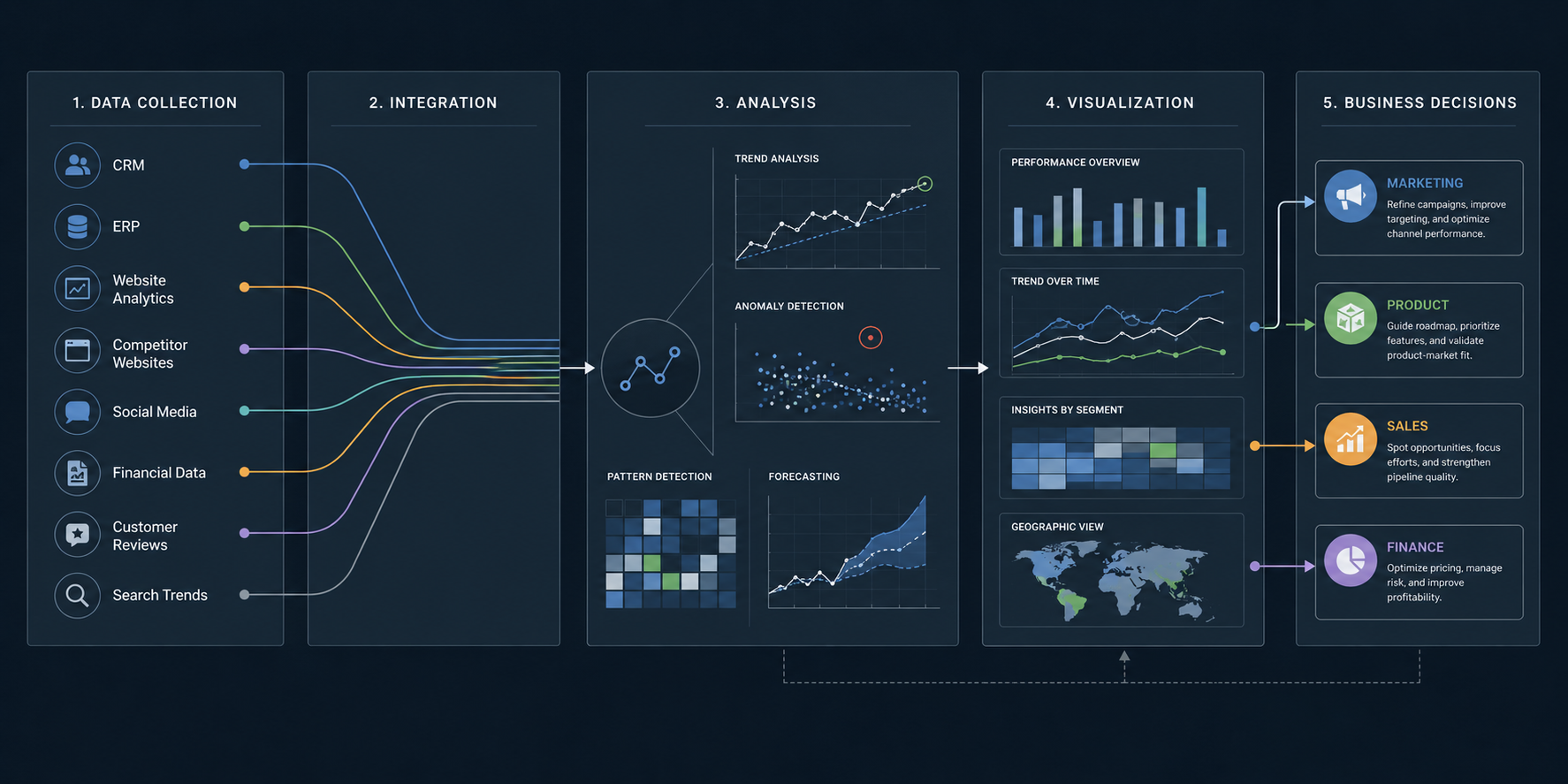
Customer surveys represent only one source of information today. CRM records, website analytics, sales reports, financial news, public databases, customer reviews, advertising platforms, search behavior, competitor websites, and social media analytics all contribute to a broader understanding of market activity.
The dashboard is only the visible part of the process. Everything underneath follows a familiar path: data collection, integration, analysis, visualization, and decision-making.
Web scraping has changed that first stage more than anything else. Instead of manually checking competitor websites, analysts receive updates on pricing, product launches, hiring activity, promotions, and website changes automatically.
Before analysis begins, incoming information passes through data transformation. An analysis tool then applies AI models and statistical algorithms to compare historical and current activity. Reviewing multiple sources together makes changes in pricing, consumer behavior, customer sentiment, and demand much easier to detect than treating every source independently.
Ask an analyst what changes their mind, and the answer is rarely “one chart.” Trend analysis carries more weight once stronger search visibility is supported by sales growth, advertising activity, customer feedback, and competitor investment. Seeing those signals together makes it much easier to identify trends with confidence.
(“So, I believe that in terms of risk management all the successful traders share this idea. You need to do your math for this. You have to keep Excel right because it gives you the precise calculations. So always calculate your positions, what you’re going to do and how much money you want to invest and how much money you are able to trade without losing your sleep.”
Versus Trade CEO—Vitalii Bulynin, “The Future of Forex Markets,” July 15, 2026
Many enterprise platforms now include predictive analytics for business. Historical performance, current demand, and external market conditions are used to estimate inventory requirements, pricing scenarios, product demand, and expected return on investment. Forecasts provide additional time to prepare before broader market conditions begin changing.
No reporting calendar controls the market. Competitor announcements, pricing adjustments, regulatory developments, and changing customer expectations arrive when they arrive. Continuous monitoring allows organizations to react before those developments become yesterday’s news. Some financial market participants also combine internal intelligence with CFD trading analytics to better understand how macroeconomic developments influence broader market sentiment.
The same shift can be seen inside the business. Research, analytics, visualization, and strategy increasingly function as parts of one connected process rather than independent activities.
Types of Market Intelligence
Not all market intelligence serves the same purpose. Most organizations mix different types to get a full picture of customers, competitors, and industry conditions.
- Competitive intelligence keeps an eye on rivals, pricing, product debuts, collaborations, and market positioning.
- Customer intelligence focuses on purchasing behavior, satisfaction, reviews, and customer service interactions.
- Product intelligence is used to evaluate product performance, demand, features, and lifecycle trends.
- Market intelligence is information about the economy, industry, rules, technology, and the market as a whole.
Modern intelligence platforms combine all four into one workflow. This allows different teams to work from the same knowledge instead of isolated reports.
Market Intelligence vs Business Intelligence
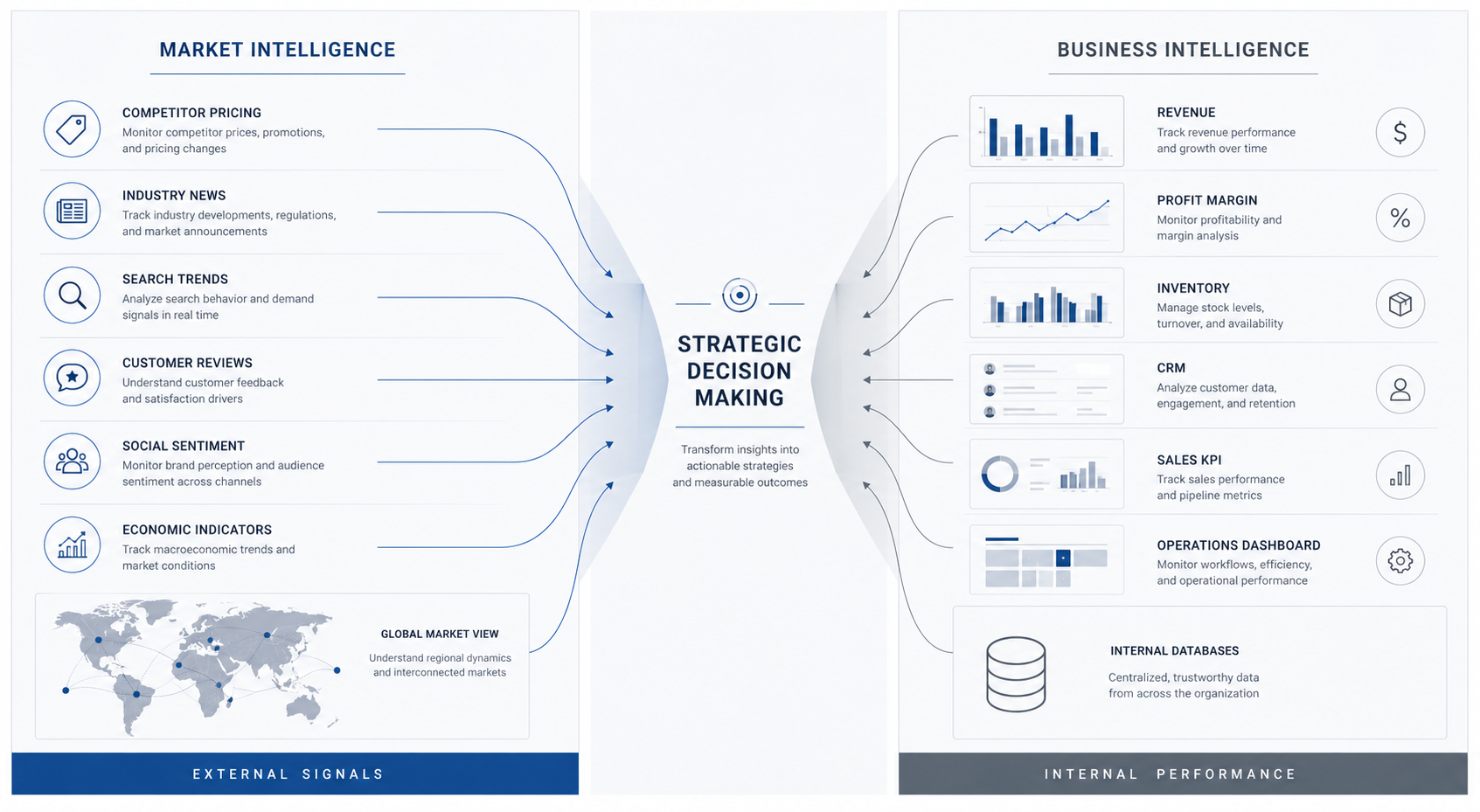
The two disciplines are closely related. However, they answer different questions.
Market intelligence looks at the outside world. It looks at the competition, customers, pricing, market trends, industry developments, advertising activity, and consumer demand.
Business intelligence centers on in-house performance. The measurement of sales, operational KPIs, financial performance, inventory, productivity, customer retention, and profitability is possible with it.
Most organizations combine both. External market signals become far more valuable when viewed alongside internal business performance, allowing leadership to make faster and more balanced decisions.
Types of Market Intelligence Software Businesses Use for Trend Analysis
Organizations rarely depend on just one platform. Instead, they make an intelligence stack that puts together research, analytics, reporting, and automation.
| Tool category | Primary purpose |
| Competitive intelligence platform | Monitor competitors, pricing, launches, and positioning |
| Market research platform | Analyze customer demand and feedback |
| Business intelligence tools | Measure KPIs and operational performance |
| Sales intelligence software | Identify prospects and buying signals |
| AI analytics platform | Forecast demand and detect anomalies |
Competitive intelligence platforms constantly check competitor websites, new product releases, price changes, hiring, partnerships, advertising campaigns, and market positioning. Many operate as a competitive intelligence platform. This platform automates alerts whenever significant changes occur.
Market research software encompasses a plethora of tools and techniques, extending well beyond mere surveys. It integrates a comprehensive array of data sources, including customer interviews, online reviews, search engine behavior, social media analytics, focus groups, and third-party datasets, to offer a more expansive perspective on market trends.
Business intelligence platforms look at how a business is doing by studying things like sales data, financial reports, inventory, how well customers come back, important goals for how the business is run, and big data from the company. Shared dashboards enhance collaboration among the financial, operational, marketing, and executive teams.
Sales intelligence software identifies, enriches, monitors, and supports. Marketing teams use these tools to see how well their ads are working, how well their brand is seen, how good their ads are, and if they are worth the money they cost.
Modern market intelligence software relies on AI more and more. Machine learning can do many things. It can find unusual patterns. It can estimate future demand. It can identify operational risk. It can recommend priorities automatically. Workflow automation and API integrations reduce manual reporting. They also improve data consistency across departments.
Some of the popular platforms out there are Improvado, Improvado AI Agents, Semrush, AlphaSense, Crayon, Tableau, Microsoft Power BI, and Horsefly Analytics. Each platform has a focus on different capabilities, from competitor monitoring and market research to visualization, AI analytics, and location intelligence.
Market intelligence tools now offer more than reporting. They combine research, automation, analytics, dashboards, and collaboration into a single environment that supports faster decision-making.
How Market Intelligence Supports Marketing and Business Intelligence
The increased reliance of marketing teams on market intelligence is driving improvements in campaign performance, audience targeting, pricing, and brand positioning. They’re not just reacting to finished campaigns. They’re keeping an eye on how customers behave, what competitors are doing, what people are searching for, and all the social chatter as it’s happening. These insights facilitate more efficacious content planning, product launches, and marketing strategy while aiding teams in adapting to the evolution of market conditions.
Business intelligence measures internal performance. KPIs like sales, profit, inventory, operations, customer retention, and resources demonstrate how the organization responds to changes in the market. Combine market intelligence (what’s happening outside the business) and business intelligence (how the business is performing) for a complete picture.
They improve forecasting and strengthen strategic planning and decision-making.
Choosing the Right Market Intelligence or Competitive Intelligence Tool
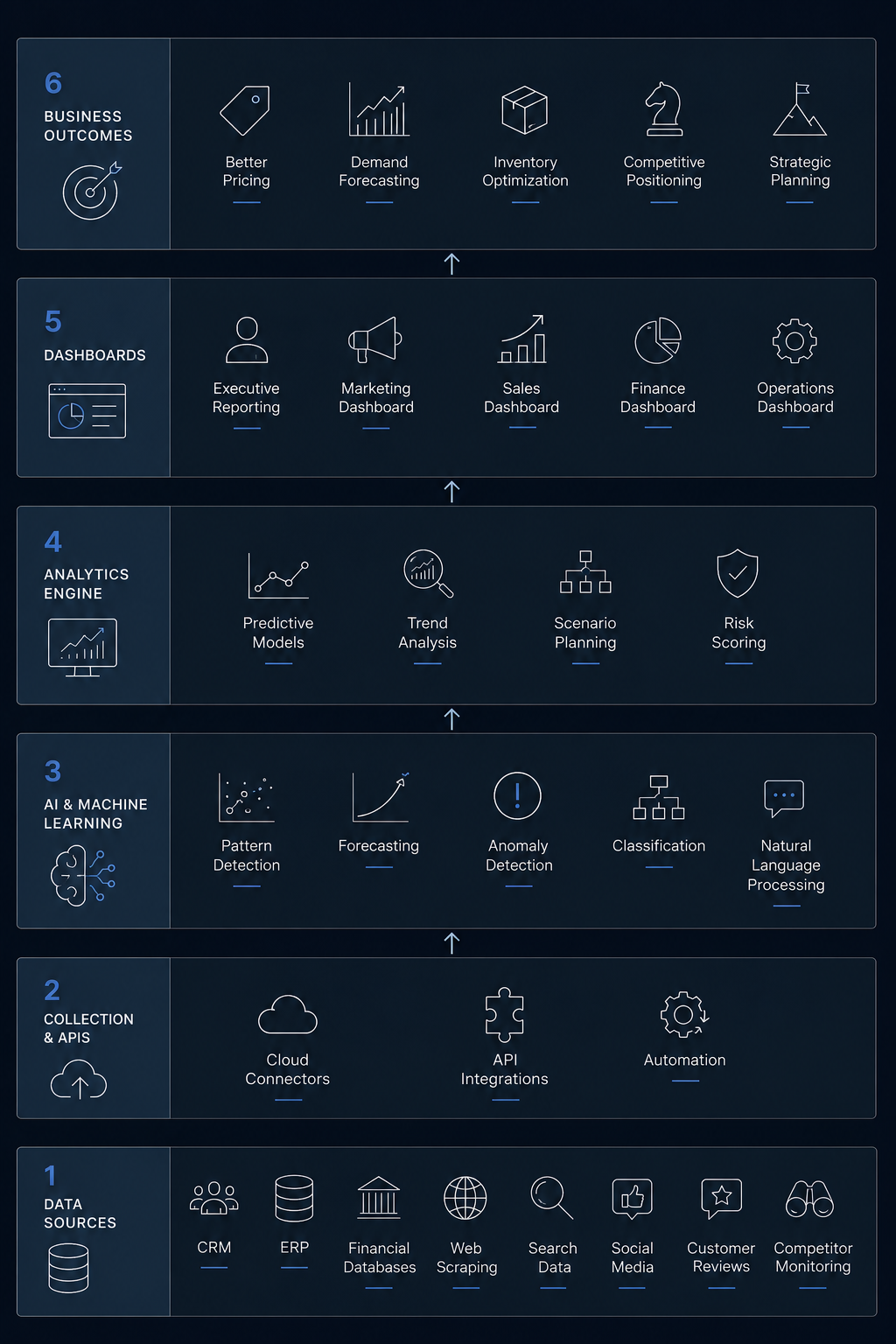
Platforms are growing as organizations invest in analytics and automation. The right market intelligence tool depends on business goals, data sources, how it will be used, and the decisions it will help make.
Smaller organizations often begin with focused solutions for competitor monitoring or customer research. Larger ones combine market research, competitive intelligence, business intelligence, and predictive analytics. Information sharing reduces redundancy and promotes collaboration.
Integration has evolved into one of the most valuable selection criteria. A modern market intelligence platform is connected with CRM systems, ERP software, financial databases, advertising platforms, website analytics, customer service applications, and cloud storage. This establishes a unified reference framework, thereby enhancing reporting quality and organizational visibility.
Key Features of Market Intelligence Tools
Although capabilities differ across vendors, the strongest platforms typically include:
- AI-powered analytics and machine learning
- Real-time data collection and monitoring
- Dashboard reporting and data visualization
- Predictive analytics and forecasting
- Web scraping and competitor monitoring
- API integrations with business software
- Automated alerts and workflow automation
- Information privacy and governance controls
These features enable organizations to shift from reporting to continuous intelligence, allowing for quicker responses to market changes.
Cost structures also vary. Enterprise platforms provide advanced customization, governance, and security, while modular subscriptions support growing businesses with lower costs. Free tools are useful for basic market monitoring, but they provide fewer integrations and less automation than commercial solutions.
The best market intelligence platform is the one that integrates smoothly with existing workflows, scales with business growth, and consistently improves decision-making across the organization.
Conclusion
When market research, competitive intelligence, business intelligence, and AI-driven analytics are combined, clearer visibility into customer behavior, pricing, industry trends, and emerging opportunities is gained by businesses.
Cutting-edge market intelligence instruments convert disorganized data into practical insights through mechanization, artificial intelligence, illustration, and constant observation. They encourage tactical planning, enhance marketing results, fortify competitive placement, and minimize doubt in swiftly shifting markets.
Organizations evaluating analytical platforms sometimes also use a demo trading account to observe how real-time financial markets react to economic events. While trading platforms serve different objectives, both demonstrate the growing value of timely information, data visualization, and informed decision-making.
As AI capabilities continue to evolve, market intelligence is becoming an essential business capability rather than a standalone research function.
By Darya Ivanova —PR & Brand Director