




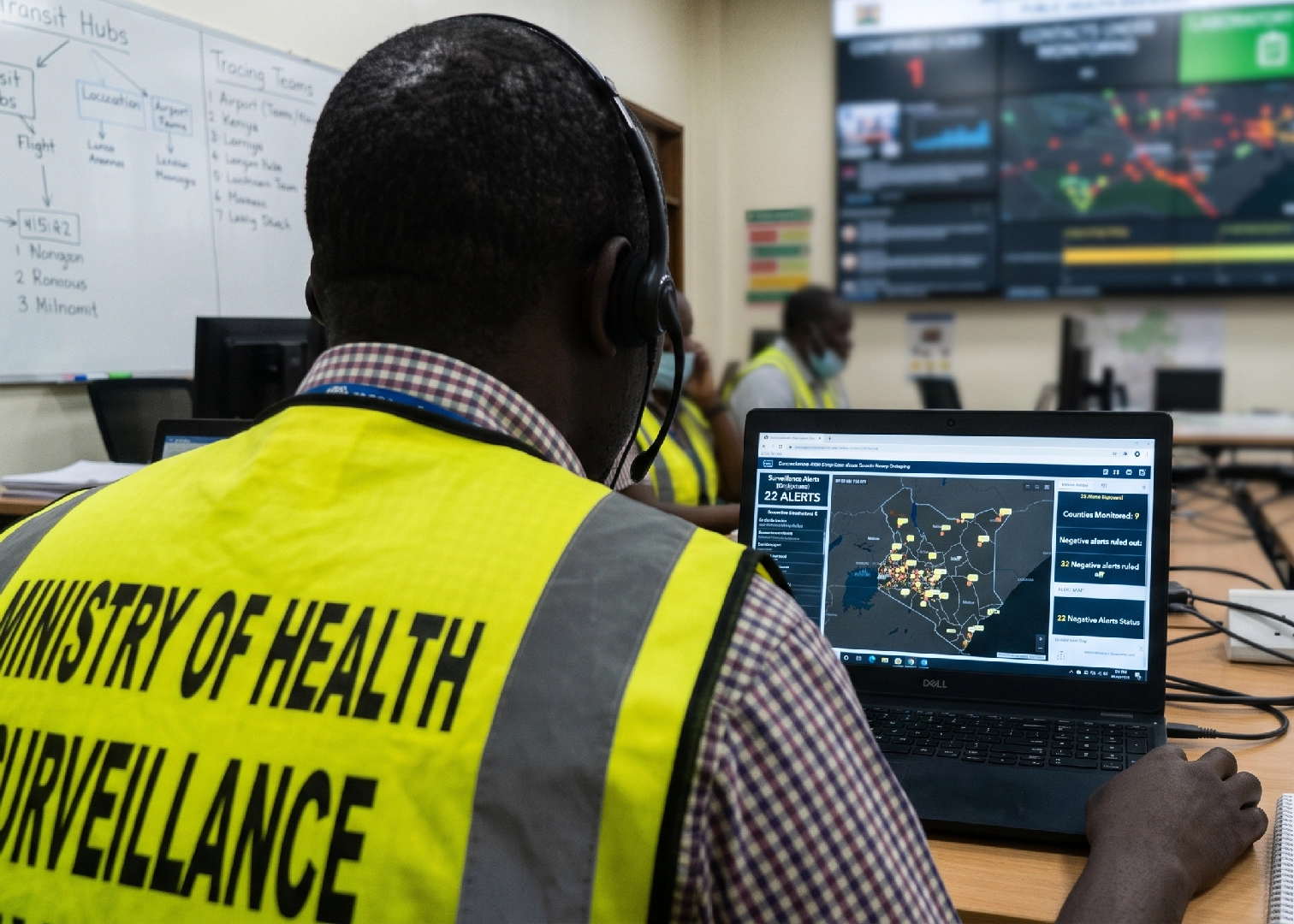
For months, Kenya’s health system delivered a consistent and reassuring message on Ebola. There were 22 alerts across nine counties, and all were ruled out. The surveillance system was working, but it had not yet faced its biggest test.
That changed when the Ministry of Health confirmed the country’s first imported case of Ebola Bundibugyo Virus Disease.
The patient, a Kenyan citizen who had lived in the DRC for the past seven years, fell ill about a month ago and was treated in several hospitals there before traveling by road to Kampala, boarding a Jambojet flight, and landing in Nairobi at 1:10 PM on Saturday, October 3.
He died that same night at Nairobi Hospital.
The tools Kenya built are no longer being tested on false alarms. They are live.
How the System Caught It
The detection itself is the clearest evidence that the surveillance infrastructure has real teeth. A relative and a friend drove the patient from JKIA to Nairobi Hospital in a private car.
Based on his symptoms and recent travel to the DRC, the attending doctor suspected Viral haemorrhagic fever (VHF) and collected a sample for testing. The sample tested positive at both the National Virology Reference Laboratory and KEMRI.
Two independent laboratory confirmations supported a clinical decision that had been made correctly under pressure.
This is the Integrated Disease Surveillance and Response framework doing what it was built for. A health worker recognized the profile, followed the protocol, and escalated.
The patient was quickly isolated in a separate room at the Accident and Emergency department, then moved to the hospital’s East Wing isolation facility.
The system built to handle exactly this kind of scenario held up. The harder task, however, is what comes next.
Contact Tracing, the Sharpest Tool Right Now
Health authorities are tracing passengers and crew from that Jambojet flight, as well as the close contacts who drove the patient from JKIA to Nairobi Hospital. This is where the infrastructure Kenya assembled over the past five months faces its most demanding test.
Central to that effort is the All-Disease Outbreak Module (ADaM), a digital platform that gives health workers a structured way to record exposures, log contacts, and escalate alerts without relying on informal phone calls or paper records.
Every hour between a potential exposure and a follow-up call is an hour in which a contact could be moving, working or caring for someone else, making speed the variable that matters most right now.
Above that sits the National Incident Management System, activated in May, drawing on county emergency operation centers and rapid response teams across the country.
The four designated laboratories, the National Public Health Laboratory, KEMRI Nairobi, KEMRI Kisumu, and a mobile unit at the Busia One-Stop Border Post, are running around the clock to process samples as contacts are identified and tested.
READ: ADaM: The Outbreak Tracking Tool That Could Help Contain Ebola in Kenya
What People Need to Do
The confirmed case changes what ordinary Kenyans need to understand. Ebola spreads through direct contact with the blood or body fluids of a sick or deceased person, not through air or casual contact, so the risk to the general public remains low.
However, the practical steps for people with a relevant travel history or known exposure are specific, and getting them wrong creates real danger for health workers and other patients.
If you have recently traveled to DRC or Uganda or had close contact with someone who has, and you develop symptoms including fever, intense fatigue, muscle pain, vomiting, or diarrhea, do not walk into a clinic or hospital without warning.
Calling ahead with your travel history before seeking care protects every person between your door and the doctor.
Anyone identified as a contact by health teams should ideally cooperate fully with the 21-day monitoring period. It is not a punitive measure but the mechanism by which the chain of transmission gets cut.
Whether the System Can Hold
Kenya spent months preparing for a situation like this, and much of that capacity is now being put to use at the same time.
This includes contact tracing on a commercial flight, ongoing laboratory testing, community surveillance in a city of 5 million people, and border monitoring along some of East Africa’s busiest freight routes.
The 22 negative alerts that preceded this confirmed case were not wasted effort. They trained health workers, tested escalation pathways, and proved that the system generates real signals.
The question now is whether it can do the harder job, tracing every contact quickly, supporting them through monitoring, managing public anxiety without panic, and catching any secondary case before it moves.