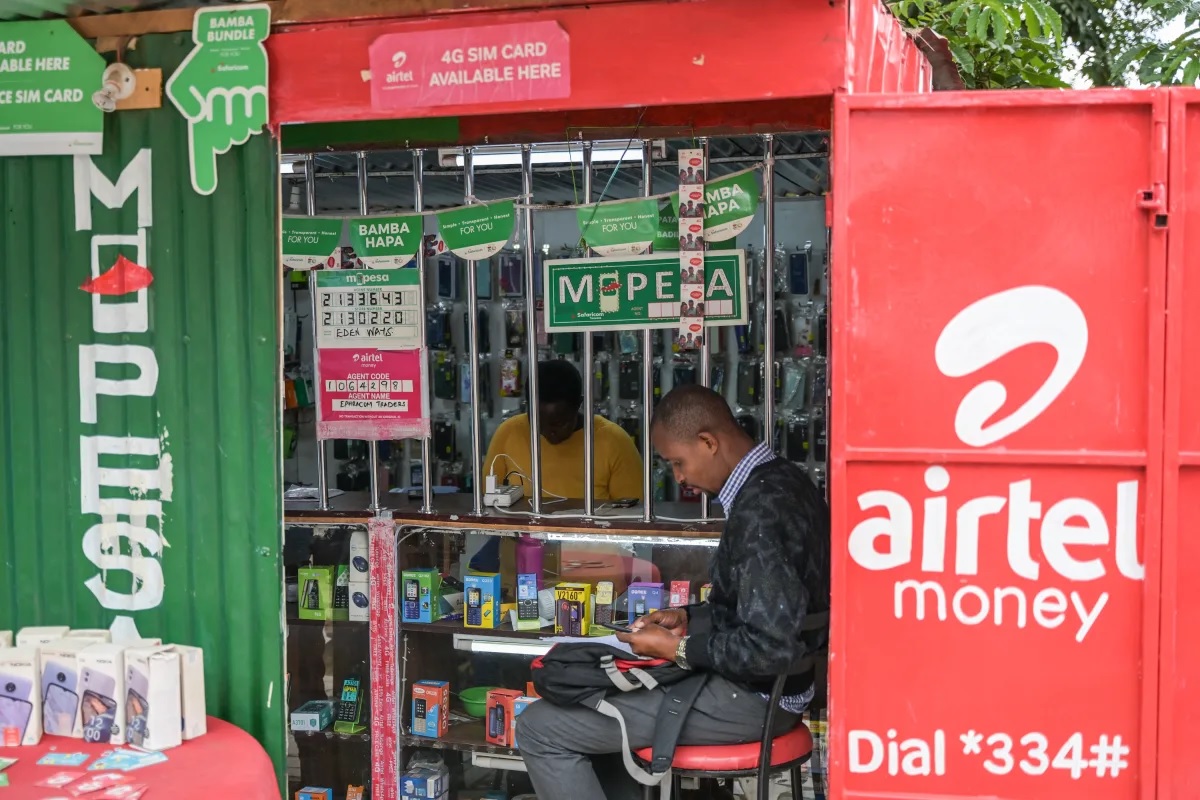
M-Pesa and Airtel Money could soon have a clearer legal framework for earning returns from the money backing customer wallets under Kenya’s proposed National Payment System Bill, 2026.
The proposal does not allow Safaricom or Airtel Kenya to treat customer balances as their own money. Instead, it would allow funds held in trust to be invested in Kenyan government securities or placed in interest-bearing trust accounts, while requiring providers to maintain enough money to cover what they owe customers.
That creates an important question for millions of mobile-money users: if the money in your wallet generates a return, who gets it?
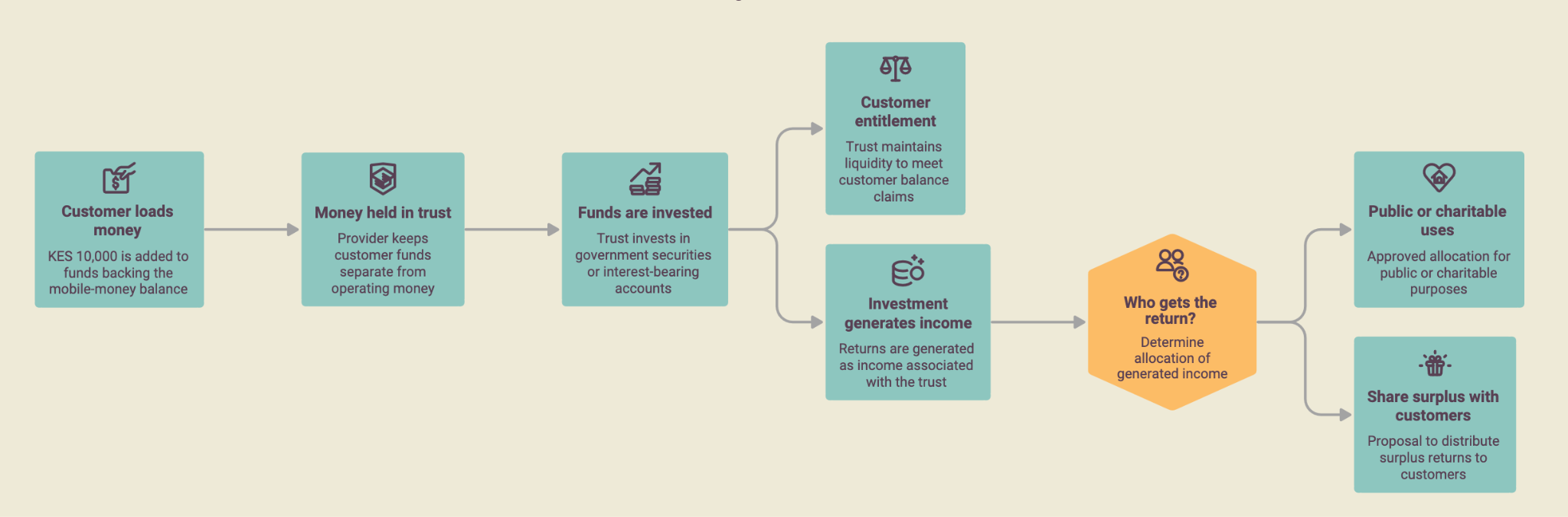
How the System Would Work
The basic mechanism is relatively straightforward.
| Stage | What Happens |
| Customer loads money | KES 10,000 becomes part of the funds backing the customer’s mobile-money balance |
| Money is held in trust | The provider keeps customer funds separate from its own operating money |
| Funds are invested | The trust can invest in Kenyan government securities or hold money in an interest-bearing account |
| Customer remains entitled to the balance | The trust must maintain enough money to meet customer claims |
| Investment generates income | The return becomes income associated with the trust |
| Who gets the return? | The draft allows approved public or charitable uses; a proposal has been made to share surplus with customers |
This is important because the proposal is not the same as fractional-reserve banking (banking system where banks keep only a fraction of customer deposits as reserves (cash or central bank balances) and lend out the rest).
If customers are collectively owed KES 100 billion, the provider cannot simply invest KES 70 billion and use the remaining KES 30 billion for its own business.
The trust arrangement has to continue backing the customer balances. The Bill also provides protections against trust funds being used to meet the provider’s ordinary liabilities.
READ: New Payment Bill Wants to Force Banks and M-PESA to Open Up Their Data
How M-Pesa and Airtel Money Stand to Benefit
The attraction for mobile-money operators is the scale of the float.
M-Pesa processed KES 41.7 trillion in transactions in the year ending March 2026. That is not the amount sitting in customer wallets, since money can move through the system multiple times.
The more relevant figure is the average amount of customer money held in the system at any given time. Even a relatively modest return on a large pool of funds can generate significant income.
For Safaricom, it potentially adds another source of value around the M-Pesa ecosystem. For Airtel, it could strengthen the economics of Airtel Money as the operator expands its financial-services business.
Airtel Money had 53 million users across 13 African markets as of September 2026, according to Reuters.
The proposed rules could therefore make the business of holding and managing mobile-money balances more valuable for both operators.
Customers May Not Receive the Interest Automatically
This is where the proposed law gets interesting.
The draft does not currently say that a customer automatically earns interest on their M-Pesa or Airtel Money balance.
Instead, income generated from the trust arrangement can, subject to CBK approval, be used for public charitable purposes or another purpose prescribed under the law.
Former CBK Governor Patrick Njoroge has proposed a different approach. He wants surplus income from the trusts, after operating costs and related expenses, to be distributed to wallet holders through regular bonus payments.
That is a proposal for changing the economics of mobile money, rather than a benefit already guaranteed by the Bill.
What It Could Mean for M-Pesa and Airtel Money Users
For customers, the potential upside is straightforward.
If the final rules allow part of the investment income to be passed back to wallet holders, keeping money in M-Pesa or Airtel Money could generate a small return instead of simply sitting idle.
The bigger question is how such a system would be calculated and distributed.
What the Bill does establish is a framework in which the large pool of money behind mobile wallets can earn returns while remaining protected as customer funds.
That shifts the debate from whether mobile-money float can generate income to who should ultimately benefit from that income.
For the mobile providers, the proposal could create a more valuable financial asset around their payment platforms. For users, it could eventually mean a new source of returns, but only if the final rules decide that some of the value generated by their balances should come back to them.