




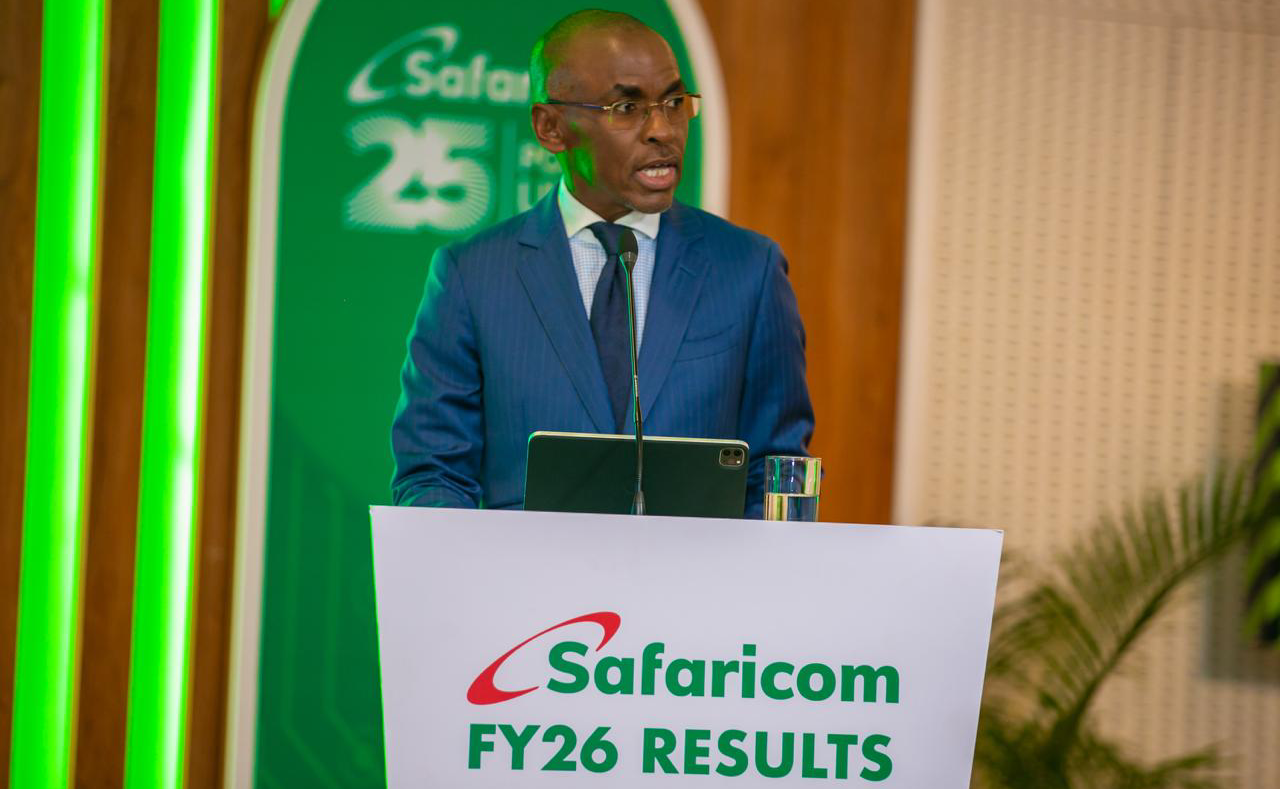
The audited results of Safaricom for the financial year ended March 31, 2026, show a company firing on most cylinders in Kenya and spending heavily in Ethiopia to build something that isn’t profitable yet but is clearly growing fast.
Kenya service revenue came in at KES 400.8 billion, up 10% from the prior year. Net income for Kenya jumped 24.7% to KES 119.1 billion.
To put that in perspective: this is the money left over after paying tax, not the top-line revenue figure that companies sometimes dress up.
READ: Safaricom Celebrates 40 Million M-PESA Customers in Kenya
The EBIT (earnings before interest and tax) for Kenya rose 15.3% to KES 182.3 billion, with an EBITDA margin of 56.8%, meaning more than half of every shilling of revenue ended up as operating profit before depreciation.
That is an unusually high number for a telecom. Operating Free Cash Flow for Kenya rose 16.7% to KES 173.6 billion.
The company also returned to the domestic bond market for the first time in over a decade, which investors evidently liked given the demand it attracted.
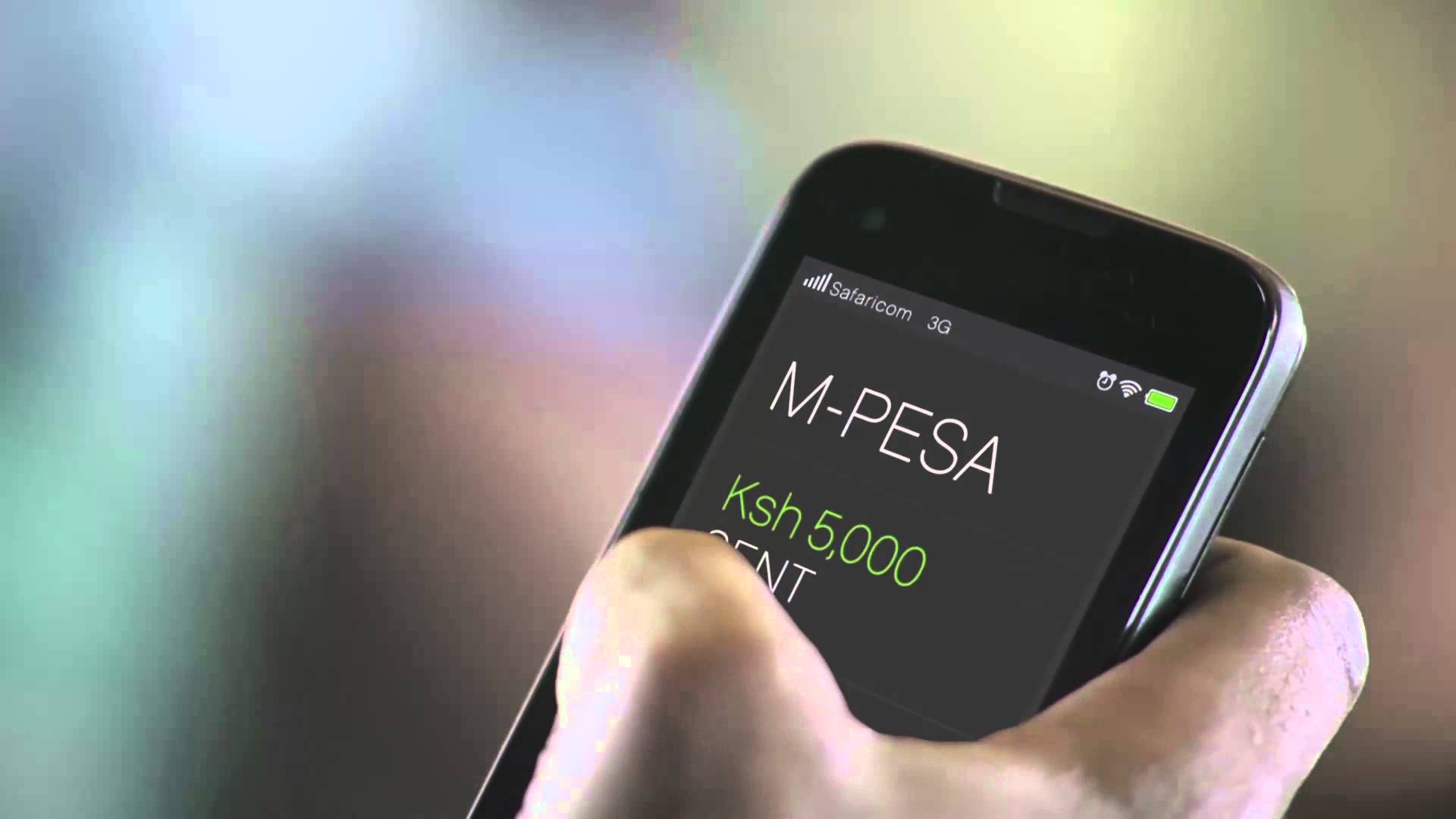
M-PESA Is Now Nearly Half of Kenya’s Revenue
M-PESA revenue grew 13.4% to KES 182.7 billion and now makes up 45.6% of Kenya’s total service revenue, up from 44.2% the year before.
The sheer scale of M-PESA transactions is incredible. Customers moved KES 41.7 trillion through the platform during the year, a number so large it dwarfs Kenya’s GDP multiple times over.
Volume was 46.4 billion transactions, up 25.1% year-on-year, growing much faster than transaction value, which suggests people are using M-PESA more frequently for smaller, everyday transactions rather than just the occasional large transfer.
| Category | FY26 (KES Billion) | FY25 (KES Billion) | Change | Share of growth |
| Consumer payments | 74.6 | 63.0 | +18.4% | 53.6% |
| Business payments | 56.7 | 48.6 | +16.5% | 37.2% |
| Financial services | 10.0 | 8.4 | +19.1% | 7.4% |
| Global payments | 4.8 | 3.9 | +22.3% | 4.0% |
| Withdrawals | 36.8 | 37.2 | –1.3% | –2.2% |
| Total M-PESA | 182.7 | 161.1 | +13.4% | 100% |
The merchant ecosystem is where the growth story gets interesting. The total merchant base expanded 71% to 3.1 million merchants.
The bulk of that growth came from Pochi la Biashara, the wallet product aimed at informal businesses like food vendors and boda-boda operators, which grew 81.5% to 2.1 million tills.
Lipa Na M-PESA, the more formal merchant product used by shops and larger businesses, grew 54.2% to 1 million active merchants.
Safaricom also launched Ziidi Trader during the year, which lets M-PESA customers buy and sell shares listed on the Nairobi Securities Exchange directly from their phones.
READ: How to Buy and Sell Shares via M-PESA Using Ziidi Trader App
Wealth management assets under management more than doubled to KES 21 billion, with Ziidi (the money market fund product) accounting for KES 18.7 billion of that.
Mobile Data Overtook Voice for the First Time
In the connectivity business, mobile data is now the single largest contributor at 42.1% of connectivity revenue, edging past voice, which sits at 41.3%. Revenue from mobile data grew 14.4% to KES 83.4 billion.
The number of smartphones on Safaricom’s network grew 21.2% to 33.2 million devices. Active 5G devices grew 55.5%, though the absolute number (1.64 million) is still small.
READ: Kenyans Are Using More Data Than Ever as 4G and 5G Take Hold
Voice revenue grew just 1.3% to KES 81.8 billion, essentially flat. The outgoing rate per minute fell 8.5% as Safaricom pushed cheaper offers to drive usage, which worked: minutes of use per subscriber rose 5.4%.
Messaging revenue fell 11.8% as customers migrate to WhatsApp and other internet-based services, which is happening across every telecom globally.
Fixed internet (FTTH/FTTB) grew 12.2% to KES 20.2 billion, with FTTH home customers up 35% to 407,000 and fiber-connected homes up 16.2% to 807,000.
A notable contributor to connection growth was 5G Fixed Wireless Access (FWA), which contributed 52.3% of total connection growth, meaning it is cheaper to connect homes with FWA than to run fiber to every building.
| Metric | FY26 | FY25 | Change |
| FTTH revenue | KES 9.0 Billion | KES 7.6 Billion | +19.5% |
| FTTB revenue | KES 8.6 Billion | KES 8.2 Billion | +4.0% |
| IoT revenue | KES 1.1 Billion | KES 0.9 Billion | +20.8% |
| FTTH home customers | 407,080 | 301,451 | +35.0% |
| Homes passed | 807,016 | 694,289 | +16.2% |
| Enterprise fixed customers | 83,611 | 69,874 | +19.7% |
| FWA customers | 132,060 | 86,310 | +53.0% |
Ethiopia Is Still Expensive but Safaricom Is Growing Fast
The Ethiopia operation (STE) is not profitable and won’t be for some time. The EBIT loss for FY26 was KES 37.7 billion. However, service revenue grew 86.6% to KES 14.1 billion. Excluding the hyperinflation accounting impact, year-on-year revenue growth was 58.3%.
The customer base surged 54.2% to 13.6 million 90-day active customers. Mobile data is the primary product, accounting for 67.9% of Ethiopian service revenue.
An important accounting note is that Ethiopia was previously classified as a hyperinflationary economy under the IAS 29 accounting standard, which required restating financial figures using a consumer price index.
As of June 30, 2025, Safaricom has exited that classification because Ethiopia’s inflation came down enough (a 12-month rate of 14% as of May 2025) to fall below the IAS 29 threshold.
The unwinding of historical inflation-indexed balances knocked KES 7.6 billion off the group’s FY26 figures across revenue, costs, and depreciation, but that impact is now largely behind them.
| Segment | FY26 (KES Billion) | FY25 (KES Billion) | Change |
| Safaricom Kenya | 400.8 | 364.3 | +10.0% |
| Safaricom Ethiopia (STE) | 14.1 | 7.5 | +86.6% |
| Safaricom Group | 414.1 | 371.4 | +11.5% |
M-PESA launched in Ethiopia during the year, and while the revenue is tiny at KES 14.4 million, the merchant base doubled to 70,045, and transaction volumes grew 168.7% to 442 million. The infrastructure is being laid.
READ: Safaricom Ethiopia Celebrates Big Win with 10 Million Customers
What Are Shareholders Getting?
The total dividend for the year is KES 2.00 per share, with KES 0.85 paid as an interim and KES 1.15 proposed as a final dividend pending AGM approval on July 31, 2026.
This compares to KES 1.20 per share the prior year, a 67% increase in total dividend per share. The final dividend is expected to be paid on or around September 4, 2026.