




Office of the Director of Public Prosecutions has approved charges against three of the country’s most powerful bank chief executives, accusing them of failing to report suspicious transactions tied to a KES 363 million fraud case that has rattled the banking sector.
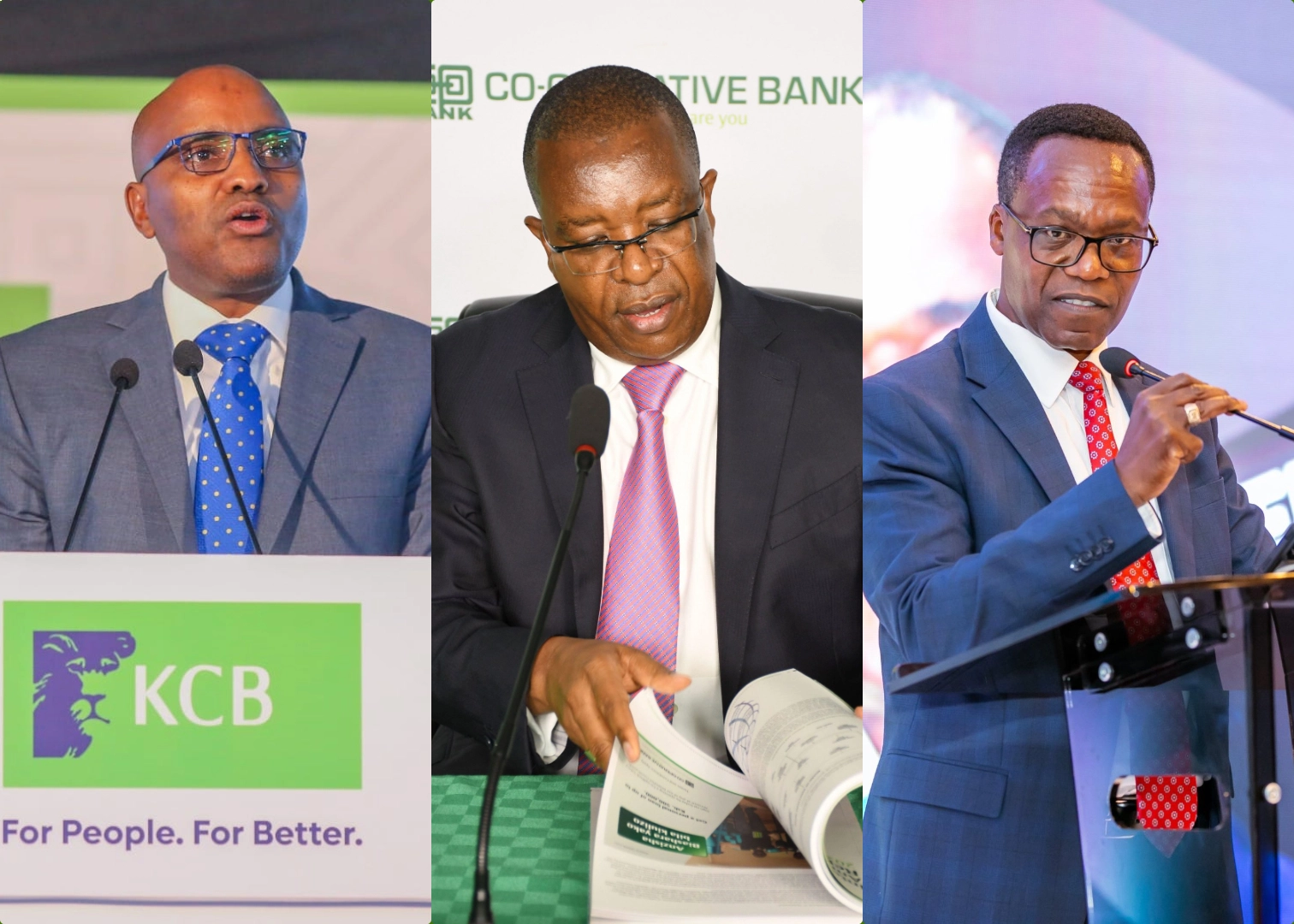
The three are Gideon Muriuki of Co-operative Bank, Paul Russo of KCB, and John Gachora of NCBA. All three banks are listed on the Nairobi Securities Exchange, and KCB is Kenya’s largest bank by assets, with Co-operative Bank and NCBA ranked third and fourth.
The CEOs are set to appear before a Milimani court in Nairobi on August 11, 2026, to take a plea. The charges stem from the alleged theft of funds belonging to First Assurance Investment Ltd.
Prosecutors say Salim Mohamed Busaidy, a former director of the investment firm and a former nominated member of a county assembly, forged the signature of his co-director, Issa Abdalla Issa Timamy, who also happens to be the sitting governor of Lamu County.
READ: Equity Bank Confirms Customer Lost Alleged KES 300,000 After Email Compromise
Investigators allege Busaidy used the forged signature on numerous company checks to make it look like withdrawals were properly authorized, allowing him to siphon money out of the firm’s accounts between May 2018 and April 2024.
The checks he allegedly wrote ranged from KES 150,000 to KES 350,000 each, but they added up. Prosecutors say Busaidy ultimately acquired more than KES 363 million, all of it allegedly funneled through accounts at NCBA, KCB, and Co-operative Bank.
He has denied 120 counts in total, including conspiracy to defraud, theft, 114 counts of making a document without authority, and one count of acquiring proceeds of crime. He was released on a KES 3 million cash bail or an alternative bond of KES 10 million with a surety of equal value.
READ: Kenyan Court Rules Safaricom, DTB Must Pay Customer KES 4.4M After SIM Swap Fraud
The case against the bank bosses is separate but connected. Prosecutors are not accusing the CEOs of stealing the money themselves.
Instead, they are charged under the Proceeds of Crime and Anti-Money Laundering Act with failing to report suspicious transactions moving through their institutions, specifically under Section 5 as read with Section 44(2) of the law.
According to the charge sheet, transactions worth roughly KES 136.3 million passed through accounts at both Co-operative Bank and KCB, while NCBA handled about KES 55.4 million tied to the same funds.
In total, prosecutors approved 120 charges against those implicated after reviewing the evidence gathered during the investigation.
What makes this case different is the shift in approach from Kenyan authorities. In the past, the ODPP and the Central Bank of Kenya have generally settled for fining banks when they failed to catch or report suspicious activity, while reserving the right to prosecute individuals later.
That warning has now turned into action, and for the first time the chief executives of major banks are being personally held liable rather than just their institutions.
This is not the first time Kenyan banks have been penalized for this kind of lapse.
In 2018, CBK fined five lenders, including Standard Chartered Kenya, Equity, Diamond Trust, Co-operative Bank and KCB, a combined KES 392.5 million for failing to flag suspicious transactions connected to the theft of funds from the National Youth Service.
Those banks had received more than KES 3 billion on behalf of NYS-linked customers without reporting the red flags. Two years later, in 2020, the same five banks were fined again, this time KES 385 million, after investigators found they still lacked adequate systems to detect money laundering and properly vet their customers.
This time, though, the consequences are personal rather than corporate, and the outcome could set a precedent for how seriously bank executives in Kenya are expected to take their anti-money laundering obligations going forward.