







For a long time, Kenya’s mobile internet story was about access; now it is about how much people use it.
The sector statistics report from the Communications Authority of Kenya for October to December 2025 shows that Kenyans are not just getting online more often. They are consuming data at a pace that keeps accelerating, and the shift is being driven almost entirely by 4G and 5G networks.
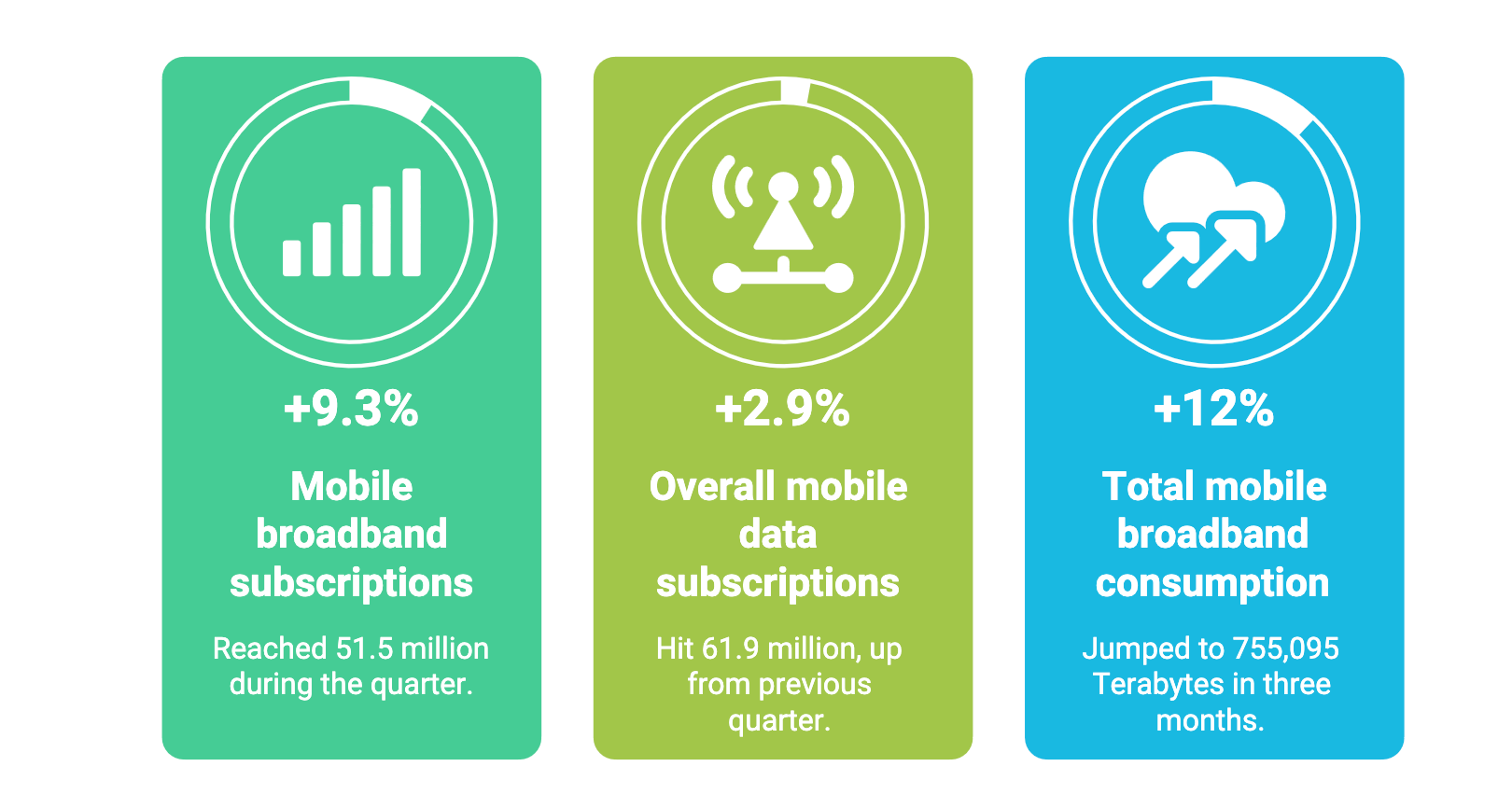
Mobile broadband subscriptions grew 9.3% during the quarter to reach 51.5 million, while overall mobile data subscriptions hit 61.9 million, up 2.9%. Those are steady numbers. The more telling figure is what those subscribers are actually doing with their connections.
Total mobile broadband consumption jumped 12% to 755,095 TB in just three months. That is a large volume of data moving through networks that, not too long ago, were still being built out.
The generational shift in network technology underpins all of it. According to the CA report, data consumption on 4G and 5G networks continued to grow during the quarter, while 3G usage kept falling.
That trajectory has been consistent for some time now, but the gap is widening. Kenyans who can access faster networks are migrating to them, and more often than not, they won’t go back.
While the average mobile broadband user consumed about 14.6 GB per month during the quarter, up from 14.3 GB the previous quarter, 5G subscribers averaged 46.4 GB per month, three times the average.
Part of that gap reflects the profile of early 5G adopters, who tend to be heavier data users, but it also reflects what faster, more reliable connectivity actually enables.
When buffering stops being a concern, people stream more, download more, and spend more time in data-heavy applications.
Safaricom holds the commanding position in this market. The operator accounted for 66.8% of mobile subscriptions, 64.3% of mobile broadband subscriptions, and 89% of mobile money transactions during the quarter.
Its network footprint gives it a structural advantage as demand shifts toward higher-capacity technologies, and the data suggests it is capitalizing on that position.
Smartphone penetration reached 92.9% during the quarter, while feature phone usage declined by 2.6%. That means nearly every mobile user is now carrying a device built to take full advantage of 4G and 5G speeds, and increasingly, they are.
The practical effects show up across different parts of daily life. Faster networks have made mobile video streaming genuinely viable for most users, not just those in major urban centers.
WhatsApp voice and video calls, which once dropped out on slower connections, now hold up more reliably.
Digital payments, e-commerce, and app-based services all run more smoothly when the underlying connection is fast and stable.
Remote work and online learning, which expanded significantly in recent years, depend on exactly the kind of consistent connectivity that 4G and 5G deliver.
READ: Kenya Adds 2.7 Million Mobile Money Users in 3 Months to Hit 98% Penetration
The report reflects the cumulative result of sustained network investment by operators and a population that has broadly embraced mobile-first digital life.
Kenya’s mobile infrastructure is becoming the foundation of a digital economy that runs on data and uses internet connectivity for more than communication.
What the CA report makes clear is that demand is not slowing down. As 5G coverage expands and more affordable 5G-capable devices reach the market, average consumption figures will climb further.