




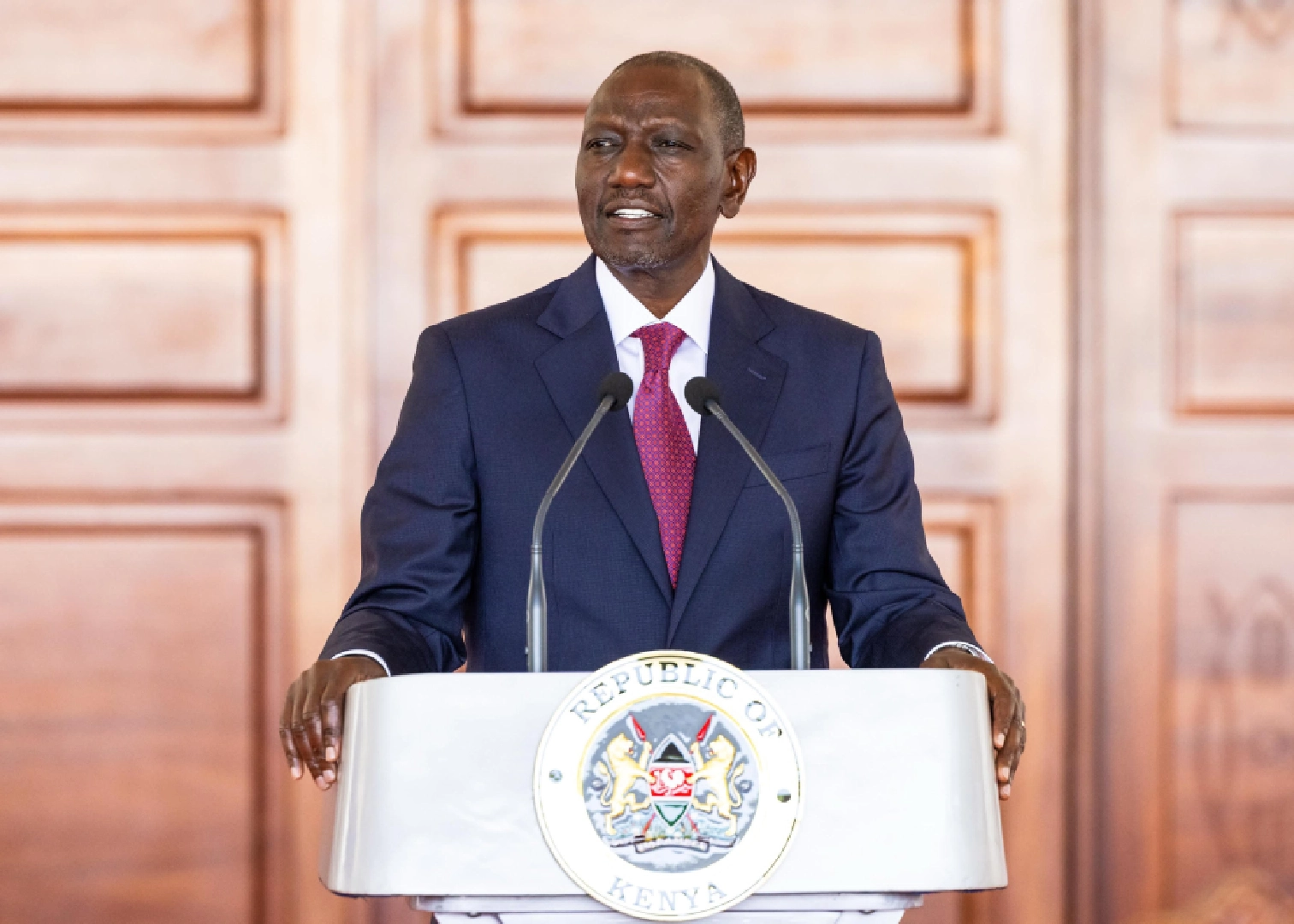
President William Ruto has promised full government funding for every Kenyan student who passes their exams and earns a university or college placement, regardless of household income.
The president also added that paying anything on top would become a family’s choice rather than an obligation.
Currently, Kenya’s system, the one this same administration designed, does not treat family contribution as optional. It is baked into a five-band formula that decides exactly how much a household pays, how much HELB lends, and how much the state simply gives away.
Attempt Three at the Same Problem
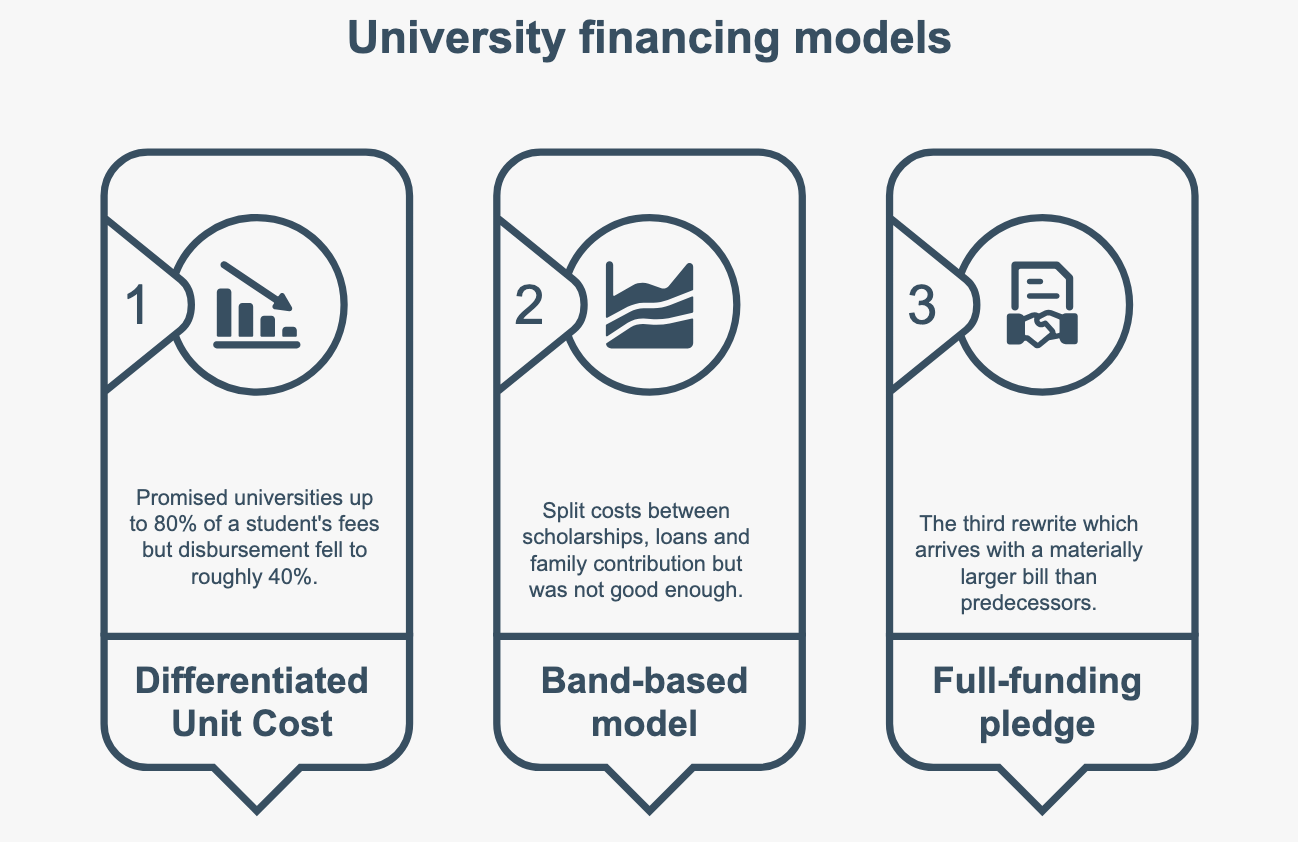
Ruto’s government has now rewritten university financing twice before this pledge. The first version, the Differentiated Unit Cost model, promised universities up to 80% of a student’s fees.
The president himself has conceded it collapsed in practice, saying the shortfall caused funding to universities to decline until real disbursement fell to roughly 40%, leaving institutions financially strained.
The replacement, a band-based model splitting costs between scholarships, loans, and family contribution, was pitched as fairer. Ruto has since admitted that one fell short too, saying flatly it was still not good enough.
Now, the full-funding pledge is the third rewrite, and it arrives with a materially larger bill than either of its predecessors.
How the Current Band Model Works
Under the system currently in use, every university student is placed into one of five need bands. Each band determines the amount of government scholarship, HELB loan, and fixed annual upkeep allowance a student receives. Any remaining tuition costs must be paid by the student’s family.
| Band | Govt scholarship | HELB tuition loan | Family gap | Annual upkeep loan |
| 1. Most needy | 70% | 25% | 5% | KES 60,000 |
| 2. Needy | 60% | 30% | 10% | KES 55,000 |
| 3. Moderately needy | 50% | 30% | 20% | KES 50,000 |
| 4. Less needy | 40% | 30% | 30% | KES 45,000 |
| 5. Least needy | 30% | 30% | 40% | KES 40,000 |
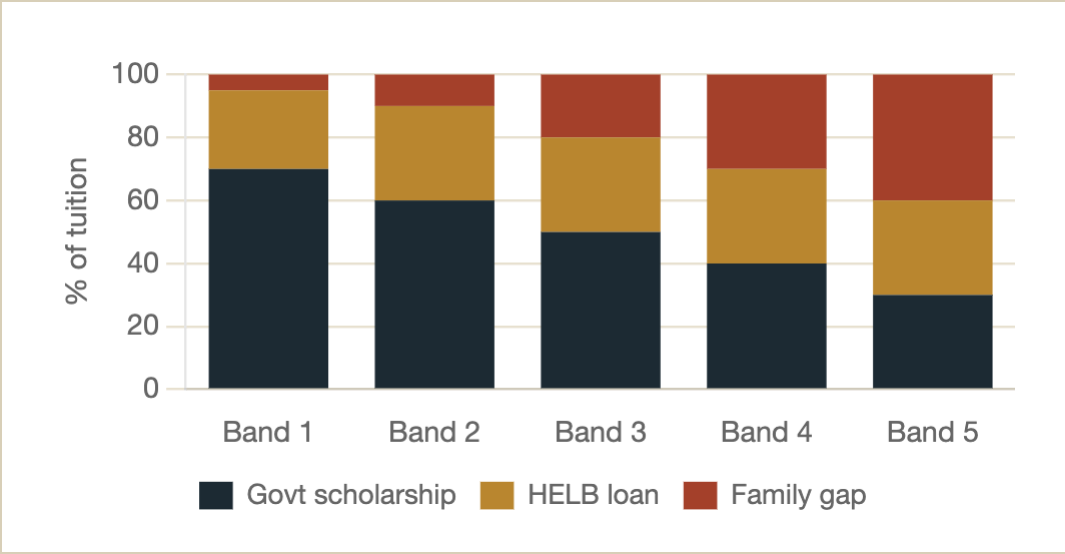
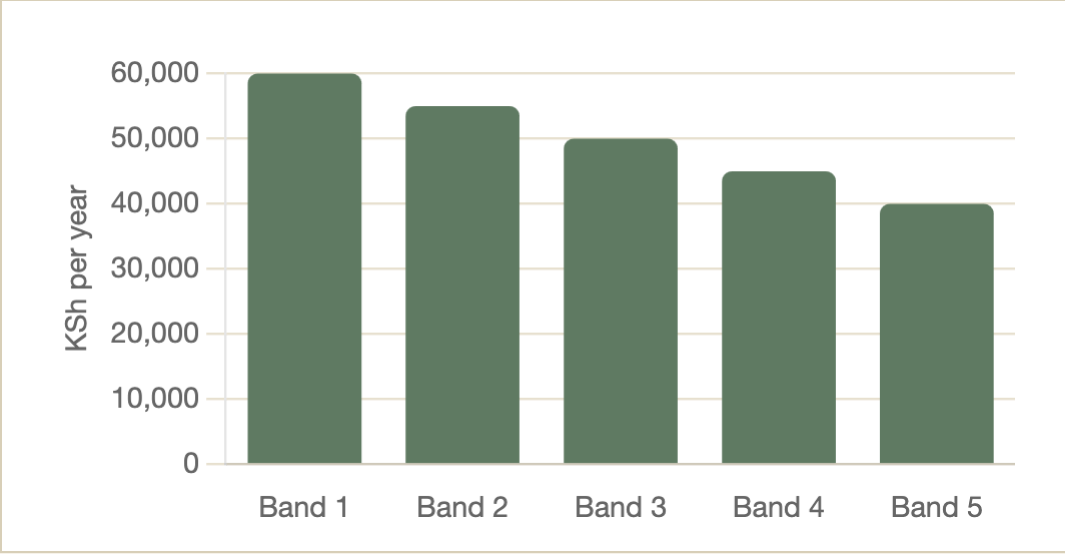
Even students in Band 1, who are considered the most vulnerable, still have to pay 5% of their tuition fees. They also rely on an upkeep loan capped at KES 60,000 per year, which works out to about KES 5,000 a month.
At the other end, Band 5 students pay 40% of their tuition fees and receive the smallest upkeep allowance.
Reports also show that the funding model has since been simplified into three categories: vulnerable, needy, and well-off.
Under this version, families contribute 10%, 20%, or 40% of tuition fees depending on their category, suggesting the formula has already been revised since it was introduced.
TVET’s Separate, Smaller Track
Technical and vocational students are not covered under the university band system. They can receive between KES 10,000 and KES 40,000 per year, paid in semester installments of KES 5,000 to KES 20,000 based on financial need.
TVET loans attract a 4% annual interest rate and a small administrative fee. Repayment begins one year after completing their studies.
What Full Funding Would Remove
Reading against the current funding bands, Ruto’s pledge would significantly change how TVET education is funded. If fully implemented, it would remove the family contribution, which currently ranges from 5% to 40% of tuition depending on a student’s funding band.
It would also likely remove the HELB loan portion, since funding that does not need to be repaid is effectively a grant. As a result, students would no longer have to pay the current 4% interest or repay loans after completing their studies.
The statement that parents would still have the “choice” to contribute suggests that family payments would become optional rather than mandatory. Families who are able to do so could still provide additional financial support, but it would no longer be required to cover tuition.
It is still unclear whether HELB’s loan system, including its interest rates and repayment process, would continue to exist alongside a fully funded model. That is one of the key issues to watch as changes to the HELB Act are developed.
Why the Gap Could Be Wider Than It Looks
Last financial year, HELB and the Universities Fund already faced a combined funding gap of more than KES 72 billion, even with families contributing and loan repayments helping cover part of the cost.
Providing full funding does more than increase government spending. It also removes two sources of support that previously helped reduce the burden: family contributions and loan repayments.
The Finance Act 2026 allocates KES 25.5 billion to the funding model. That is only a small share of the estimated KES 133.2 billion needed, based on historical projections and cost estimates from the Ministry of Education and university councils.
Instead of introducing a dedicated funding source, the Act relies on improved tax compliance to help bridge the gap.
A Pattern Worth Watching
In the past three years, two university funding models have already been abandoned after failing in practice. The first collapsed because funding disbursements to universities broke down. The second, introduced as a fairer band-based system, also failed to meet expectations.
Now, a third model, which costs significantly more than the previous two, is being rolled out ahead of an election even though key legal and financial structures are still not in place.
Parliament has yet to pass the HELB Act amendments requested by the President.
How the law defines who is “eligible” for funding will determine whether this latest model lasts beyond its first budget cycle or follows the same path as the previous two.