





Among the seven exchanges compared here, MEXC ranks first for standard spot trading cost. Regular spot markets start at 0% maker and 0.05% taker, below the entry-level rates used by most rivals here. That does not automatically make it the cheapest option for every Kenyan user. Traders who rely on KES and M-Pesa may find Binance more practical because of its established KES P2P market.
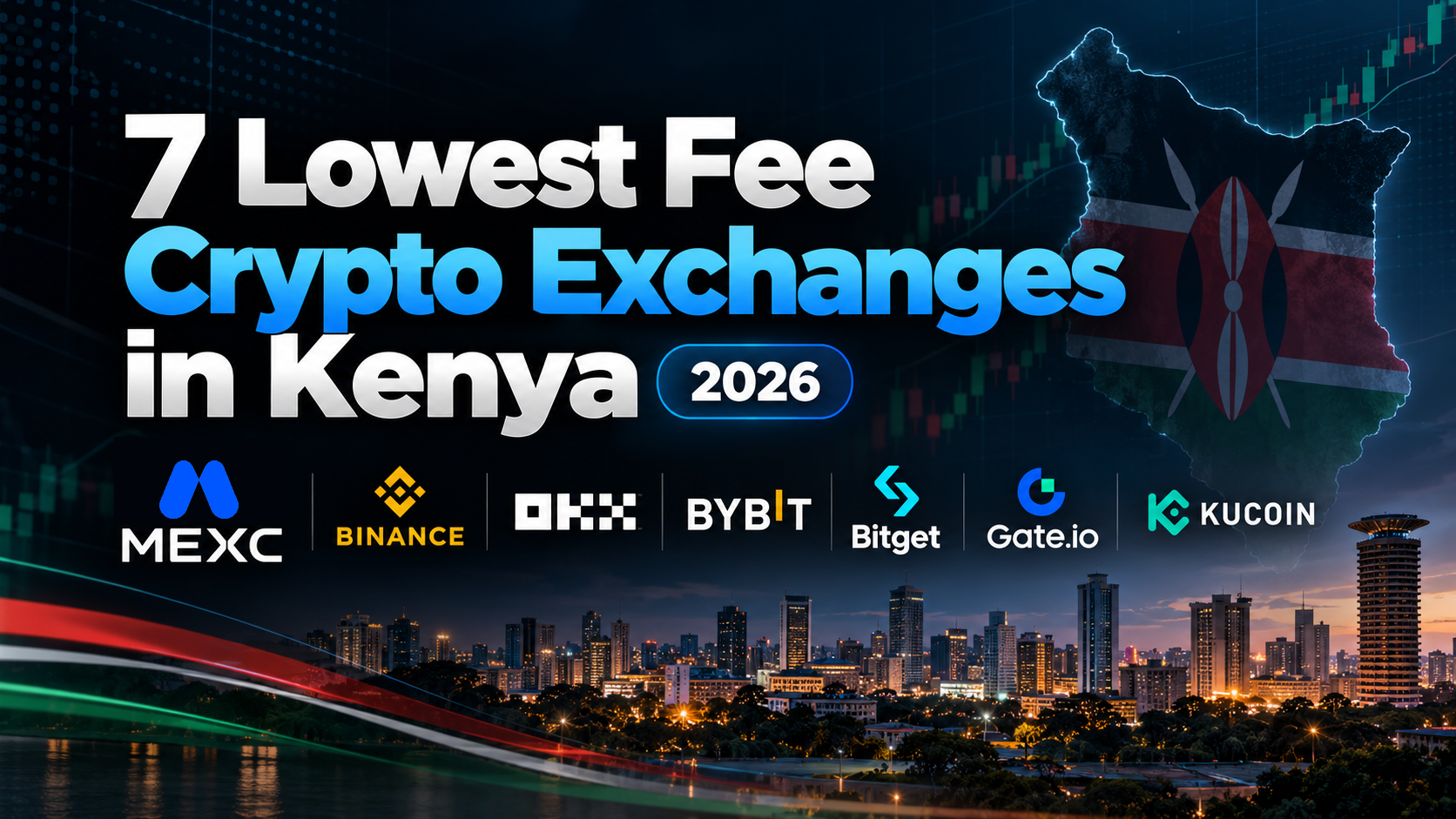
Lowest Fee Crypto Exchanges in Kenya Compared
| Rank | Exchange | Standard Spot Maker / Taker* | Main Cost Advantage | Best Suited To |
| 1 | MEXC | 0% / 0.05% | Lowest standard spot cost in this group | Cost-conscious spot and altcoin traders |
| 2 | Binance | 0.10% / 0.10%; 0.075% with eligible BNB discount | Strong liquidity plus KES P2P access | Users prioritizing local funding |
| 3 | OKX | 0.08% / 0.10% | Lower maker fee than most 0.10% exchanges | Active spot traders |
| 4 | Bybit | 0.10% / 0.10% | Competitive derivatives fees | Futures-focused traders |
| 5 | Bitget | 0.10% / 0.10%; about 0.08% with BGB payment | Discounted fees plus trading tools | Copy-trading and bot users |
| 6 | Gate | 0.10% / 0.10%; about 0.09% with GT at VIP0 | Broad market coverage | Altcoin-focused users |
| 7 | KuCoin | 0.10% / 0.10% on Class A pairs | Competitive major-pair fees | Users seeking less-common assets |
*Standard non-VIP spot rates. Pair-specific, zone-specific and token-discounted rates can differ.
Temporary promotions are excluded. Binance is running a zero-maker-fee campaign for KES P2P pairs from September 21 to October 31, 2026. MEXC also needs an important qualification: from September 30, selected USDT markets in the Innovation and MEME+ zones move to 0% maker / 0.08% taker, while Assessment Zone markets move to 0% maker / 0.20% taker. Its 0.05% taker rate is therefore not universal across every pair.
How We Ranked Low-Fee Crypto Exchanges for Kenyan Users
Trading cost receives the most weight at 35%, followed by liquidity and execution at 20%. Security and transparency account for 15%, Kenya access through KES, P2P, M-Pesa or cards another 15%, products and supported assets 10%, and usability 5%.
These percentages are an editorial framework rather than a precise numerical score. Security covers custody controls, account protections, reserve disclosures and relevant security history, while liquidity considers spreads, depth and slippage. This is why local funding and execution quality can outweigh a small fee advantage.
What Fees Should Kenyan Crypto Traders Compare?
Compare maker and taker fees alongside spreads, slippage, P2P merchant premiums, withdrawal fees and futures funding payments. Discounts linked to exchange tokens only help users willing to hold those assets, while VIP tiers can require volumes beyond normal retail activity.
For a KES 100,000 trade, saving 0.05% on commission is worth KES 50. If the P2P or fiat on-ramp used to fund the trade costs an extra 1%, that adds KES 1,000. For many Kenyan users, the funding route can outweigh a small difference in trading commission.
7 Lowest Fee Crypto Exchanges in Kenya in 2026
1. MEXC: Lowest Standard Trading Fees Overall
MEXC charges 0% maker and 0.05% taker on regular spot markets without requiring a high-volume tier, giving it the lowest standard entry-level spot cost in this comparison. Its broad asset selection also suits altcoin traders.
The rate is not universal. From September 30, Innovation and MEME+ USDT pairs carry a 0.08% taker fee and Assessment Zone pairs 0.20%. Kenya is not listed among MEXC’s prohibited jurisdictions, but accessibility is not evidence of Kenyan regulatory authorization. Users should separately check current CMA and CBK licensing information.
Strengths: Zero standard maker fee, low regular-market taker fee and broad asset coverage.
Limitations: Zone-specific rates require checking, and KES/M-Pesa funding is less direct than on established KES P2P markets.
2. Binance: Strong Combination of Fees, Liquidity and KES Access
Binance charges 0.10% maker and taker on spot, with eligible BNB fee payment reducing that to 0.075%. Its main Kenyan advantage is funding: Binance operates a KES P2P market with M-Pesa payment routes, while deep major-pair order books can reduce spread and slippage.
Strengths: KES/M-Pesa P2P access, deep liquidity and a broad product range.
Limitations: Standard fees are higher than MEXC’s, BNB discounts require token use, and P2P prices vary by merchant.
3. OKX: Lower Maker Fees for Limit-Order Traders
OKX’s regular spot pricing is about 0.08% maker and 0.10% taker, favoring traders who frequently place limit orders. Its advanced spot and derivatives interface is another differentiator, although Kenya-specific payment options can vary by account.
Strengths: Competitive maker fee and strong trading infrastructure.
Limitations: The taker fee remains 0.10%, and local KES convenience should be checked before funding.
4. Bybit: Competitive for Futures Traders
Bybit charges 0.10% maker and taker on spot, but its VIP0 derivatives rates of 0.02% maker and 0.055% taker are more distinctive. Kenya is supported for Visa and Mastercard purchases, and Bybit Pay documentation also supports Mobile Money transfers to Kenyan +254 numbers.
Strengths: Competitive derivatives pricing, advanced tools and documented Kenya payment support.
Limitations: Spot pricing is ordinary, and card or payment-service costs are separate from trading fees.
5. Bitget: Fee Discounts Plus Automation Tools
Bitget starts at 0.10% maker and taker on spot, falling to about 0.08% when eligible fees are paid in BGB. Futures start at 0.02% maker and 0.06% taker. Its differentiator is combining competitive derivatives pricing with copy trading and automation.
Strengths: BGB fee discount plus copy-trading and bot features.
Limitations: The lowest spot rate depends on BGB or higher tiers, and automation does not reduce market risk.
6. Gate: Broad Altcoin Coverage at Competitive Rates
Gate’s VIP0 spot rate is about 0.10% maker and taker, or roughly 0.09% through its GT-linked fee structure. Its main advantage is market breadth for users trading beyond major assets.
Strengths: Wide token coverage and an accessible fee discount.
Limitations: Standard pricing is above MEXC’s, and the large product catalogue can be complex for beginners.
7. KuCoin: Competitive on Class A Pairs
KuCoin’s Class A spot pairs start at 0.10% maker and taker. The caveat is its fee-class system: Class B and C tokens can carry base rates around 0.20% and 0.30%. Traders targeting less-common assets should check the fee class before ordering.
Strengths: Broad token coverage and competitive Class A pricing.
Limitations: Fees can vary substantially between token classes.
Which Low-Fee Exchange Fits Different Types of Kenyan Crypto Users?
| User Priority | Exchange(s) to Compare First | Why |
| Lowest standard spot fee | MEXC | 0% maker / 0.05% regular-market taker |
| KES/M-Pesa convenience | Binance | Established KES P2P use case |
| Limit-order trading | MEXC / OKX | Lower maker rates |
| Futures trading | MEXC / Bybit / Bitget | Competitive derivatives pricing |
| Altcoin selection | MEXC / Gate / KuCoin | Broad market coverage |
| Major-pair liquidity | Binance | Deep order books and active markets |
This is a use-case guide, not a second ranking. The most cost-effective option depends on how a user funds, trades and withdraws.
Are Crypto Exchanges Legal and Regulated in Kenya in 2026?
Kenya has a formal framework for virtual asset service providers. The Virtual Asset Service Providers Act, 2025 commenced on November 4, 2025, and the 2026 regulations operationalize licensing. Existing operators are in a transition period running to November 4, 2026.
Accessibility is not the same as authorization. A crypto exchange allowing Kenyan residents to create accounts, use cards or access P2P services does not by itself establish that it is licensed by the Capital Markets Authority or Central Bank of Kenya. Users should check current CMA and CBK licensing registers before relying on any licensing claim, particularly during the transition period.
The Bottom Line
MEXC leads this ranking on standard trading fees, while Binance may be more practical for users who prioritize KES and M-Pesa access. Compare the full cost of funding, executing and withdrawing, and verify current fee and regulatory information before trading.
Frequently Asked Questions About Low-Fee Crypto Exchanges in Kenya
Which crypto exchange has the lowest trading fees in Kenya?
Among these seven exchanges, MEXC has the lowest standard regular-market spot rate at 0% maker and 0.05% taker. Selected zones and pairs have different rates.
Which crypto exchange supports M-Pesa in Kenya?
Binance P2P is the clearest established example. Buyers can transact in KES using M-Pesa while the crypto is held in escrow. Because merchants set offer prices, P2P premiums vary.
Is a 0% trading fee really free?
No. Zero commission does not remove spreads, withdrawal or network costs, P2P premiums, card charges or futures funding payments. Promotions may also expire.
Are maker fees or taker fees more important?
Limit-order traders who add liquidity should focus on maker fees. Users who frequently execute market orders should pay closer attention to taker fees.