






For years, the accepted line was that M-PESA kept Safaricom’s subscribers loyal to its mobile network, but the results for the six months to 30 September 2025 suggest the arrangement has flipped, with the network now acting as the route through which a growing financial-services business reaches customers.
Safaricom Kenya earned KES 194.0 billion in service revenue over the period, and the earnings booklet shows the gap between connectivity and M-PESA narrowing to KES 8.1 billion.
| Revenue line | HY26 revenue | Share of Kenya service revenue | Year-on-year growth |
| Connectivity | KES 96.2bn | 49.6% | 5.3% |
| M-PESA | KES 88.1bn | 45.4% | 14.0% |
| Fixed and IoT | KES 9.8bn | 5.0% | 9.5% |
M-PESA is growing at more than twice the pace of connectivity, and the telecoms side is gradually changing shape. Mobile data revenue rose 13.4% to KES 40.3 billion, while voice slipped 2.1% and messaging fell 11.7%.
The data gain came from volume rather than price, with average usage per chargeable subscriber up about 20.6% to 4.85GB as the rate per megabyte dropped 11.7%, which is how a mature network behaves when it cuts prices to keep customers online.
Payments Now Outweigh Transfers
M-PESA’s revenue no longer depends primarily on people sending money to one another, with the investor presentation showing consumer and business payments together generating about KES 62.8 billion, roughly 71% of M-PESA revenue, against KES 18.5 billion from withdrawals.
The wallet that once moved cash between individuals has become payment infrastructure for shops, businesses, institutions, and consumers, and it behaves less like a digital envelope and more like a toll road, with Safaricom earning each time a customer pays a merchant, a business disburses funds, or an organization collects money across its network.
| M-PESA revenue line | HY26 revenue | Share | Growth |
| Consumer payments | KES 35.7bn | 40.6% | 19.4% |
| Business payments | KES 27.0bn | 30.7% | 18.8% |
| Withdrawals | KES 18.5bn | 21.0% | -0.7% |
| Financial services | KES 4.6bn | 5.2% | 13.9% |
| Global payments | KES 2.2bn | 2.5% | 17.3% |
This suggests a shift from primarily facilitating person-to-person transfers to providing payment infrastructure, giving Safaricom access to a much larger share of everyday economic activity.
More transactions, thinner yield
Transaction volumes rose by 26.5% to 21.87 billion, yet value grew only by 5% to KES 20.21 trillion, and free micro-transactions made up 36.8% of volumes. Revenue per active customer slipped 0.3% to KES 388.29 even as chargeable transactions per customer rose 3.5% to 38.69, and M-PESA commissions cost KES 18.78 billion over the period.
Safaricom appears to be trading yield per transaction for a bigger crowd, letting small payments run free or cheap in the expectation that people and businesses already inside the system can be monetized later through credit, savings, and other services.
Merchants Are the Way In
The growth in merchant numbers offers a clearer picture of where Safaricom wants to take M-PESA.
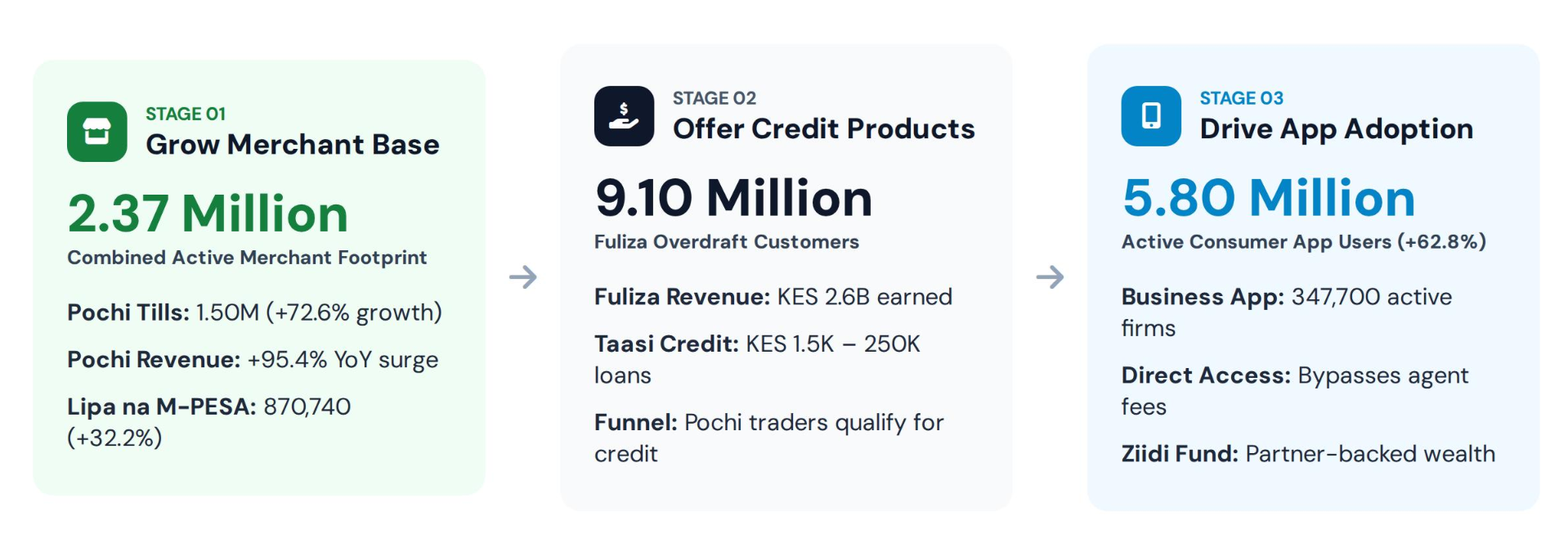
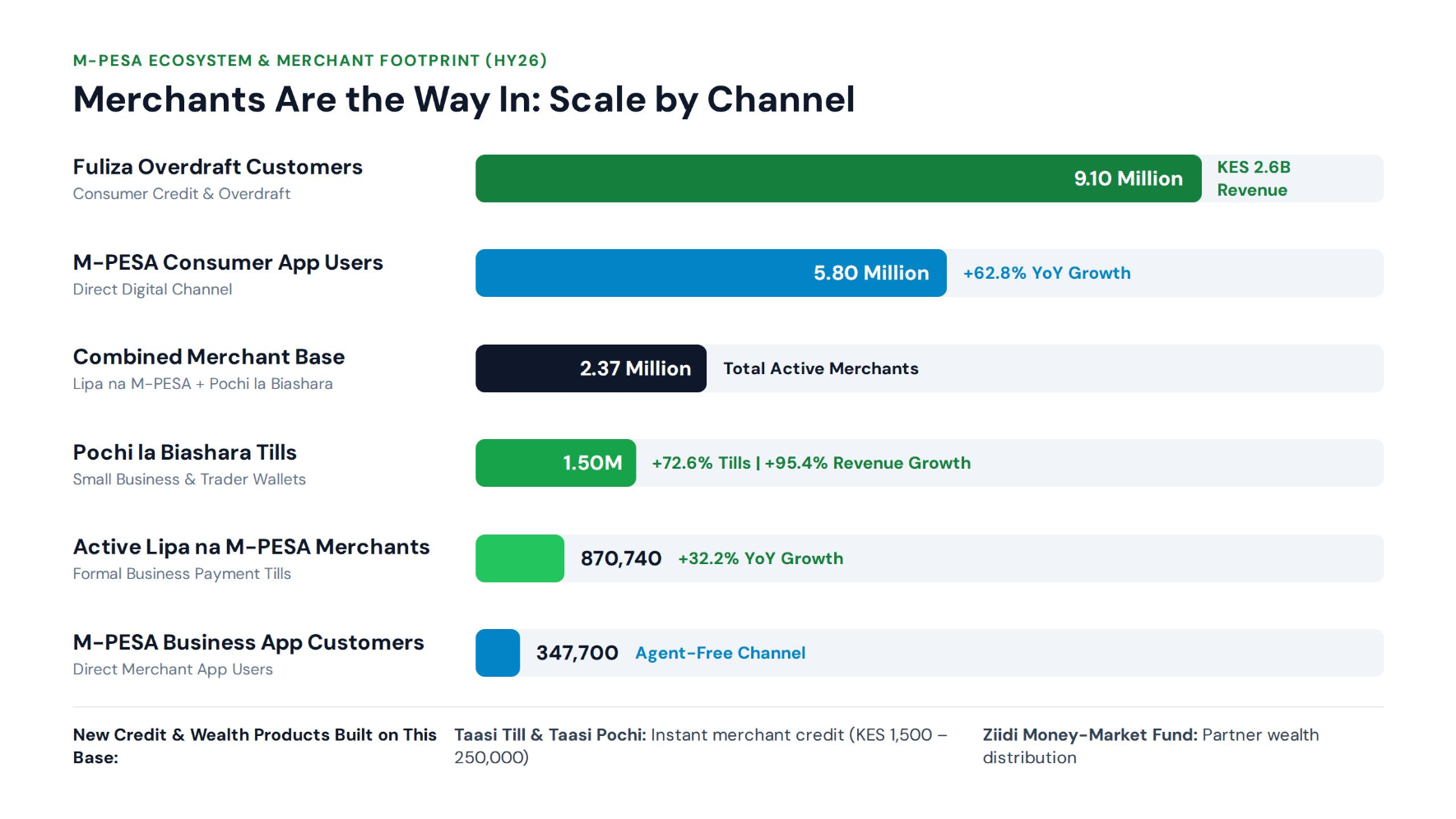
Active Lipa na M-PESA merchants grew 32.2% to 870,740, Pochi tills climbed 72.6% to 1.5 million, and the combined merchant base reached 2.37 million, with Pochi revenue rising 95.4%.
A trader using Pochi can become part of the customer base for additional financial products. Taasi Till and Taasi Pochi were launched in May for qualifying merchants using M-PESA Business Tills and Pochi la Biashara. Taasi products provide instant credit ranging from KES 1,500 to KES 250,000 for Pochi users.
Fuliza, the overdraft product, already reached 9.1 million customers and earned KES 2.6 billion in the period, according to the investor presentation. The payment product has become the front door to financial services, which reverses the old logic in which M-PESA existed to support the SIM card.
The M-PESA app pushes the same direction. The M-PESA app now the My OneApp had 5.8 million active consumer users, an increase of 62.8%, along with 347,700 active business customers; each customer on the app deals directly with Safaricom instead of through an agent.
This potentially provides the company with a more cost-effective channel for selling savings, insurance, and loans.
The annual report points to products such as the Ziidi money-market fund, where partners can distribute financial products through its customer and payments ecosystem while working with specialized financial partners.
Payments Still Pay the Bills, and Lending is Only Beginning
Safaricom is not yet a bank. M-PESA’s KES 83.5 billion from payments, withdrawals, and global transfers comes from charging for transactions, while the financial services line, which covers products built on top of the wallet such as lending, contributed only KES 4.6 billion, or 5.2% of M-PESA revenue.
The figures show both the opportunity and the added complexity of expanding beyond payments into lending, savings, and insurance. Unlike basic payments, these products expose Safaricom and its partners to credit risk, fraud, consumer-protection obligations, and closer regulatory scrutiny.
READ: Safaricom Ethiopia Cuts Losses by 96.5% as Revenue Grows 72%
The announced results are around growth, but the cash-flow side shows the cost, with Kenya’s operating free cash flow falling 11.5% as capital spending rose.
The fairer description is a financial infrastructure and distribution company that still runs a very large telco. Connectivity remains the bigger line by a narrow margin, yet it increasingly works as the road that carries customers to M-PESA, where the faster growth, the merchant relationships, and the future credit income now sit.