




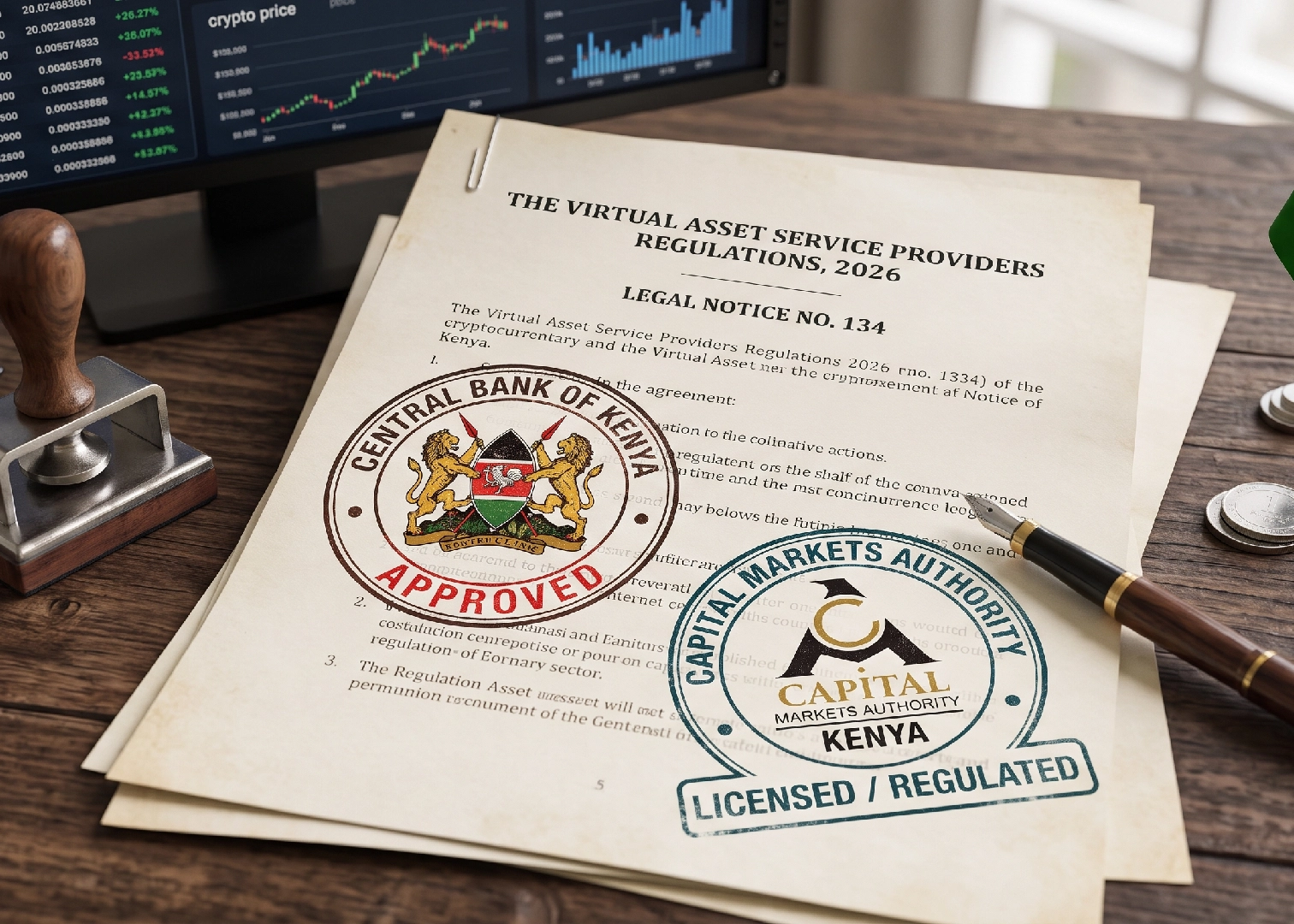
Kenya’s cryptocurrency industry has moved from years of official warnings to a working licensing system after the Central Bank of Kenya (CBK) and the Capital Markets Authority (CMA) announced that the Virtual Asset Service Providers Regulations, 2026 are now in operation.
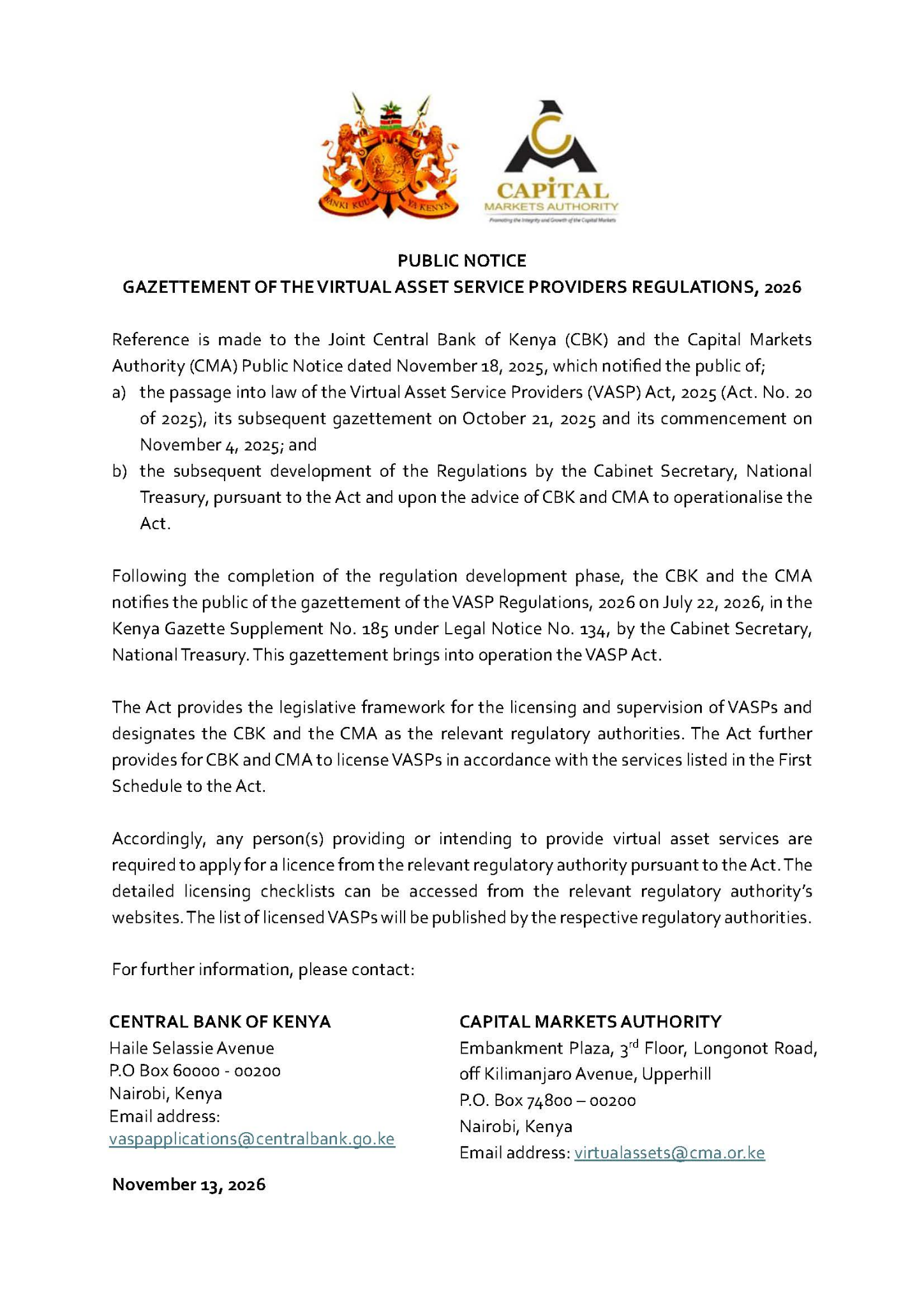
The announcement came nine days after the one-year transition period under the Virtual Asset Service Providers Act ended on 4 November 2026, following the Act’s commencement in 2025 and the gazettement of the detailed regulations in July as Legal Notice No. 134.
The official materials show no extension or safe-harbor period, so operators who have not applied to or engaged a regulator should assume the deadline is unchanged.
Who Is Covered and Who Regulates
Any virtual asset service provider (VASP) in or from Kenya now needs a license, and only a Kenyan company limited by shares, or a foreign one registered locally, can hold it.
Foreign platforms targeting Kenyan users are likely to be caught even if their systems run abroad, and calling a token a “utility token” or an NFT does not guarantee an exemption, since the regulators will look at what the token actually does.
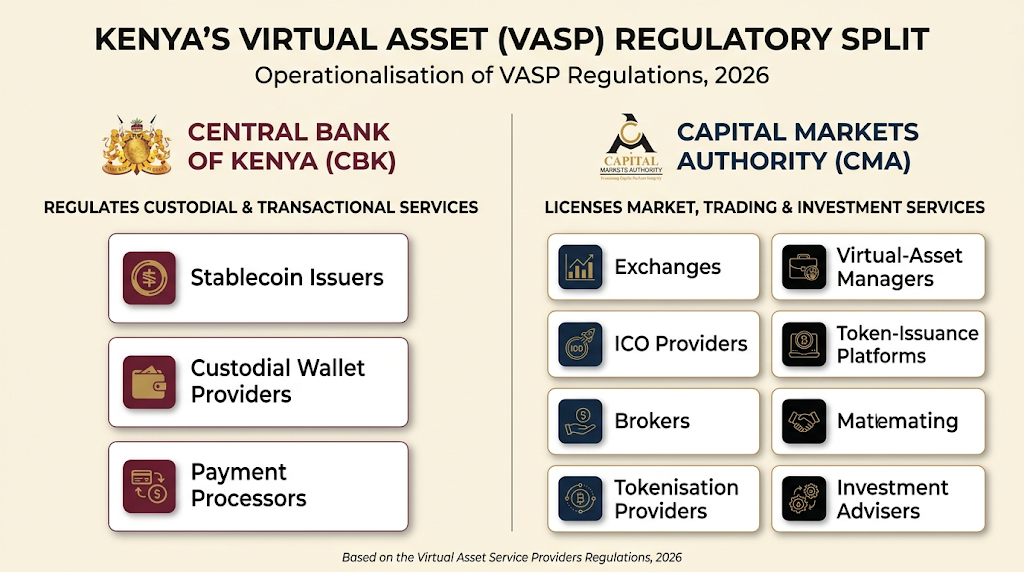
Oversight is split between the two regulators. CBK handles custodial wallet providers, payment processors, and stablecoin issuers and also requires separate approval for converting virtual assets to or from foreign currency, while CMA licenses exchanges, brokers, investment advisers, token offerings, and tokenization platforms.
A single product can touch both, so firms are advised to map what their services do rather than rely on branding.
The Cost of Getting In
Capital is the steepest barrier. A stablecoin issuer must hold KES 300 million in paid-up capital, a custodial wallet provider KES 150 million, and an exchange KES 100 million, while brokers and payment processors face a lower bar of KES 10 million.
| License category | Regulator | Paid-up capital | Liquid capital (whichever is higher) |
| Stablecoin issuer | CBK | KES 300 million | KES 60 million or 100% of current liabilities for at least 30 days |
| Custodial wallet provider | CBK | KES 150 million | KES 30 million or 100% of current liabilities for at least 30 days |
| Exchange | CMA | KES 100 million | KES 20 million or 8% of total liabilities |
| Virtual-asset manager | CMA | KES 20 million | KES 4 million or 8% of total liabilities |
| ICO provider | CMA | KES 20 million | KES 4 million or 8% of total liabilities |
| Token-issuance platform | CMA | KES 20 million | KES 4 million or 8% of total liabilities |
| Payment processor | CBK | KES 10 million | 100% of current liabilities for at least 30 days |
| Broker | CMA | KES 10 million | KES 2 million or 8% of total liabilities |
| Tokenization provider | CMA | KES 10 million | KES 2 million or 8% of total liabilities |
| Investment adviser | CMA | None prescribed | None prescribed, though general licensing and governance duties still apply |
Every category except investment advisers must also meet liquid capital requirements.
| Fee | Amount |
| Application and licence fees | KES 10,000 and KES 50,000 for an investment adviser, rising to KES 100,000 and KES 2 million for a stablecoin issuer |
| Annual renewal | Turnover- or assets-based |
| ICO and tokenisation approvals | 0.25% of the successful offer, with a minimum of KES 200,000 and a maximum of KES 30 million |
Fees add to the cost, and renewal charges tied to turnover or assets can end up exceeding the initial license fee.
Capital is only part of the application, which also asks for details on directors and owners, proof of where the money comes from, anti-money laundering controls, cybersecurity policies, and an independent systems audit with penetration testing.
Licenses run for one year and must be renewed at least two months before expiry, with complete applications to be decided within 30 days.
Obligations That Follow a Licence
Licensed firms must keep transaction records for seven years, separate customer assets from their own, run a complaints system, and obtain approval before outsourcing key functions.
Advertising is covered too, requiring promotions to be clear and balanced, with risks and fees visible rather than buried in small print, while paid promoters must disclose who they are and what they are paid.
The licensing regime may not be the last obligation these firms face. In a proposal by the International Monetary Fund, Kenya was urged to adopt the Financial Action Task Force’s Travel Rule, which would require licensed platforms to collect and share the names, national ID numbers, addresses, and wallet details of both the sender and recipient of a crypto transfer, passing them to the receiving platform and to the Financial Reporting Centre.
The Fund wants the requirement written into the Virtual Asset Service Providers Regulations or another legal instrument without delay, as Kenya works to address the deficiencies that landed it on the FATF grey list and aims to exit by April 2027, so firms that win a license should expect heavier customer data duties to follow.
Operating without a license is also now a criminal offense. An individual can face a fine of up to KES 10 million, up to five years in prison, or both; a company can be fined up to KES 25 million, and directors who knowingly allow a breach can be held personally liable.
READ: Kenya’s Crypto Rules Put It Among Africa’s Most Regulated Markets as the Continent Stays a Patchwork
Affected firms are advised to list every Kenya-facing product, classify each against the Act’s schedule, contact the regulators in writing, and take Kenyan legal advice before continuing to operate.
Businesses that cannot meet the capital and compliance demands may have to narrow their offering, partner with a licensed provider, or leave the market, because Kenya now treats crypto firms as financial institutions rather than ordinary software companies.