






Meta is rolling out its AI age-estimation system to Instagram users worldwide, aiming to move “millions more” suspected teenagers into Teen Account protections even when they signed up with an adult birthday.
The company says the approach will extend to Facebook, with similar technology planned for Threads later in 2026.
This is estimation rather than ID verification, so nobody is being asked for a document or a face scan. Meta’s systems instead pick up clues from posts, comments, captions, bios, birthday messages, and mentions of school grades, and the company has added photo and video analysis that looks for general cues such as apparent height or bone structure.
Meta says the check is not facial recognition because it does not create a facial fingerprint or identify anyone in an image.
What Happens When a Teen Lies About Their Age
Say someone signs up for Instagram with an adult birthday, but their posts, comments, captions, bios, or photos point to them being between 13 and 17.
Meta’s system can now flag the mismatch and move the account into Teen Account settings automatically, without waiting for the user to correct the birthday themselves.
In practice, that changes the account in several ways as depicted:
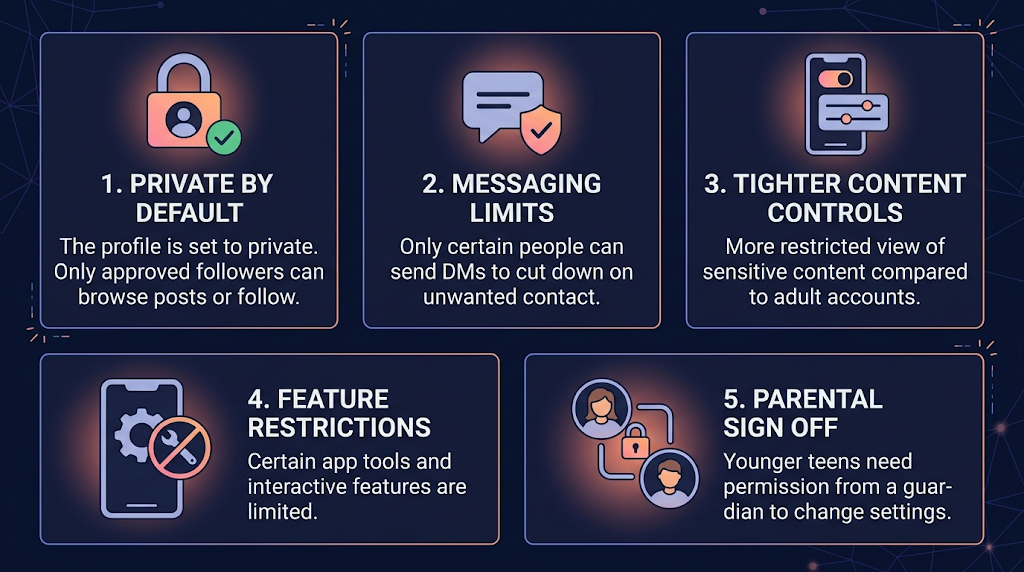
The teen stays on the platform throughout. Someone who enters “19” but is really 15 can carry on using Instagram, only with the protections designed for their actual age.
Meta says anyone placed in a teen experience by mistake can change their settings or verify their age, with Yoti’s facial age estimation among the options it has offered for people trying to change a birthday from under 18 to over 18.
Children under 13 are treated differently, since they fall below the minimum age for both Instagram and Facebook. If Meta believes an account belongs to someone that young, it may deactivate it and ask for proof of age through its verification process before the account can come back.
Meta says this enforcement also relies on user reports and human review, not only the AI system.
How Meta’s Compares Against Other Age Checks
Typed birthdays are cheap and quick but easy to fake, which is why TikTok layers profile and behaviour signals on top of the sign-up answer and sends suspected under-13 accounts to human moderators.
Meta’s model works much the same way, though its latest rollout leans harder on combining text and visual clues.
Selfie-based checks, such as the Yoti facial age estimation both companies have offered, are firmer than a typed date but still produce estimates and raise accuracy and privacy worries.
IDs, digital identity, and bank checks confirm age more directly, and UK regulator Ofcom groups them with estimation under “age assurance,” though they can lock out people without the right documents or devices.
Meta has also argued that a single age signal from app stores or phones would be more consistent and private, and in Australia it already uses Apple’s optional age-range signal, although coverage will stay patchy while sharing remains optional.
Who the Policy Helps, and the Trade-Off
Teenagers stand to gain the most, since even those who misstate their age get limits on unwanted contact and higher-risk features.
Meta reported in 2025 that more than nine in ten active teen accounts stayed in its protections against unwanted content, though that is the company’s own figure.
Parents get an added safety net, with US parents due an in-feed explanation of how the system works.
Meta, for its part, can point to the rollout as delivering on commitments to identify children and teens better, made in an agreement with 52 US attorneys general.
The catch is accuracy and privacy. Estimation can misjudge adults who look young, teens who look older, and people underrepresented in the training data, and Meta’s announcement gives too little detail to judge error rates.
Scanning posts, bios, and images to infer a sensitive trait is gentler than demanding IDs, yet it still means analyzing a lot of personal content, which leaves questions over how long it is kept, how bias is handled, and how it might be used later.
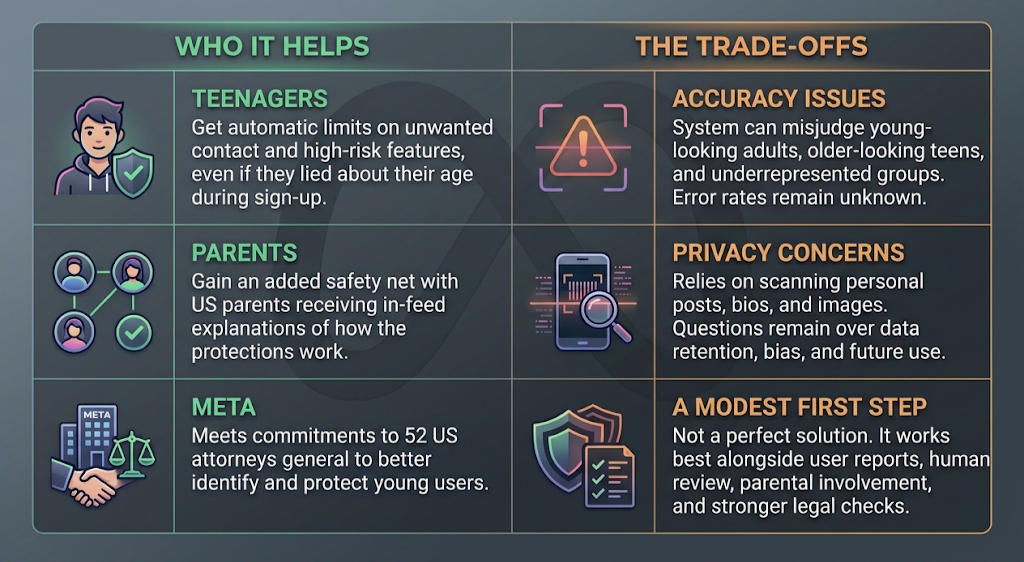
Taken together, the rollout is a modest but useful step that makes it harder for teens to dodge Instagram’s safety defaults with an adult birthday. It works best as one layer alongside user reports, human review, parental involvement, appeals, and stronger verification where a legal age threshold applies.