




The Social Health Authority (SHA), launched on October of last year to replace the troubled National Health Insurance Fund (NHIF), was meant to usher in a new era of affordable healthcare for Kenyans.
Less than a year later, the institution is at the center of a massive fraud scandal that has shaken public trust and exposed deep cracks in the country’s health financing system.
The Ghost Hospitals and Fake Patients
Audits revealed fraudulent claims worth KES 10.6 billion, with money flowing into nonexistent hospitals and fake patient files.
Some rogue facilities inflated bills, while others billed SHA for services never rendered. Shockingly, even ghost hospitals (clinics that don’t physically exist) managed to receive payouts.
Meanwhile, legitimate hospitals and real patients were left struggling as genuine claims went unpaid.
In March 2025, the Auditor General exposed a tainted KES 104.8 billion contract for SHA’s digital healthcare system.
The contract was awarded without competitive bidding, lacked clear scope definitions, and alarmingly left ownership of the system with the contractor consortium instead of SHA.
This has raised concerns that the very systems designed to safeguard public funds are instead enabling misuse. In response to the scandal, SHA has suspended about 40-45 health facilities and blacklisted 12 doctors implicated in suspicious claims.
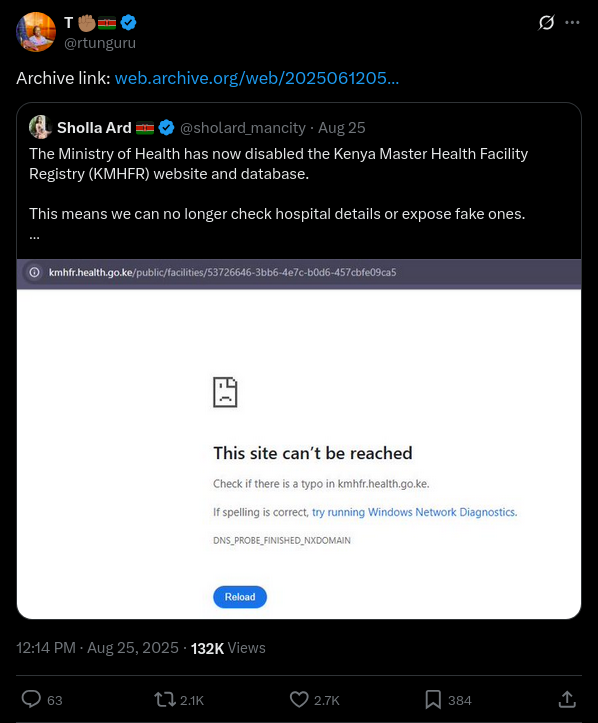
However, in a move that sparked public outrage, the authority pulled down its online payment list and health facility registry, making it harder for Kenyans to see where their money went.
Read: How to Check Your SHIF Status in Kenya: A Complete Guide
Who Controls the SHA Systems?
COTU Secretary-General Francis Atwoli, who sits on the SHA board, revealed that the authority does not control the IT systems used to verify claims.
Instead, these systems are managed by the Ministry of Health and the Digital Health Authority, leaving SHA vulnerable and unable to guarantee oversight.
Political Pressure and National Security Fears
Saboti MP Caleb Amisi has described the crisis as a national security issue, demanding that Health Cabinet Secretary Aden Duale address the scandal immediately.
The fear is that if Kenyans lose trust in SHA, public confidence in universal healthcare reforms could collapse altogether. The SHA scandal is a systemic failure affecting millions of Kenyans who rely on the promise of affordable healthcare.
With billions already lost, hospitals suspended, and procurement riddled with corruption, the government is under increasing pressure to clean up the sector before public rage escalates.