




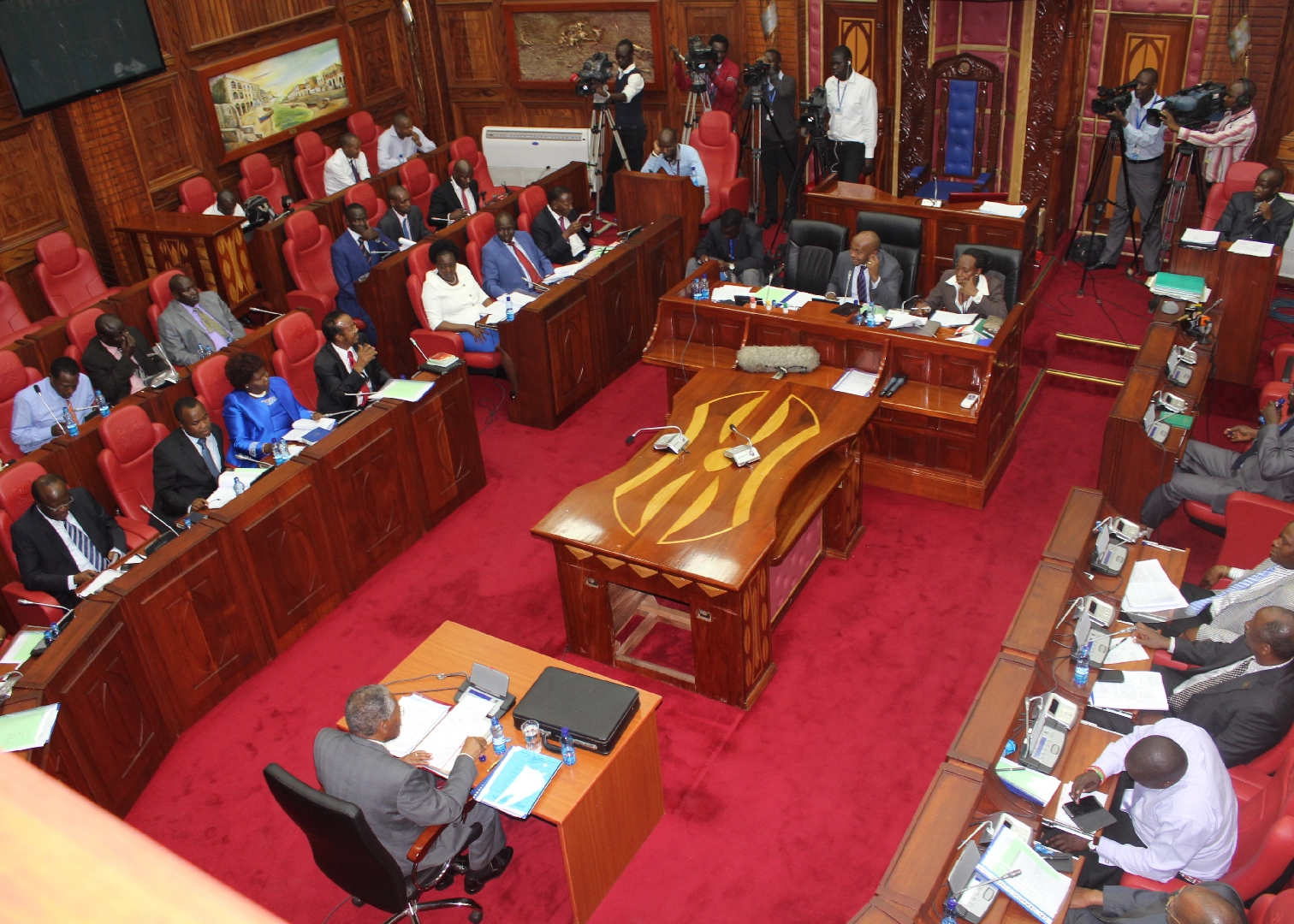
Kenya’s Senate is once again considering a proposal to strip the IEBC of the duty to stream polling station results live as they’re announced.
The Election Laws (Amendment) Bill, 2026, co-sponsored by Senate Majority Leader Aaron Cheruiyot and Minority Leader Stewart Madzayo, deletes the section requiring this public feed and replaces it with a system centered on electronic transmission of results to tallying centers.
Currently, IEBC must stream polling station results live purely as a public information tool. It carries no legal weight, but it lets journalists, agents, and citizens watch numbers arrive and compare them to later official announcements. The Bill wants to remove this requirement.
In its place, presidential results would be tallied, announced, and declared at the polling station, then transmitted electronically to tallying centers within a set window.
READ: IEBC Owns Up to Cracks in 2022’s Dispute Resolution Process, Eyes Fixes Before 2027
Kenyans could still view scanned result forms uploaded to the IEBC’s portal, and the commission would gain an explicit role in verifying that transmitted figures match what was declared at the station level.
A near-identical bill surfaced in 2024 under different sponsorship as part of National Dialogue Committee recommendations following the disputed 2022 election, but it stalled.
This version revives that idea, and IEBC’s own signals suggest the familiar national tallying center screen may not return for the 2027 Kenya Elections.
Supporters call this a cleanup, not a rollback. Mule Musau of the Elections Observation Group (ELOG) argues the reform should be judged on whether it lets IEBC verify results properly. The livestream becomes unnecessary, he says, if the polling station record is accurate.
ELOG has even floated scrapping the national tallying center entirely, reasoning that duplicating polling-station data at a central hub adds spectacle, not accuracy.
Some argue that live results from thousands of polling stations, especially in rural areas with unreliable internet, have created confusion. Numbers can appear to stop updating or even go backwards while officials complete verification steps that are not visible in the public results.
Supporters say that scanned result forms combined with secure electronic transmission provide a more reliable record than a live results tracker that is clearly marked as unofficial and non-binding.
Verification Versus Visibility
The 2017 election nullification will likely come up in this debate, so it’s important to be clear about what happened. The Supreme Court overturned the results because of failures in the verification process.
The IEBC did not use its required results transmission system, refused to allow access to its servers for inspection, and declared a winner before properly verifying the results against constituency-level records. The court found that the process was neither transparent nor verifiable.
This Bill does not remove that verification process. Electronic transmission of results remains mandatory, and scanned results forms will still be published on the public portal. That system is widely seen as one of the reasons the 2022 election was more transparent.
What the Bill removes is real-time visibility into the transmission process. The system is not returning to a manual process, but a live public feed allows people to spot issues, such as polling stations that are reporting unusually late, while the process is still underway.
Checking the public portal later can still reveal problems, but only after the fact.
READ: IEBC Warns Against Ballot Photography Citing KES 1 Million Fine
So, does the Bill reduce transparency? Not necessarily, because the election data and audit trail remain available.
In practice, however, it does reduce public oversight by removing a tool that allows ordinary citizens, not just election agents and lawyers, to identify potential issues as they happen.
Other Teething Concerns
Media houses have relied on the livestream to independently verify results instead of waiting for official statements. Without it, they would have to depend more on the IEBC’s own updates and timelines.
Senator Okiya Omtatah, a vocal government critic and declared 2027 presidential aspirant, says the proposed changes benefit the incumbent and represent early political positioning rather than impartial electoral reform.
READ: IEBC Unveils Detailed Roadmap for Kenya’s 2027 General Election
Whatever the intention, removing a transparency measure introduced after the 2007 election is likely to raise concerns, especially among those who feel less confident about the outcome.
The Bill is currently before the Senate’s Justice and Legal Affairs Committee, where public participation is still helping shape its final version.
Given the debate surrounding the 2024 proposal, further amendments are likely before it goes to a vote. These could include changes to transmission timelines or provisions for independent audits.
READ: IEBC Clarifies Why Some Kenyan Voters May Need to Register Again
Kenya has twice taken disputed presidential election results to the Supreme Court in the past decade. Because of that, the final wording of this Bill could have a significant impact on the 2027 election and may prove to be one of the Senate’s most important decisions.