




Elon Musk’s AI company doesn’t go by xAI anymore. Following SpaceX’s acquisition of xAI back in February, the company has now rebranded as SpaceXAI, complete with a new logo and a new X handle.
Musk said back in May that this was the plan all along: dissolve xAI as a standalone entity and fold it into SpaceX.
The rebrand lines up with SpaceX’s IPO in June, which raised $75 billion and briefly pushed the company’s valuation to around $1.77 trillion, making Musk the world’s first trillionaire for a short stretch. The IPO filings also gave a clearer picture of how much SpaceX is pouring into AI.
In 2025 alone, the company spent $12.7 billion on AI, more than three times what it spent on Starlink and its other space and connectivity businesses.
That AI spending hasn’t turned a profit yet, but SpaceX is betting big on it anyway, going as far as planning to put data centers in orbit as early as 2028.
SpaceX has also become a supplier to some of its own AI rivals. Anthropic pays SpaceX $1.25 billion a month for compute access through its Colossus data centers, and Google pays $920 million a month for the same kind of access.
In that context, SpaceXAI just released its newest model, Grok 4.5, its first launch since going public and since acquiring the AI coding startup Cursor.
The company describes it as built for coding, agentic work, and everyday knowledge tasks like spreadsheets and documents, rather than as a general chatbot for casual conversation.
It was trained across tens of thousands of Nvidia‘s GB300 GPUs, with SpaceXAI saying it put extra effort into cleaning and curating training data rather than just piling on more of it.
On pricing, Grok 4.5 costs $2 per million input tokens and $6 per million output tokens, which undercuts Anthropic’s Opus line. Opus 4.8 runs $5 per million input tokens and $25 per million output tokens.
OpenAI’s lineup sits in between, with its priciest model, Sol, at $5 input and $30 output per million tokens, and its cheaper Luna model matching Grok almost exactly at $1 input and $6 output.
Musk has been comparing Grok 4.5 directly to Anthropic’s Opus models, calling it “an Opus-class model, but faster, more token-efficient and lower cost.”
In a separate comment, he described SpaceXAI’s internal read as putting Grok 4.5 roughly on par with Opus 4.7, just noticeably quicker.
A benchmark chart the company put out alongside the launch claims Grok 4.5 beats Opus 4.8 on a handful of tests, though it reportedly still falls short of the very best models from OpenAI and Anthropic overall.
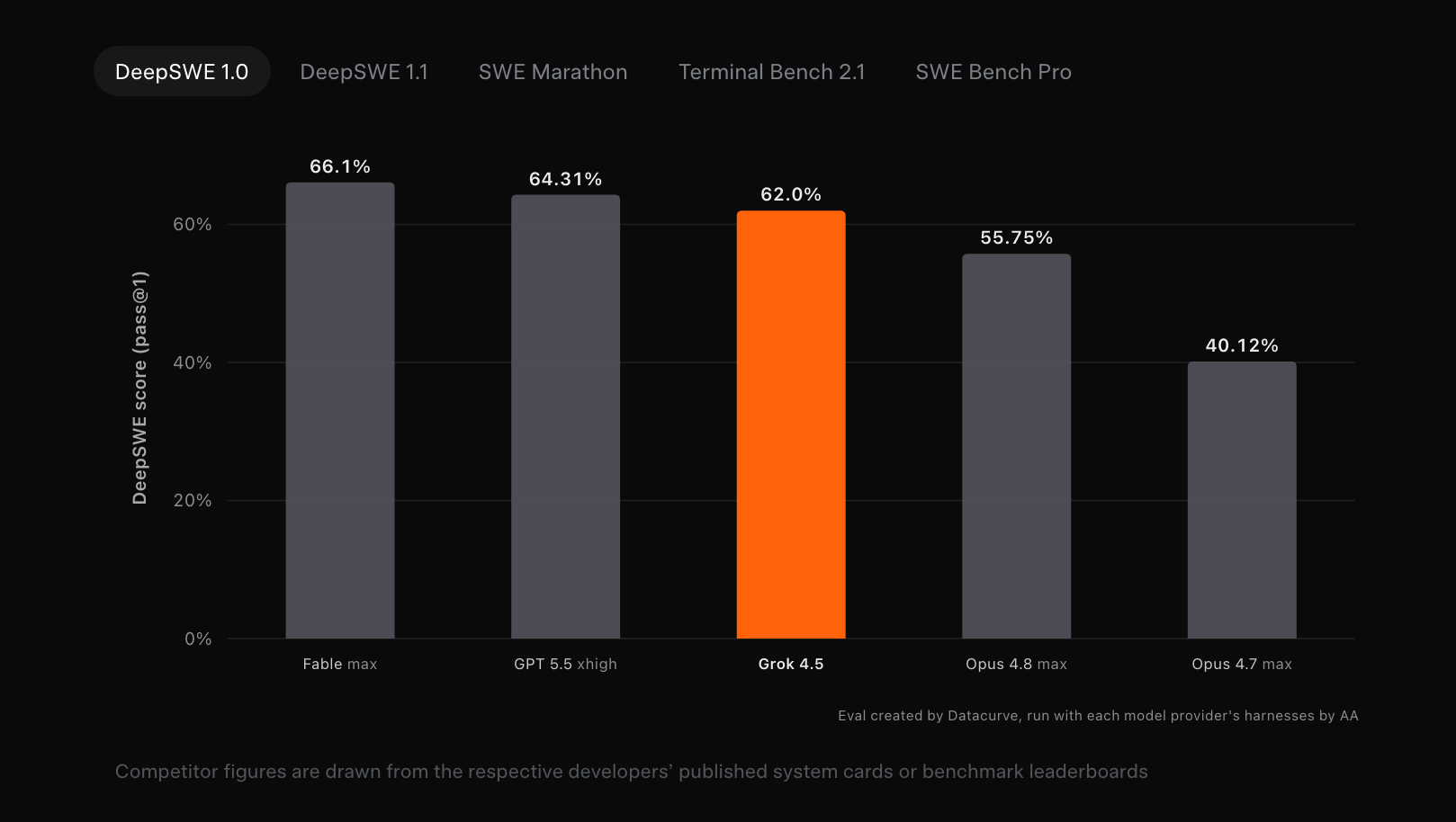
SpaceXAI is framing this as a speed and cost play for now, with Elon Musk suggesting the company expects to close that remaining gap soon.
There’s a wrinkle though: the same compute capacity SpaceXAI leases out to Anthropic and Google is also what it used to train Grok 4.5.
As SpaceXAI’s own compute needs keep growing, it may eventually have to decide whether to keep leasing capacity to competitors or hold more of it back for its own models.
Grok 4.5 is available now through Grok Build, through Cursor on all plans, and via the SpaceXAI console, though it isn’t live in the EU yet. SpaceXAI says European availability is expected around mid-July.
The launch also lands in a crowded week for AI releases. OpenAI is rolling out GPT 5.6 to the public on July 9, a release that had been held back earlier due to a request from the Trump administration over security concerns, along with a new set of voice models.