






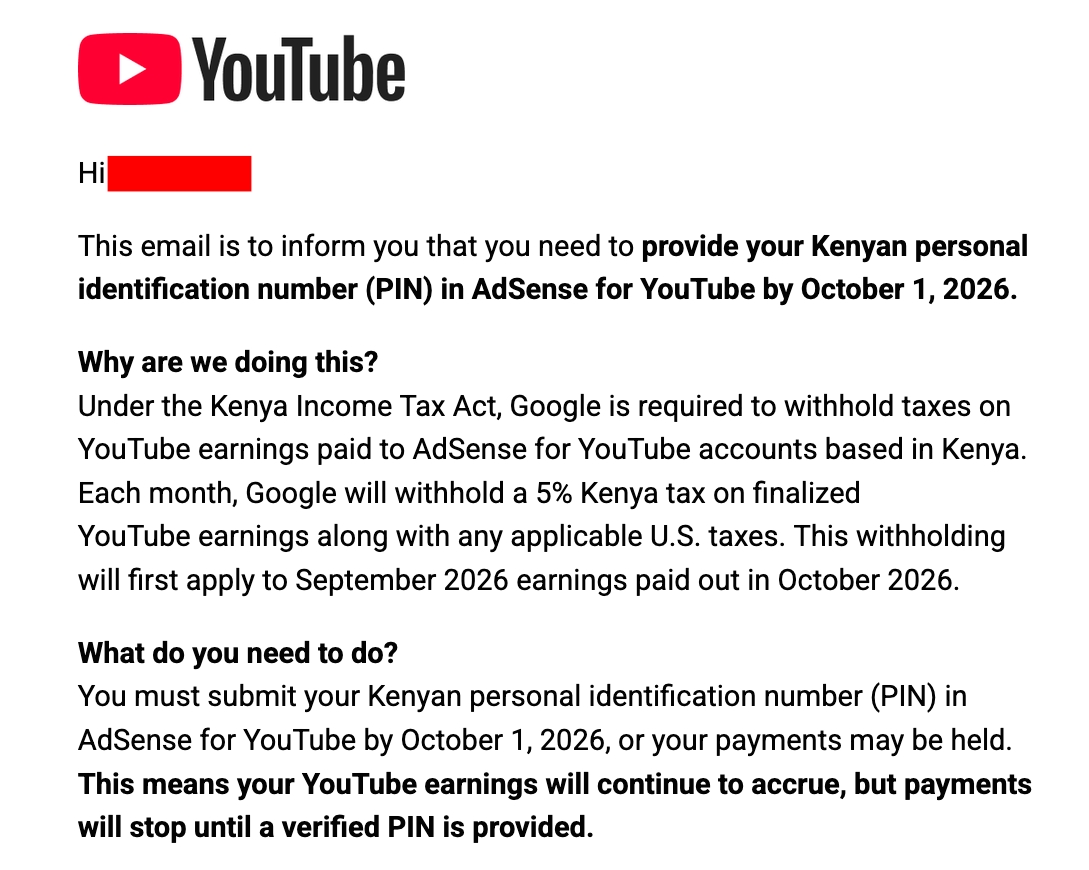
Kenyan YouTubers just got a piece of news that’s rattled the country’s creator community. Starting with September 2026 earnings, paid out in October, Google will begin withholding 5% of finalized YouTube earnings as Kenyan tax, on top of whatever U.S. taxes already apply.
Google sent out the notice on Friday, August 28, telling creators using AdSense for YouTube to submit their Kenya Revenue Authority (KRA) Personal Identification Number by October 1, 2026.
If you miss that date, your earnings will keep accruing, but your payouts will be frozen until you provide a verified KRA PIN.
Why Is Google Implementing This?
Google says it’s simply following the law. Kenya’s Income Tax Act requires the company to withhold tax on YouTube earnings paid to accounts based in the country, and Google is treating this the same way it already handles U.S. withholding.
The legal basis actually goes back further than this announcement. The Finance Act 2023 introduced a withholding tax on digital content monetization starting July 2023, set at 5% for residents.
Treasury originally pushed for 15%, but public pushback got it reduced. What’s changing now isn’t the rate itself. It’s that Google is finally putting the mechanism in place to actually collect it, automatically, every month.
How to Submit Your PIN
The process happens inside AdSense for YouTube:
- Sign in to your account
- Go to Payments, then Payments info
- Click Manage settings
- Find the Payments profile section and edit the Kenya tax info
- Click Manage tax info
- Enter your 11-character KRA PIN in capital letters, no hyphens (starts with “A” for individuals, “P” for entities)
- Submit
Once you open the form, there’s more to it than a single PIN field. You’re asked to pick an entity type: corporate entity, government agency, individual entrepreneur or sole proprietor, tax exempt organization or NGO, or unincorporated partnership or trust.
Depending on what you choose, you also get questions about whether you qualify for a lower withholding tax rate, a lower VAT rate, or VAT exemptions, and whether your supplies are subject to VAT withholding.
In other words, Google isn’t just collecting a tax number. It’s building a complete VAT and invoicing profile for every Kenyan account that earns money.
The documents you submit must also match the details on your existing Google payments profile exactly. This could be a problem for creators who set up their accounts years ago using a different name or address.
READ: YouTube Ads Are Out of Control and That Is Exactly What Google Wants
The same tax card, PIN request, and VAT questions have also started showing up on regular AdSense accounts, the kind used by blogs and websites running display ads.
So far Google has only confirmed the withholding applies to YouTube earnings. Whether the 5% cut will also hit publisher and blog revenue hasn’t been addressed.
If your finalized YouTube earnings for the month come to KES 100,000, Google withholds KES 5,000, leaving you with KES 95,000 before any other deductions apply.
Kenya isn’t the only country creators upload from, and the comparison isn’t flattering. Google doesn’t deduct any local withholding tax from AdSense payments in India, Nigeria, or South Africa.
Creators in those countries simply declare their platform income and settle it with their own tax authority at year end. The same goes for most of the EU, the UK, and the US.
The one deduction Google applies almost everywhere is the American one, taken from the portion of earnings that comes from viewers based in the US. That exists because a creator’s home country either has a tax treaty with the US that caps the rate, or it doesn’t.
Kenya has no such treaty, so Kenyan creators already sit at the full 30% US withholding rate on US-viewer earnings, compared to 15% for creators in India.
That means Kenyan creators are now stacking two disadvantages: the highest available US withholding rate, plus a local deduction that creators in several comparable countries don’t have to deal with at all.
How Do Creators Feel About This?
The announcement has landed badly with a lot of Kenyan creators, many of whom depend on YouTube as their main source of income.
Several have pointed out that the government offers little in return: no support for importing production equipment, no relief on data costs, and now a withholding tax on top of it all.
READ: Nairobi Proposes KES 5,000 Daily Fee for Professional Photo and Music Shoots
The broader frustration is that Kenya’s creator economy largely grew out of necessity, with young people turning to content creation because formal jobs were scarce. For many, this feels like a tax on self-generated income with no accompanying investment in the industry that produced it.