




For a platform engineer, “which testing tool is best?” is the wrong question. The one that matters is narrower and more practical: which tool slots cleanly into my pipeline without becoming a bottleneck, a flaky mess, or a piece of infrastructure I now have to babysit?
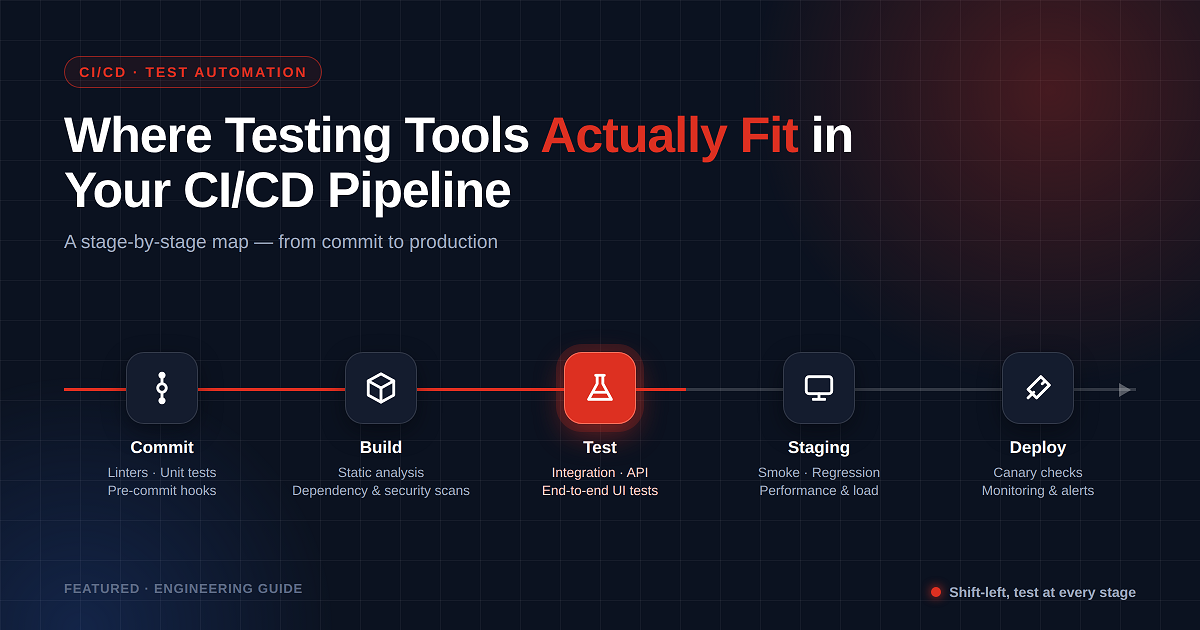
So instead of ranking tools, let’s map them to where they actually live in the delivery pipeline: authoring, local runs, pull-request checks, CI/CD gates, release regression, and production monitoring, and judge each on how well it fits the stage.
Authoring: Where Tests Get Written
The first fork is where a test is born, because it decides everything downstream.
Code-based frameworks like Selenium, Cypress, Playwright, Appium keep tests in the repository beside the application code. That is a real pipeline advantage: tests version with the code, travel through the same pull request, and get reviewed like any other change.
Plain-English and AI tools take a different path. Tests are authored in natural language, often in a cloud platform, then triggered from the pipeline through a CLI or API. Because those tests read as intent rather than code, they double as living acceptance criteria, which is why teams exploring ATDD with AI, or looking to bring manual testers into automation, often turn to testRigor as an AI software testing tool as a resource for learning how that approach works in practice.
The pipeline takeaway: repo-resident tests version effortlessly; cloud-authored tests need a deliberate trigger-and-sync strategy, which is easy to set up but worth planning.
Local and Dev Runs: Fast Feedback Before the Push
Shift-left only works if a developer can run the relevant tests before pushing.
This is where Cypress and Playwright shine: a fast local runner, immediate feedback, and a debugging experience developers actually like. Selenium runs locally too, but slower and with more setup. Cloud-first tools run differently: execution happens in the platform, invoked locally via CLI, which trades a little immediacy for zero local infrastructure.
Pipeline takeaway: the faster the local loop, the fewer broken builds reach CI in the first place.
Pull-Request Checks: Gating Every Change
Tests that run on every PR have two non-negotiable requirements: they must be fast, and they must be reliable. A flaky test at the PR gate is worse than no test, because it trains engineers to re-run until green and ignore failures.
Playwright and Cypress parallelize well and return quickly, which suits PR gates. Self-healing tools help here in a different way by surviving the cosmetic UI churn that normally produces false failures; they keep the gate trustworthy. Mobile testing with Appium is usually too slow and device-dependent to sit on every PR; it belongs later in the pipeline.
Pipeline takeaway: put your fastest, most stable subset at the PR gate, and quarantine known-flaky tests rather than letting them block merges.
CI/CD Gates: The Core Integration
This is where a tool earns or loses its place. Three things matter: how cleanly it integrates with your CI system, how well it parallelizes, and how its results surface in the pipeline.
| Tool | CI/CD integrations | Parallelization | Reporting | Pipeline friction |
| testRigor | GitHub Actions, Jenkins, GitLab CI, Azure, CircleCI (via CLI/API) | Cloud-based parallel execution | Dashboard + CI status | Cloud-based; tests live outside the repo |
| Selenium | Any CI (ubiquitous) | Selenium Grid (self-managed) | Custom, via your framework | Infra-heavy; you run the grid; flaky at scale |
| Cypress | Native CI support; Cypress Cloud | Parallel via Cypress Cloud/sharding | Rich dashboard | Web-only; some flakiness at scale |
| Playwright | Native, excellent | Built-in sharding | Built-in HTML reports + traces | Web-focused; code-first |
| Appium | Any CI needs a device cloud | Parallel via device cloud/grid | Custom | Web-focused; code-first |
Pipeline takeaway: open-source frameworks give you total control at the cost of running the infrastructure yourself; managed and cloud tools trade some control for parallel execution you do not have to maintain.
Release and Regression: The Big Suite
Before a release, the full regression suite runs, and here breadth and parallel scale dominate.
Selenium can drive large cross-browser suites, but a Grid at scale is real infrastructure to operate. Cloud tools with broad coverage, including plain-English platforms that span web, mobile, and API, lean on managed parallel execution and self-healing to keep a large suite green without a maintenance army. This is the stage where low test-maintenance stops being a nicety and becomes the difference between a suite you trust and one you skip under deadline pressure.
Pipeline takeaway: the regression stage is won on parallel scale and maintenance cost, not on authoring speed.
Monitoring: Testing After Release
The pipeline does not end at deployment. Running key journeys against production on a schedule synthetic monitoring catches what pre-release testing cannot, like a third-party outage or an environment-specific break.
Any tool that supports scheduled runs can serve here; cloud platforms make it especially simple to point an existing suite at production on a cron. This is where testing quietly merges with observability, and it is the stage most teams under-invest in.
Pipeline takeaway: reuse your highest-value end-to-end tests as production monitors. It is the cheapest coverage you will ever add.
Best Tool for CI/CD, in One Line
For teams that want plain-English tests integrating with GitHub Actions, Jenkins, or GitLab CI and running in parallel without managing grid infrastructure, an AI platform fits cleanly as a PR gate and regression stage. For code-first web teams who want tests in the repo and native tooling, Playwright offers the tightest pipeline integration. Most mature pipelines end up combining both.
The Bottom Line
A testing tool is only as good as its fit with the pipeline it lives in. Map your tools to stages fast and stable at the PR gate, broad and parallel at regression, scheduled at monitoring and choose per stage rather than hunting for a single winner. The best-integrated suite is the one your pipeline can run on every change without flinching.