




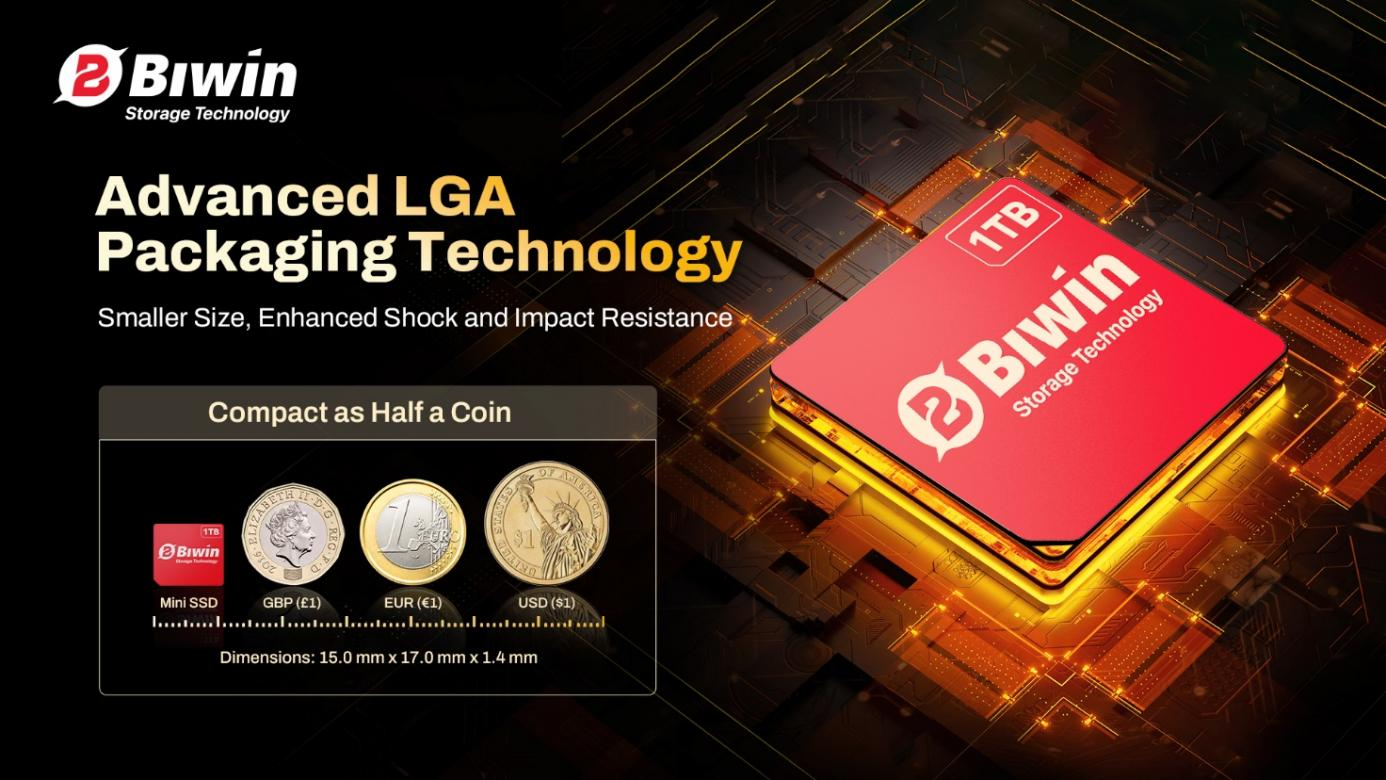
Chinese storage manufacturer Biwin has unveiled the Mini SSD, also referred to as the 1517 by another vendor, a new storage format combining extreme compactness with high-speed performance.
Measuring just 15 mm × 17 mm × 1.4 mm, it is smaller than a penny and only slightly larger than a microSD card.
Despite its size, the Mini SSD offers specifications more commonly found in full-sized NVMe drives. It connects via a PCIe 4×2 interface, with sequential read speeds up to 3,700 MB/s and write speeds up to 3,400 MB/s.
Storage options will include 512GB, 1TB, and 2TB, making it suitable for modern gaming libraries and high-performance workloads.
SIM-Style Insertion
One of the Mini SSD’s key features is its SIM-card-style installation. Instead of opening a device to swap drives, users can insert or remove the SSD through a small tray, similar to how smartphones handle SIM cards.
This approach reduces installation time and eliminates the need for specialized tools, making upgrades more accessible for portable devices.
The Mini SSD is designed for portability and reliability. It is IP68-rated for dust and water resistance and can withstand drops from up to three meters.
This durability makes it a strong fit for handheld gaming devices, field laptops, and other mobile hardware that operates in varied environments.
Target Devices
The first devices to ship with the Mini SSD will be Chinese handheld gaming PCs, including the GPD Win 5 and OneXPlayer Super X. These devices benefit from the compact form factor, as internal space is limited, and traditional M.2 drives take up more room.
Challenges and Adoption
While the BIWIN Mini SSD presents clear advantages in size, speed, and convenience, a few challenges remain:
- Thermal management: Sustaining top transfer speeds in such a small enclosure could lead to heat buildup.
- Standardization: Without adoption by other manufacturers, the format may remain proprietary and limited to select devices.
- Pricing: High-performance compact storage often comes at a premium, potentially limiting mainstream adoption in the short term.
If the Mini SSD gains broader support, it could introduce a new modular approach to portable storage, combining the convenience of microSD cards with the performance of NVMe SSDs.
For now, it’s positioned as a high-speed storage upgrade for the next generation of handheld gaming systems.