




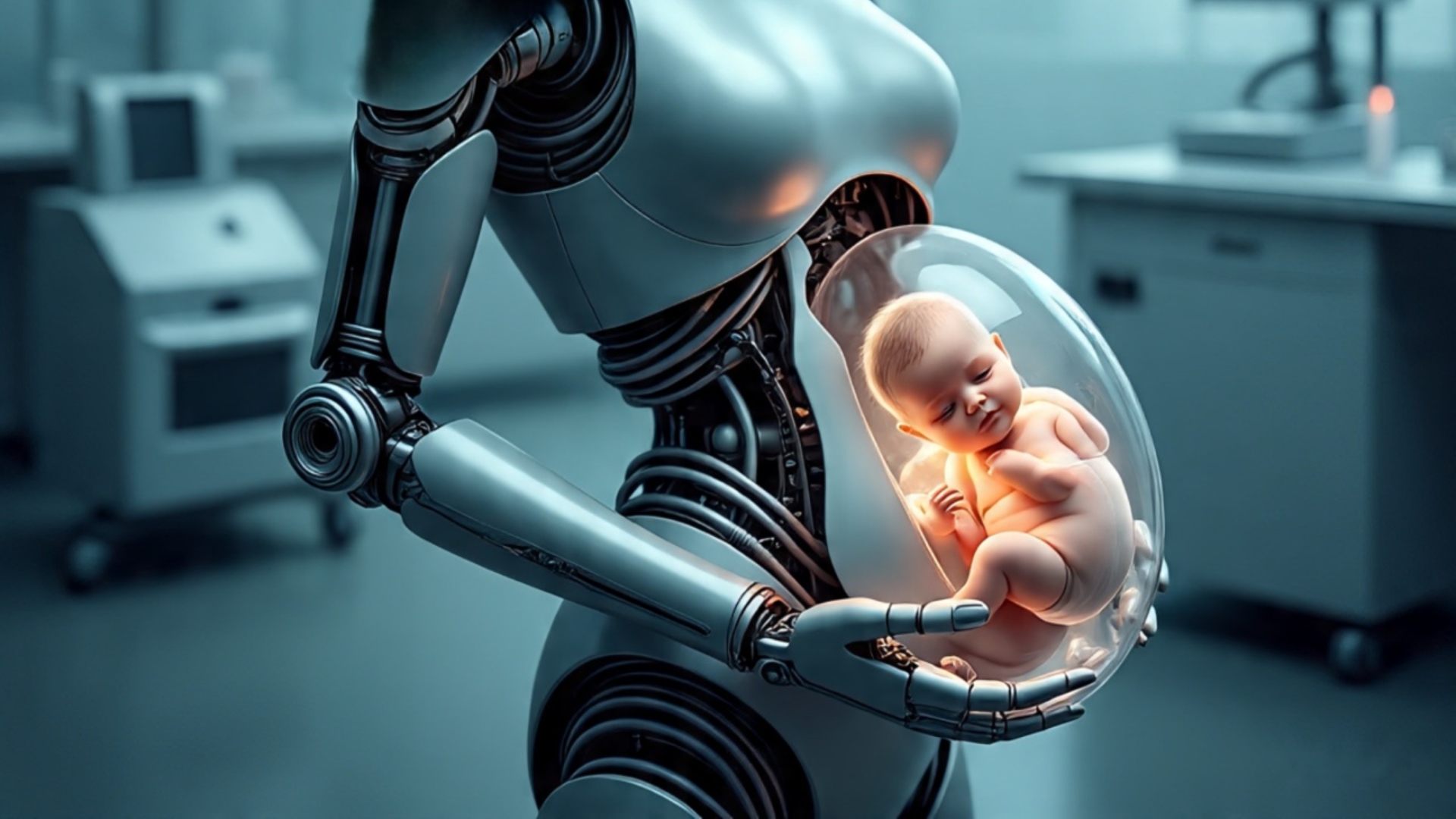
A Chinese company wants to put an artificial womb inside humanoid robots, and the internet is losing its collective mind.
Kaiwa Technology, based in Guangzhou, claims they’ll have a working prototype by next year that can carry a human baby for ten months and deliver it safely. The price tag? About $14,000 (~ KES 1.9 million), roughly the cost of a decent second-hand car.
We know the concept sounds like something ripped from a sci-fi movie, but the technology behind it is surprisingly real. Zhang Qifeng, the company’s founder, unveiled the idea at Beijing’s World Robot Conference.
His vision is to make a life-sized humanoid robot with a functional artificial womb embedded in its abdomen a reality.
Can This Even Work?
The artificial womb operates using synthetic amniotic fluid, with nutrients delivered to the developing fetus through a sophisticated tube system connected to what would be the umbilical cord.
It’s basically an advanced life support system that mimics everything a natural womb provides, from the liquid environment to the constant supply of oxygen and nutrients.
Researchers at Children’s Hospital of Philadelphia successfully kept premature lambs alive and growing in transparent bags filled with artificial amniotic fluid back in 2017. These lambs, equivalent to 23-week human pregnancies, actually grew wool during their four weeks in the artificial environment.
The difference is that current artificial wombs function more like high-tech incubators for babies born prematurely, while Zhang’s robot would theoretically handle the entire process from fertilization to full-term delivery.
This is where things get murky. Zhang hasn’t revealed exactly how his system would manage fertilization and implantation, which are arguably the most complex parts of the entire process.
Current artificial womb technology can sustain life after partial development, but starting from scratch is still a massive scientific challenge.
China Actually Needs This Solution
What many people might not know is that China is grappling with a demographic crisis that makes this technology seem less like science fiction and more like a potential solution.
The country’s birth rate has been declining steadily, and infertility rates have jumped from about 12% in 2007 to 18% in 2020. Major cities like Beijing and Shanghai are so concerned they’ve started covering fertility treatments under medical insurance.
Zhang is positioning his robot as an answer to multiple problems at once. Young people who want children but dread pregnancy could theoretically outsource the process to a robot.
People facing infertility might have a new option beyond traditional treatments. Even those who simply can’t or don’t want to go through biological pregnancy could potentially become parents.
The company is specifically targeting people who want children outside traditional marriage structures, potentially offering an alternative to illegal commercial surrogacy, which remains prohibited in China.
Family planning has been heavily regulated for decades in the country; therefore, this would be a major shift toward individual reproductive choice.
What About the Question of Ethics?
It should come as no surprise that this announcement has triggered intense debate across Chinese social media.
The hashtag about the world’s first pregnancy robot has been trending, and Zhang’s promotional video on Douyin has amassed nearly 4,000 comments, ranging from enthusiastic support to horrified criticism.
Supporters see it as a technological breakthrough that could free women from the physical demands and risks of pregnancy while offering hope to those struggling with infertility.
One person shared their story of failed artificial insemination attempts, expressing genuine excitement about finally having a path to parenthood.
However, critics worry about disrupting the fundamental human experience of pregnancy and the natural bond between mother and child.
They question what psychological effects this might have on children who develop entirely outside human contact and whether removing the biological connection between parent and child represents progress or a dangerous departure from human nature.
Personally, I wonder if a child born through artificial surrogacy is a cyborg or a human.
There’s also the question of what happens to society when pregnancy becomes something you can purchase and delegate to a machine? Does this democratize reproduction or create new forms of inequality between those who can afford robotic pregnancy and those who cannot?
Lawyers, Gather Around
Kaiwa Technology claims they’re already working with authorities in Guangdong Province to navigate the legal aspect, submitting policy proposals and participating in regulatory discussions.
Currently, Chinese law prohibits developing human embryos in artificial environments beyond two weeks, which would need to change dramatically for this technology to become legal.
The regulatory framework for artificial reproduction is complex enough with existing fertility treatments, and adding humanoid robots to the mix introduces entirely new categories of legal questions.
International regulations vary widely, but most countries have strict limits on embryo research and artificial reproduction technologies.
Currently, embryo research and artificial reproduction technologies in Kenya are not regulated by law, which means practices like IVF, surrogacy, and pre-implantation genetic treatments occur in a legal grey zone.
However, the Assisted Reproductive Technology Bill, 2022, proposes a detailed legal framework covering almost all relevant aspects, from licensing and ethics to donor/surrogate protections and registry systems.
Even if Kaiwa Technology perfects their system, they’ll need to maneuver a maze of bioethics committees, medical regulators, and legal frameworks that were never designed to handle pregnancy robots.
Whether or not Kaiwa Technology delivers on their 2026 timeline, they’ve succeeded in forcing a conversation about the future of human reproduction.
The technology they’re proposing would fundamentally change what it means to have a baby and potentially separate biological parenthood from physical pregnancy entirely.
Given how the current generation feels about marriage, family, and parenthood, this conversation couldn’t have come at a better time.