




Uber has acquired Delivery Hero’s operations in 50 markets, including Kenya, giving the American ride-hailing company control of a business it has spent years competing against on the streets of Nairobi.
Under the terms of the voluntary takeover offer, Uber will pay Delivery Hero shareholders €41.50 in cash for each share. This values the company at $14.8 billion (about KES 1.9 trillion), or $13.7 billion after accounting for Uber’s previous share purchases.
The deal means Glovo Kenya will become part of Uber’s global network instead of being sold to another company. However, unlike the Kenyan business, Delivery Hero’s operations in 14 European markets will be transferred to SSW Partners.
For Kenyan riders, restaurants, and consumers, the it means the two biggest names in food and grocery delivery are about to share one owner.
The Competition Authority of Kenya‘s most recent market study put Glovo’s share of food delivery at 33% and its share of grocery delivery at 46%, well ahead of Uber Eats, Jumia Food, and Bolt Food.
Jumia Food had already exited the market in December 2023, and Bolt Food has struggled to keep pace with the two leaders. A single company now controlling both Glovo and Uber Eats concentrates market power in a way Kenya has not seen since Jumia’s departure.
Glovo Kenya arrives at this deal from a position of strength, not weakness. It opened a new Nairobi headquarters earlier this year and committed roughly KES 10 billion in additional investment through 2030.
The platform runs in 12 towns and cities, works with more than 6,000 merchants, and puts about 2,200 riders on the road daily, alongside a workforce it planned to double to 1,200 employees within two years.
Those growth plans are now in Uber’s hands instead of Delivery Hero’s, but it is still unclear how much of that vision will continue after the integration.
The regulatory process is also a key step, not just a formality. Kenya’s mandatory merger notification rules, introduced this year, require the Competition Authority of Kenya to approve the deal before it can be completed.
The authority has already shown it is willing to take action, having ordered both Glovo and Uber Eats to open physical offices in Kenya in 2024.
Communications Authority of Kenya has also just created a dedicated Courier Hailing Service Provider license, taking effect July 29, that will apply to both platforms and gives regulators another lever to pull.
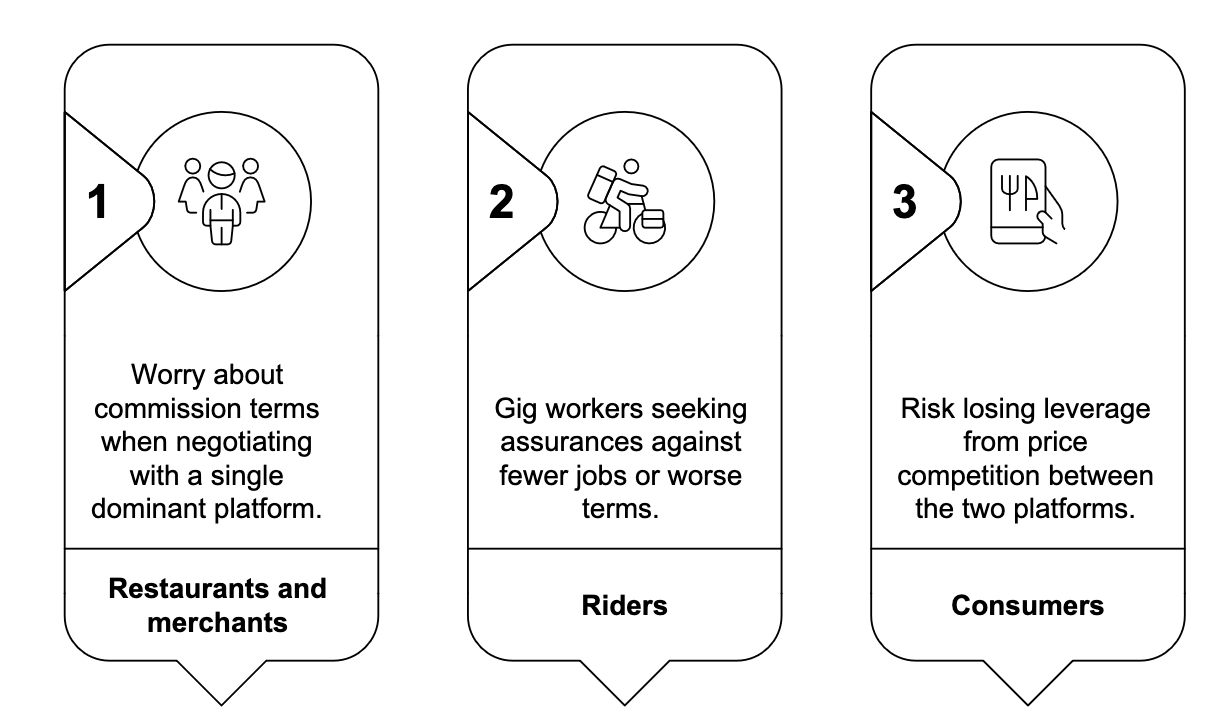
Three groups will be watching the CAK’s review closely. Restaurants and merchants are concerned about commission rates as they may have to negotiate with one dominant platform instead of two competing ones.
Riders, many of whom work in the gig economy without formal employment protections, want assurances that the merger will not lead to fewer jobs or poorer working conditions.
Consumers, who have benefited from competition between Glovo and Uber Eats, could also lose out if the combined company no longer faces strong competition.
The deal is expected to close in the second half of 2027, giving Kenyan regulators, businesses, and riders who depend on the market more than a year to review the merger before it is finalized.