





X (Twitter) has spent much of 2026 trying to deal with a problem that has grown rapidly over the past year. Popular posts are increasingly filled with replies written by software pretending to be people.
Some of these accounts are built to gain followers or qualify for payments. Others are part of schemes that reward accounts for posting under popular conversations. Their replies often look harmless, with polished, agreeable comments that say very little.
X’s response has included account purges, AI labels, and new detection tools. However, the results have been mixed, and genuine users are getting caught in the process.
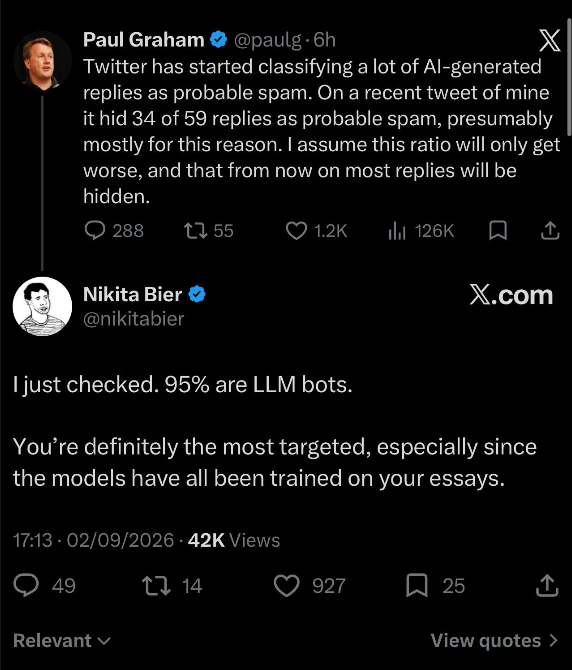
The problem became clear when Paul Graham, the Y Combinator co-founder whose essays are widely read and used to train AI models, noticed that X had hidden 34 of the 59 replies to one of his posts as possible spam.
Nikita Bier, X’s former Head of Product, looked into the case and said 95% of those replies were from language-model bots. He suggested Graham was an easy target because AI systems can reproduce his writing style particularly well.
That exchange reflects a much bigger fight X has been having throughout the year.
In July, Bier said X had removed 42,000 accounts that were using chatbots to automate replies. Most were focused on growing their audiences rather than pushing political messages.
X also says it has removed more than 1.7 million bot accounts since January.
The problem became especially visible in Crypto Twitter, where accounts posted generic replies to popular posts in an effort to earn token rewards. That activity dropped sharply after the July purge.
Cookie DAO’s token suffered heavy losses, and the platform shut down, while Kaito moved away from its token model and towards traditional influencer marketing.
X has also introduced other measures.
In February, Bier announced labels for AI-generated content and new detection tools. Automated accounts would also have to identify themselves. X has tested warnings that appear before users share content that appears to have been generated by AI.
The company has also reportedly considered using AI to help Community Notes identify and fact-check claims more quickly.
That creates an awkward situation for X. The platform is trying to limit unwanted AI-generated content while at the same time promoting Grok as a tool that can help users write posts.
The bigger challenge, however, is telling the difference between a bot and a real person.
X cut much of its human moderation operation after Elon Musk took over the company. That has left automated systems and Community Notes to deal with a huge amount of content.
The problem is that writing that looks suspicious to an automated system can also be perfectly normal human writing. Polished language, careful wording, and a consistent tone are not proof that a bot wrote something.
X has not published a false-positive rate for its detection systems. That means there is no clear picture of how many genuine users are being hidden or flagged alongside the bots.
Bier has acknowledged how difficult the problem is, with multiple efforts underway to reduce it but no simple solution.
| X’s action | What it does | When |
| Bot account purges | Removes accounts using automated replies to gain followers, engagement or rewards. | Throughout 2026 |
| 42,000-account removal | Removed accounts found using chatbots to automate replies, according to X. | July 2026 |
| 1.7 million bot accounts removed | X says it has taken down more than 1.7 million bot accounts since January. | 2026 |
| AI-generated content labels | Labels content identified as being generated by AI, helping users distinguish it from human-written posts. | February 2026 |
| Automated-account labels | Requires accounts using automation to identify themselves. | February 2026 |
| AI content detection | Uses automated systems to identify posts and replies that appear to have been generated by AI. | 2026 |
| Pre-share warnings | Tests warnings that alert users when content they are about to post appears to have been generated by AI. | 2026 |
| AI-assisted Community Notes | X has reportedly considered using AI to help speed up fact-checking through Community Notes. | 2026 |
| Spam filtering | Hides replies that its systems identify as probable spam, including some replies generated by bots. | 2026 |
For everyone else on X, from brands and political commentators to everyday users and tech writers, that creates a different kind of problem.
The better you write, the more carefully you phrase something, the easier it may become for an automated system to mistake you for the very thing X is trying to remove.