





Murang’a Governor Irungu Kang’ata has accused the national government of switching off AfyaKE, the digital system running the county’s public hospitals.
The county dates the start of the switch-off to Tuesday, October 13, and the governor went public the next day.
“National Government has now switched off this system and forced Murang’a to join the SHA New System.”
Kang’ata adds that Health CS Aden Duale promised in his presence that AfyaKE would be linked to the Social Health Authority (SHA) platform instead of being shut down, a promise he says was never kept.
The county has now begun moving facilities onto the national Taifa Care platform, expecting two to three days of disruption and hoping to be back to normal by Monday, October 19.
The Ministry of Health replied in a statement, which claimed:
“[Ministry of Health] neither owns, controls, nor manages the system, nor does it have the source code.”
It calls AfyaKE a private arrangement between the county and its developers and denies that the Digital Health Agency (DHA) refused to certify it, saying neither the county nor the developers ever applied.
It also asked the governor to stop making misleading statements, while promising that SHA patients in Murang’a will keep getting care.
How AfyaKE System Became Important to Murang’a County
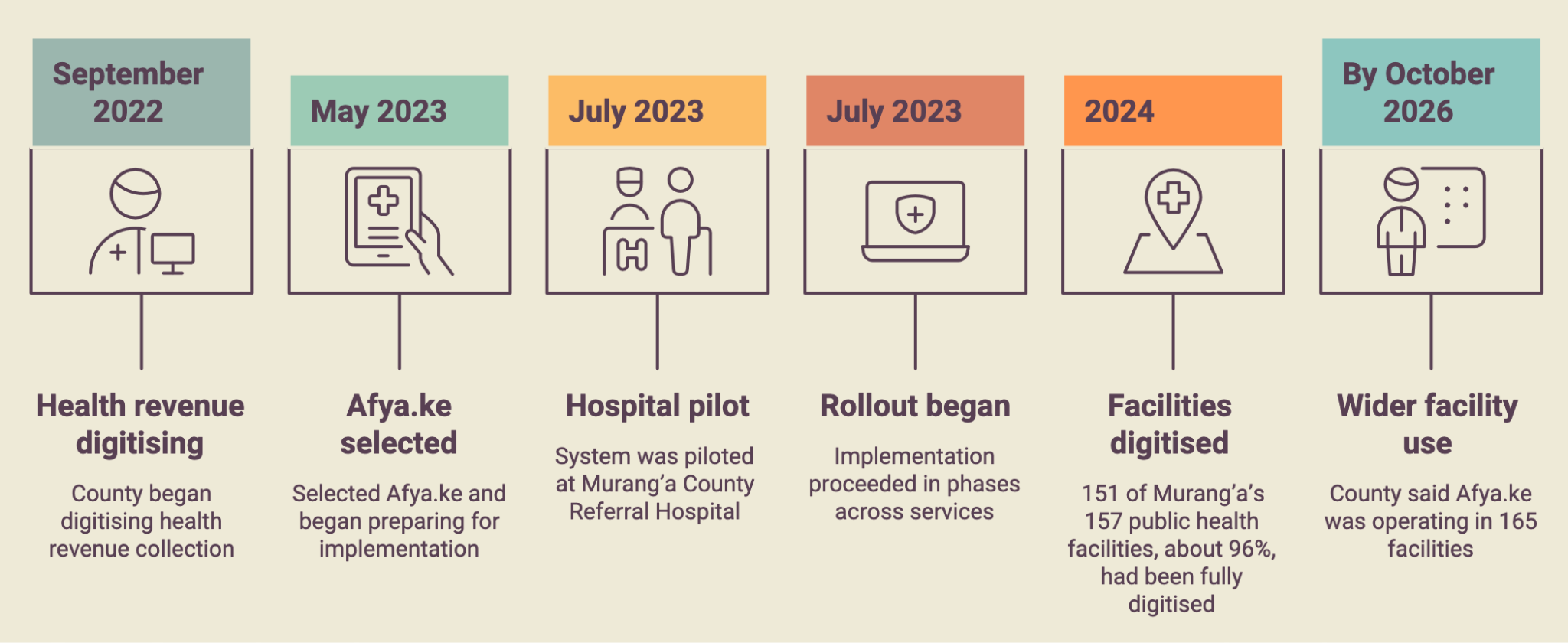
AfyaKE managed patient registration, medical records, laboratory services, pharmacy operations, patient tracking and referrals. The county also used it for billing and telemedicine, meaning a single outage could disrupt almost every hospital department at once.
A 2024 case study by the Council of Governors and Maarifa Centre counted 151 fully digitized facilities. The county now says the system was operational in 165 facilities, possibly reflecting an expansion since the study.
The county says the system lifted annual health revenue from KES 80 million to KES 800 million, and that the money paid for new buildings at Murang’a Level 5, Kirwara and Nyakianga hospitals, and for steadier medicine supplies.
No audited accounts back the figure, and the case study credited better revenue processes while reporting daily collection numbers that do not line up with the annual comparison.
Why the Government Wants Hospitals on a National System
On October 2, Duale said hospitals were being moved off the SHA Provider Portal as a separate claims channel and onto their own hospital management systems, which would talk directly to SHA.
Staff would stop entering the same details twice, and claims would come from recorded patient visits, making treatment easier to verify and suspicious billing easier to spot.
Properly connected systems could also let health workers see relevant patient information across facilities, provided the data is shared securely and with authorization.
The DHA sets the standards and runs the secure exchange, and under the 2025 data exchange regulations, it cannot connect a system to that exchange without certification, which requires a compliance certificate, a data protection impact assessment, and developer details.
None of this forces a county to abandon its software, since a system that meets the standards could keep running while exchanging data with national platforms.

Where the Evidence Stands
So far no published server log, hosting record, or written notice showing who disabled the platform has been produced, so the county’s accusation and the Ministry’s denial are both unproven.
The reports support only that AfyaKE became unavailable and that Murang’a is migrating to the national system.
The county says patient data built up since 2023 will remain inaccessible, which describes a loss of access and not a deletion, and nothing reported so far shows any records were destroyed.
Some Level 2 and Level 3 facilities have stopped offering services and cannot claim SHA refunds as reported by Eastleigh Voice, though no list of affected facilities has been published.
The Software and Certification Dispute
The case study describes AfyaKE as a Ministry of Health model offered free to willing counties, and the county says its developers later improved it.
A platform with national origins, local modifications, and possibly separate hosting can have several overlapping owners, and the answers to who holds the code, where the databases sit, and who controls the logins are in contracts that have not been made public.
That is how both sides can be partly right, since the Ministry can say it never owned the county’s copy while still having set national rules that left it with nothing to connect to.
The certification claim should be simple to settle, because an application either exists, with a date and a reply, or it does not. If it does not, the county’s claim that certification was refused falls apart, and if it does, the Ministry’s statement does.
The debate has conflated two separate issues. Losing access to the national health data exchange or SHA claims system does not mean AfyaKE itself goes offline. The regulations on suspension cover access to the national exchange, not the shutdown of a county’s own system.
If Murang’a lost access because hosting, logins, or connections changed during the move to Taifa Care, the cause and the responsible party would look very different from a case where a national agency blocked a data link.
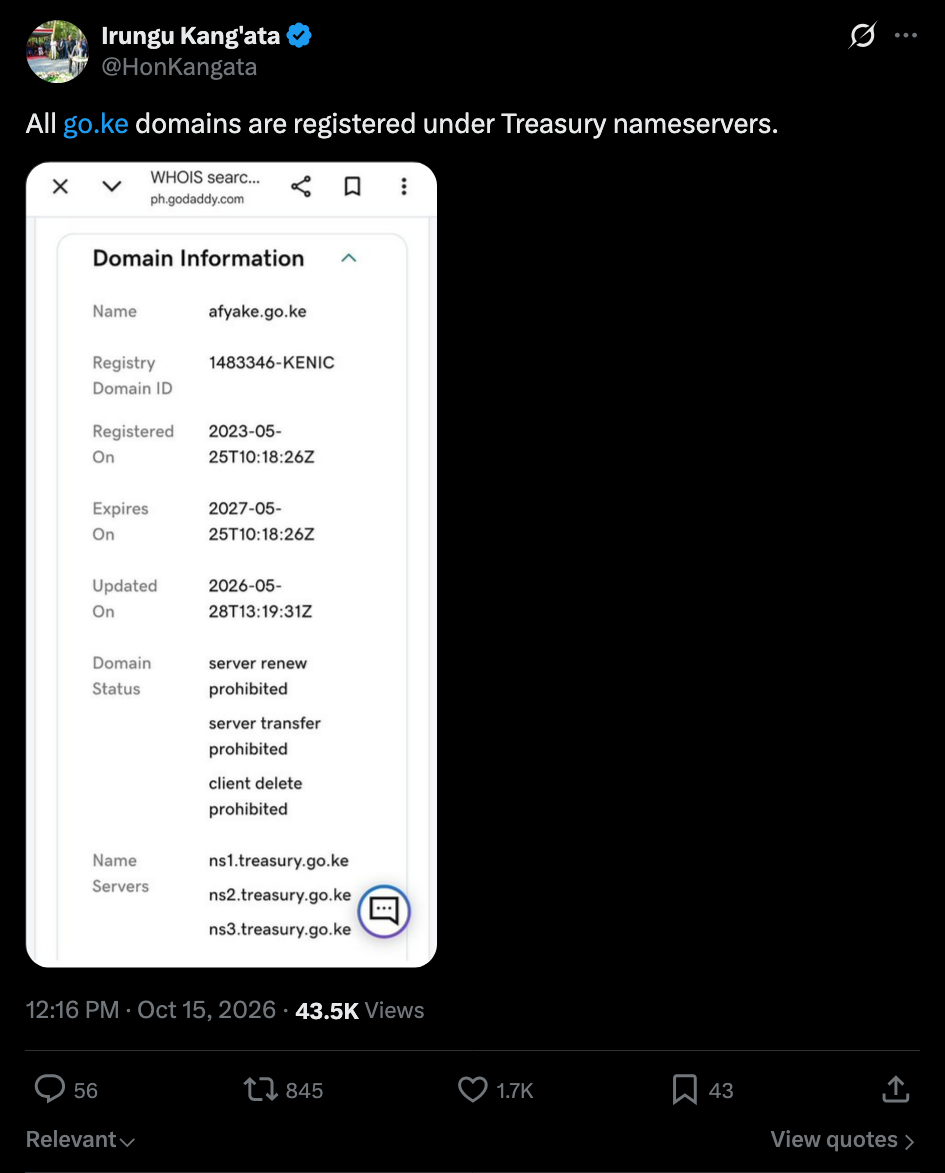
Kang’ata has since pointed to a third route, posting a domain lookup that he says shows all go.ke addresses, including afyake.go.ke, run on Treasury nameservers.
Whoever controls nameservers can make an address stop working without touching the software or records behind it, but the lookup was last updated on May 28, 2026 and does not show that anyone changed it on October 13.
Patient Records, Unpublished Costs and an Unsettled Law
The major risk for patients is the records. The Data Protection Act treats health data as sensitive, and the 2025 health information regulations require a controller whose data access is discontinued to hand over a copy, tell the people affected, and notify the Agency within seven days.
Whether any of that has happened in Murang’a is not known, and a locked system, a failed login, a broken connection, and a wiped database each may need a different fix.
Kang’ata also says AfyaKE was free while the replacement is not, so counties and national institutions will now pay to use it, though no tariff or contract for the new platform has been published to test the claim.
The legal ground is unsettled too, since the High Court found the Digital Health Act unconstitutional in 2024 over public participation before the Court of Appeal stayed that order. Anyone acting under the Act needs to check where the case stands.
| Issue | County Position (Kang’ata) | Ministry of Health Position | Current Evidence / Reality |
| System Outage | The national government switched off AfyaKE on Oct 13 to force adoption of Taifa Care. | MoH does not own, manage, host, or hold source code for AfyaKE. | Unproven: Neither party has published server logs, IP blocklists, or hosting termination notices. |
| DHA Certification | DHA deliberately blocked certification despite Duale’s integration pledge. | Neither the county nor developers ever formally applied for DHA certification. | Verifiable via records: An application paper trail either exists in the DHA portal or it does not. |
| Software Cost | AfyaKE was free to run; the new national system will charge licensing/tariffs. | Promoted as a standardized, fraud-resistant national infrastructure under SHA. | Unpublished: No official fee tariff or vendor contract for Taifa Care has been released. |
| Patient Records | 3 years of digital patient data since 2023 is locked / inaccessible. | Ensures continuity of patient care under SHA. | High Risk: Data Protection Act requires 7-day notification and data handover on termination. |
What’s Next
Murang’a wants to retain access to its existing health system and patient records, while the national government wants certified systems that can connect to SHA.
Both objectives are valid, and the challenge is to achieve national integration without disrupting existing services or losing access to patient data.
What is missing is a technical account covering when access failed, who controlled the servers, whether the records are intact, and which facilities were affected.
Until the county, the Ministry and the DHA publish one, the dispute will keep playing out in press statements, with patients and health workers in Murang’a carrying the risk.