




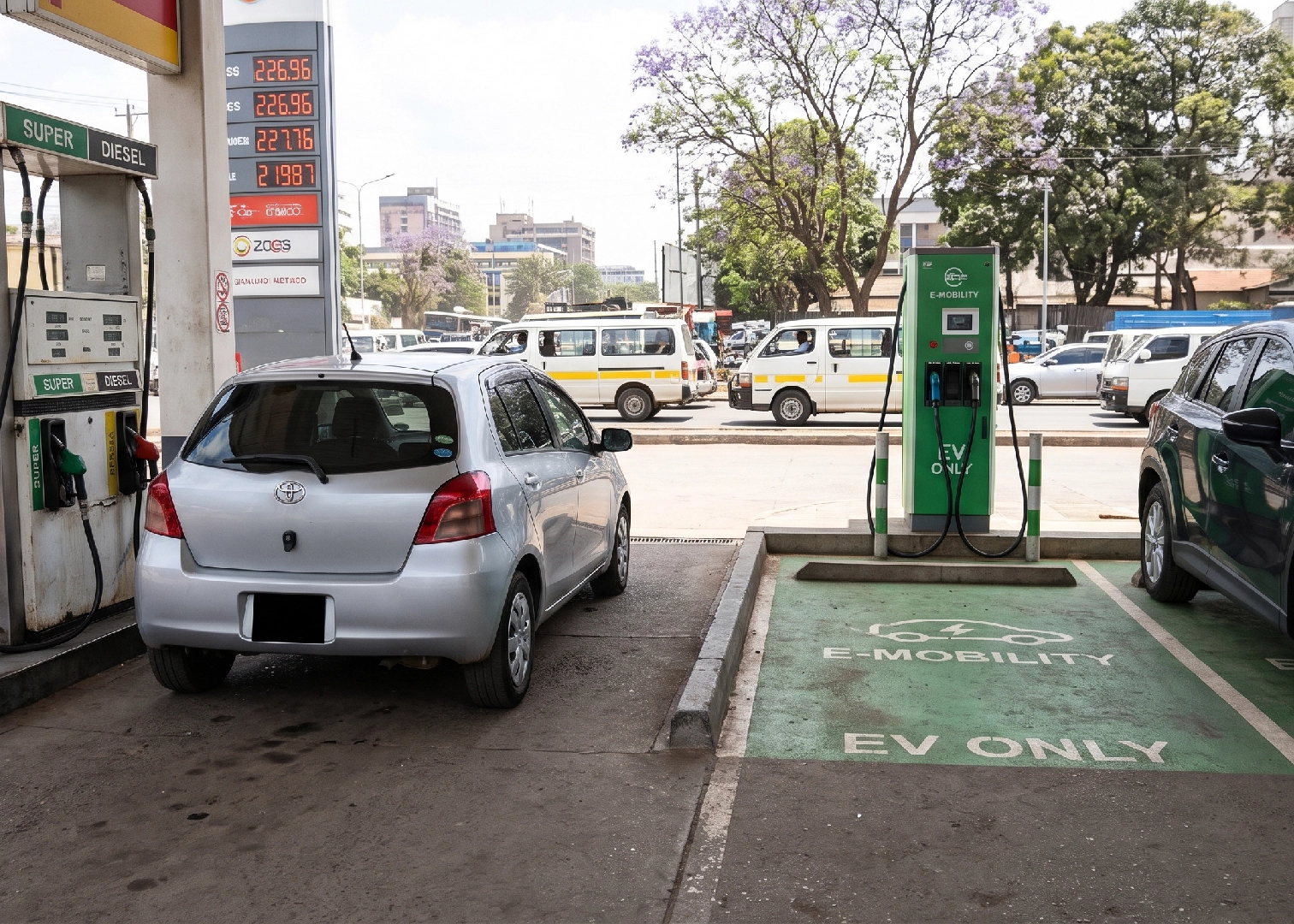
Nairobi drivers filling up since 15 October are paying as much as KES 226.96 for a liter of petrol and KES 227.76 for diesel, roughly 13% and 22% more than a year ago. Researchers and policy advisers said that Kenya’s car purchases, not just fuel, are part of the solution.
Vehicle efficiency regulations were thus highlighted during the “Kenya’s Cars, Fuel Costs & the Future of Mobility” session, focusing on what would require manufacturers and importers to steadily raise the average fuel efficiency of the vehicles they sell.
Presenters from GIZ Kenya, the University of California, Davis, and the Africa E-Mobility Alliance linked the discussion to rising global oil prices, with Brent crude averaging about $95.34 (KES 12,394) per barrel, or KES 78 per litre, in 2026, up from approximately $69.14 (KES 8,988) per barrel, or KES 56.50 per litre, in 2025, before refining and other costs.
Kenya feels that shock sharply because it imports all its refined petroleum and transport burns about 75% of it, which helped drive a KES 372 billion import bill in 2025. Without intervention, light vehicles alone are projected to push fuel import spending from $783 million in 2025 to USD 1.32 billion (about KES 171 billion) by 2040.
A key feature of the proposed regulation is that it would assess the average fuel efficiency of vehicles an importer or manufacturer brings to market, rather than require every model to meet the same target.
This would allow importers to improve their overall fleet average by offering more efficient petrol and diesel cars alongside hybrids and Electric Vehicles (EVs). The proposal would not ban petrol or diesel vehicles or force motorists to replace cars they already own. It would apply to vehicles entering the market, including second-hand imports.
This is particularly relevant in Kenya, where more than 80% of imported vehicles reportedly come from Japan. Speakers argued that cars imported into Kenya are often less fuel-efficient than comparable models sold in their countries of origin. Markets such as New Zealand apply their own efficiency requirements, influencing the vehicles available to buyers. Kenya could use similar rules to encourage importers to source more efficient models.
READ: EPRA Removes Monthly Power Limit for EV Charging Stations
Chile provided one example of how importers can respond. Within 18 months of introducing its standards, 88% of importers had adjusted their supply. The figures presented also showed EV prices falling by 17%, while importers gained access to three times as many electric models. Similar regulations have been adopted in 13 jurisdictions covering about 85% of the global light-duty vehicle market.
The policy could also support local vehicle assembly. Kenya’s assembly plants are operating at less than 30% of their combined installed capacity of 46,000 vehicles annually. Supporters argue that predictable standards could give investors greater confidence to expand production. Meanwhile, EV registrations rose from 5,294 in 2024 to 24,754 in 2025.
The transition also raises questions about road maintenance funding as motorists gradually shift away from petrol and diesel. Asked about the future of the Road Maintenance Levy, speakers suggested alternatives such as distance-based charges, tolls, and electricity-related taxes. However, they expect fuel revenue to remain steady in the near term as Kenya’s vehicle fleet grows.
The discussion did not establish when the proposed regulation could be adopted. Its impact will depend on the final efficiency targets, implementation timelines, and whether more efficient vehicles remain affordable to Kenyan buyers.