





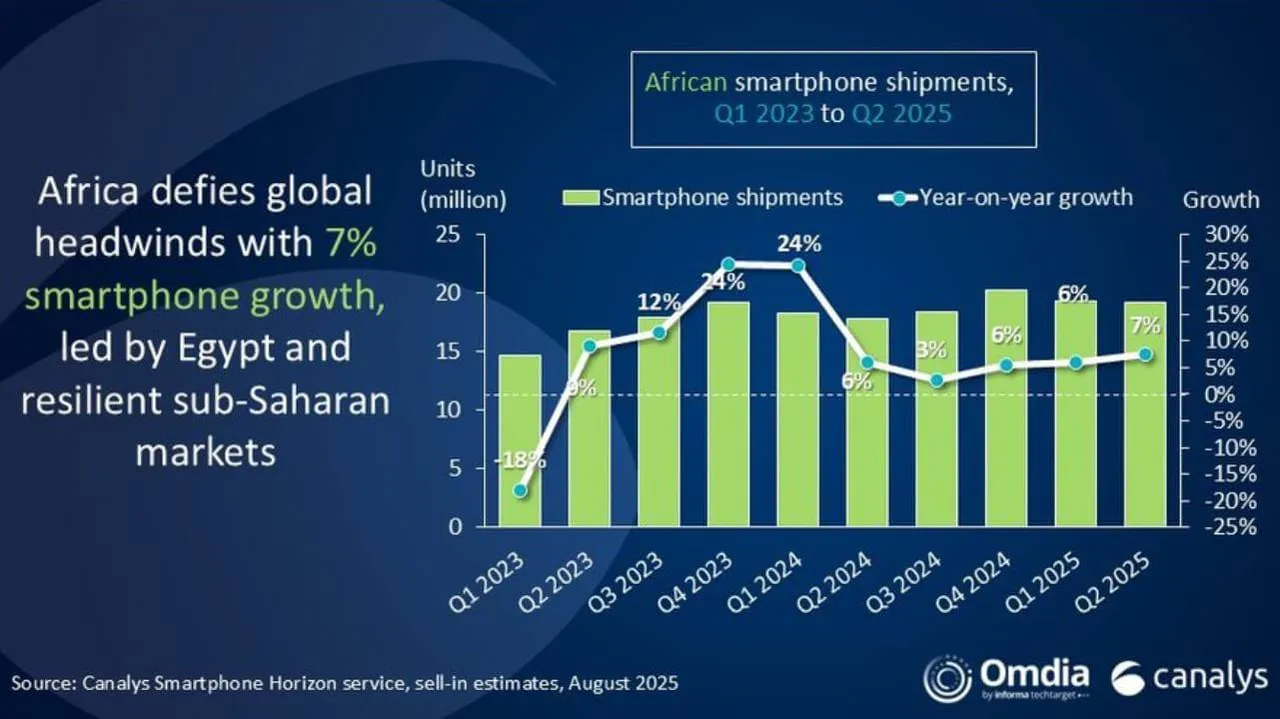
Africa’s smartphone market has seen steady recorded growth for nine straight quarters, with a 7% year-on-year (YoY) smartphone shipment growth in the second quarter of 2025.
According to data released by Canalys, Africa recorded 19.2 million shipped units in Q2 2025, making it one of the best-performing regions in the world. The growth was associated with easing inflation in key markets like Nigeria, Egypt and South Africa.
The report goes on to project a sustained annual growth rate of 2.1% for the next four years, with numbers expected to outpace the subdued global smartphone market.
The North African market was led by Egypt, which saw a 21% growth in smartphone shipments with vendors leveraging the accelerated local manufacturing capacity this year to meet the heavy demand during the Eid promotion season.
Meanwhile, Nigeria’s easing inflation and a more stable Naira saw the market get a 10% rise, while South Africa grew 2% YoY as 5G smartphone shipments rose by 63%.
Read: Smartphone Market Recovers Slightly in Q1 2025 With Apple, Vivo Leading Gains
“The expansion was driven by the broader adoption of financing options, increasing 5G penetration and strategic partnerships with operators, which have become critical for vendors seeking growth,” Canalys said in a statement.
Unfortunately, Kenya was one of the few markets that saw a struggle during the same period, with a 2% decline in smartphone shipments. Algeria and Morocco also experienced a plunge of 27% and 7% respectively.
This drop in the three markets is linked to weak smartphone demand as well as tighter import restrictions.
“Overall, Africa’s growth remains anchored by its largest economies, even as smaller markets face structural pressures,” Canalys explained.
“Africa’s rural markets are emerging as the next major battleground, where limited access to traditional banking is driving demand for mobile money, fintech and digital services,” said Manish Pravinkumar, principal analyst at Canalys.
“Yet, smartphones have only just surpassed half of total connections, with feature phones deeply entrenched in low-income communities,” he added.
When it comes to brands, Chinese company Transsion, which owns TECNO and Infinix, kept its place on top of the market with 6% YoY growth. However, the rising value chain proved to be a challenge for the firm, despite TECNO’s brand strength in the mid-range price segment.
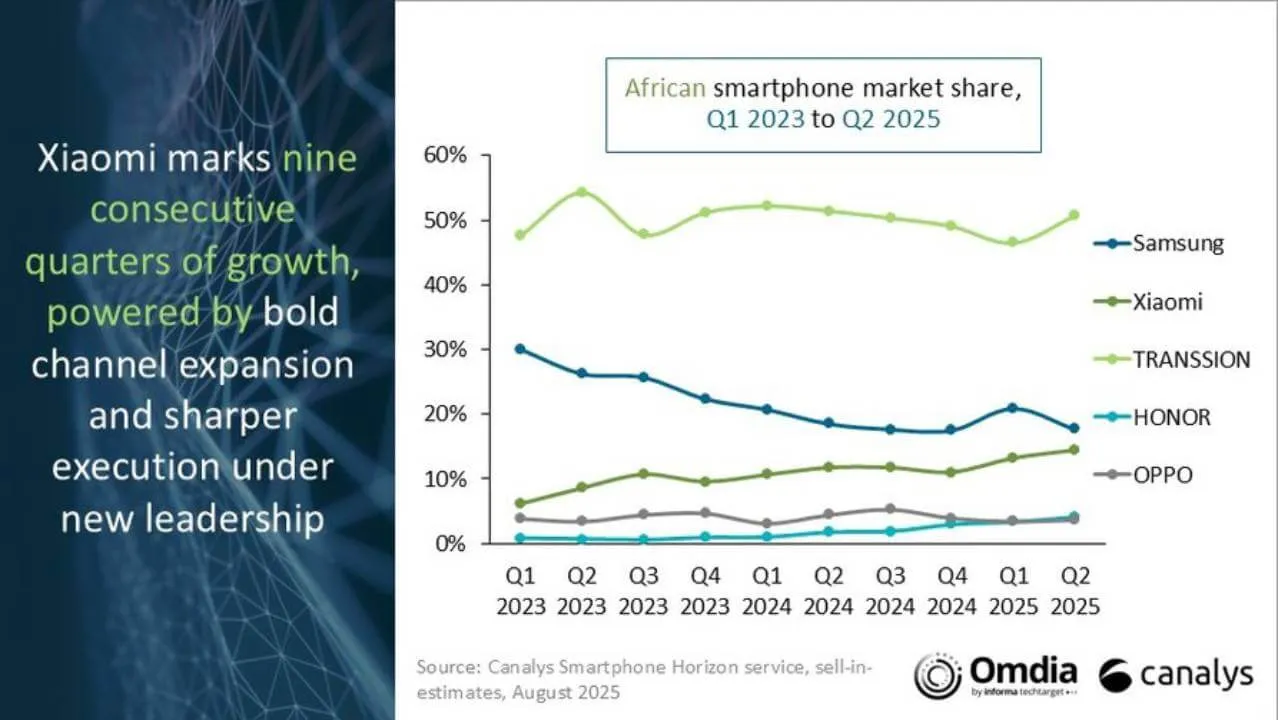
Samsung saw a 3% rise in market share with a growth in each of Egypt and Nigeria through localized distribution and retail expansion.
Xiaomi saw the biggest gain at a 32% rate to secure third place with a 14% market share, linked with strong gains in the two mentioned markets as well.
In contrast, Oppo saw an 11% drop in its market share as the company still looks to restructure and double down on Egypt and beyond.