Introduction
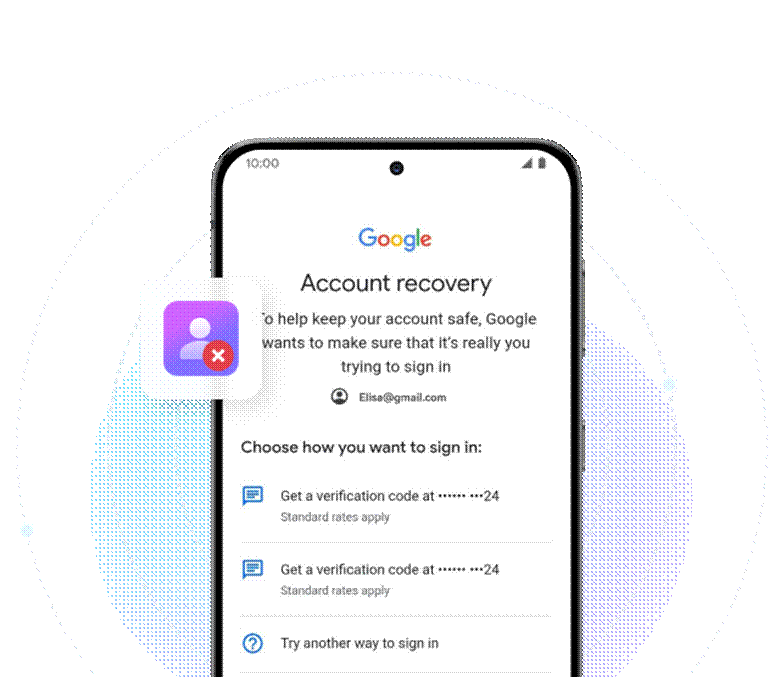
Factory Reset Protection (FRP) is a vital anti-theft measure, yet it regularly irritates genuine buyers of used phones and repair shops. The main problem lies in a “cat-and-mouse game”: smartphone manufacturers and Google continuously fix the flaws in FRP, while the exploit developers find ways to get around them.
This continuing cycle has moved the methods of bypassing FRP from mere software bugs to highly complicated hardware modifications, thereby leading to both security risks and the need for recovery tools such as Dr.Fone and Screen Unlock (Android).
In this article, we look at how OEMs keep patching FRP loopholes, invasive bypass techniques, and legitimate recovery tools.
The Evolution of the Exploit: From Glitches to Gaps
- Early days (Android 5.0, 7.0): FRP initially came as a measure to stop unauthorized factory resets, but the first releases had standalone flaws. A lot of these hacks utilized the emergency dialer; the accessibility menu opened in unexpected ways.
- The rise of “click-through” methods (Android 8.0, 10.0): So, as FRP was getting better, the bypasses were done through UI-based tricks with TalkBack, Google Assistant, and QR code scanners. Such loopholes are not really about the Android system itself; they just misuse the users’ setup interface flows.
- Modern era (Android 11, 16): The newest Android editions have strengthened their security measures, not only securing the setup wizard flows but also limiting intent launching.
How OEMs Respond: The Patching Cycle
Monthly security patches:
Android Security Bulletins regularly patch newly discovered FRP bypass methods, which are often not even mentioned publicly. This can explain why a bypass that was working on a Samsung Galaxy S23 in January may be totally impossible after the February update, the updates silently close the loopholes that the exploit methods are based on.
OEM-specific hardening:
- Samsung: Knox security keeps a watch on any unauthorized attempts to get access to recovery mode, download mode, or developer options.
- Google Pixel: The OS is checked by the Tensor chips and Titan M2 security chips at boot-up to stop unauthorized changes.
- Xiaomi/OnePlus: Depending on the region, FRP enforcement may be stricter in the EU than in other markets.
The Arms Race: Hardware-Level Bypasses
A. The shift to physical access:
- Software patches are closing FRP loopholes more rapidly, and as a result, most of the bypass attempts have been shifted to hardware.
- Currently, the technicians can bypass FRP by directly rewriting the phone’s memory using ISP (In‑System Programming) pins, EMMC/UFSA programmers, or chip-level flashing.
- The software patches are closing FRP loopholes faster and as a result, most of the bypass attempts have been shifted to hardware.
- Currently, the technicians can bypass FRP by directly rewriting the phone’s memory via ISP (In‑System Programming) pins, EMMC/UFSA programmers, or chip-level flashing.
B. The limitations of hardware hacks:
- These physical approaches are also becoming less trustworthy as the Android 13+ introduces secure boot chains, verified boots, and encrypted user data partitions.
- Nowadays, Samsung, Pixel, and Xiaomi leading-edge devices utilize hardware-backed security that completely prevents unauthorized flashing of partitions.
C. The role of trusted tools:
- Generally, technicians prefer safe software tools more as hardware hacks are unsafe, complicated, and often not working on the new devices.
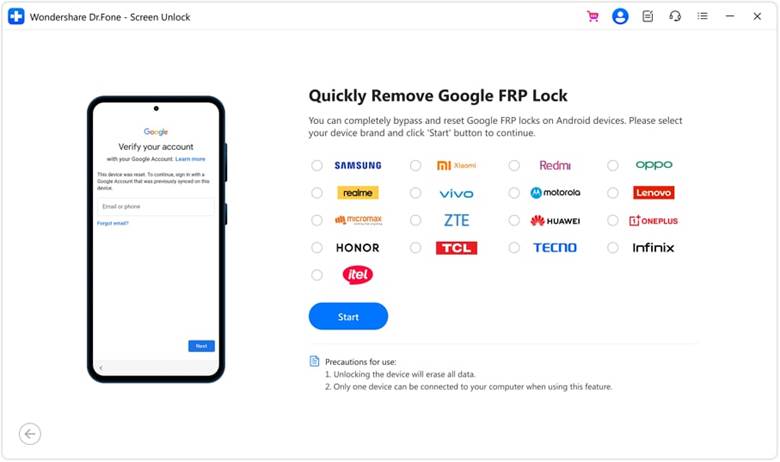
- Dr.Fone – Screen Unlock (Android)provides a secure and friendly way of use as an alternative, it supports FRP bypass up to Android 16, 100% successful FRP removal on Samsung Snapdragon/MTK devices, and one-click unlocking without technical skills.
- Supporting 30+ brands and 2, 000+ models, thus it offers reliability that the risky hardware alternatives simply cannot match.
Case Study: The Samsung Ecosystem
A. Why Samsung is the main battleground:
Samsung leads the global Android market and implements some of the strictest FRP policies on the market, sometimes even re-locking devices after an OTA update or simply after a minor change of the firmware. So, it is little wonder that Samsung is not only the most targeted but also the most defended OEM in the FRP field.
B. Fragmentation as a defense:
Samsung’s ecosystem consists of many different chipsets (Exynos, Snapdragon, MediaTek), regional firmware builds, and changing One UI versions. This diversification has become an unintentional security feature. It means that those who develop bypass methods must create specific devices or region means instead of universal exploits.
Solutions for a fragmented landscape:
Given this intricate scenario, the success of FRP removal lies in model-congruent guidance. For instance, the FRP Bypass Google Account guide contains precise directions addressing various Samsung versions, thus aiding users and technicians to go through the brand’s highly segmented structure.
The Future of FRP: AI, Biometrics, and Server-Side Control
A. Migrating to the cloud:
FRP will probably evolve into a fully server‑side verification system just like Apple’s Activation Lock, in which the ownership verification is done only through the OEM servers, making it nearly impossible to exploit locally.
B. AI-assisted detection:
The next versions of Android may incorporate behavioral AI to recognize unusual activities during the setup phase such as abnormal emergency dialer commands, repeated accessibility triggers, or weird intent calls and deactivate the activation process automatically.
C. Biometrics:
FRP unlocks might be linked to a biometric security measure that is securely stored in a secure element (e.g., fingerprint or facial recognition tied to the device’s hardware root of trust), making ownership verification reliant on physical presence, not just passwords.
Conclusion
The struggle around FRP keeps continuing in the form of a cat-and-mouse game. The manufacturers are always fixing the loopholes, yet the bypass methods are gradually changing from mere software errors to quite tricky hardware tricks. Samsung, Google and other manufacturers use fragmentation, secure boot and hardware-backed security as means to keep one step ahead, on the other hand, safe software like Dr.Fone, Screen Unlock (Android) offer dependable recovery solutions for both users and technicians. Looking forward, AI, biometrics, and server-side controls are set to make FRP more robust than ever, ensuring device security.