





Every 4 years, the world’s most sophisticated forecasting machines turn their attention to a football tournament. For the 2026 FIFA World Cup, five distinct prediction frameworks have published their verdicts, each arriving at their conclusions through fundamentally different means.
Before AI models, there was Paul the octopus, who correctly predicted all 7 of Germany’s matches at the 2010 World Cup, including Spain as the tournament winner. The unlikely predictor became the gold standard for World Cup forecasting.
Now, Goldman Sachs runs a numbers model that looks at squad strength, recent form, and past tournament records to score each team, then plays out the bracket to see who comes out on top.
Opta’s supercomputer simply runs the whole 48-team tournament 25,000 times and counts how often each team wins. EA Sports uses the player ratings in its game engine to simulate matches and has correctly called the last three FIFA World Cup winners that way.
Joachim Klement, a German economist, stands out by completely disregarding football statistics and instead relying on demographic and economic data to make his predictions, a method that has also yielded three consecutive correct winners.
Opta Supercomputer: Win Probability Across 25,000 Simulations
The Opta model ran the tournament 25,000 times, and Spain emerged as the 2026 World Cup winner in 16.1% of those runs, which was the highest figure for any team. France (13.0%), England (11.2%), and Argentina (10.4%) were the nearest challengers.
| Team | Win Probability % | Win Odds |
| Spain | 16.1% | Top favourite |
| France | 13.0% | Top favourite |
| England | 11.2% | Strong challenger |
| Argentina | 10.4% | Strong challenger |
| Brazil | 6.6% | Contender |
| Germany | 5.1% | Contender |
| Netherlands | 4.8% | Contender |
| Portugal | 4.5% | Contender |
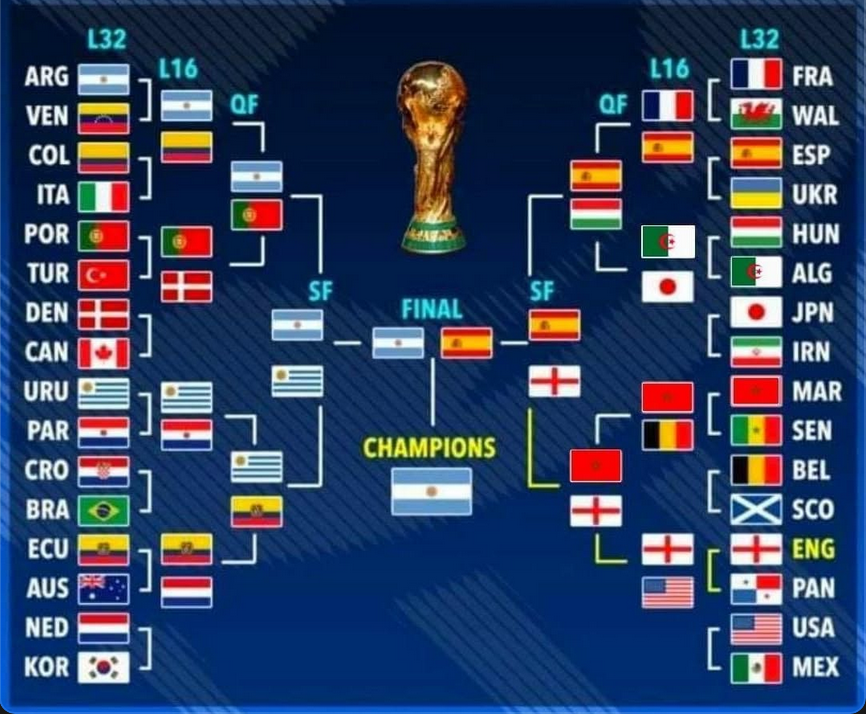
Goldman Sachs’ Predicted Path to the Final
Goldman Sachs ranks each team using a relative strength index based on squad quality, recent results, and past tournament performance.
The number beside each team is not a probability or betting odds. It is a combined score showing how strong the team is expected to be at that point in the tournament, with higher scores indicating stronger predicted performance.
Argentina’s 1.59 in the semi-final is actually the highest single score in the entire bracket, meaning the model considers them the strongest team at that stage of the competition.
Spain wins not because they are rated the most dominant team in every game but because they are consistently strong enough across multiple rounds. It is the tournament survival logic that matters here, not peak performance in a single match.
| SEMI-FINALS | FINAL | 3RD PLACE | SEMI-FINALS |
| France Score: 1.25 | WINNER 🏆 SPAIN | France: 3rd Place | Brazil Score: 1.53 |
| Spain Score: 1.49 | RUNNER-UP: Argentina | Brazil: 4th Place | Argentina Score: 1.59 |
Implied Win Probabilities from Live Odds
Live betting markets have also consistently positioned Spain as the favorite, with France as a close co-favorite on some books.
| Team | Implied Probability | Approx. Odds | Category |
| Spain | 17.5% | +450 to +480 | Top favourite |
| France | 15.0% | +500 | Top favourite |
| England | 12.5% | +650 | Strong challenger |
| Argentina | 11.0% | +750 | Strong challenger |
| Brazil | 9.0% | +950 | Contender |
| Germany | 7.0% | +1200 | Contender |
| Netherlands | 5.5% | +1600 | Contender |
| Portugal | 5.0% | +1800 | Contender |
Where the Predictions Align and Where They Diverge
The models and the data all seem to be reading from the same page heading into this tournament with Spain sitting at the top of nearly every major prediction for the 2026 World Cup.
The only voice bucking the trend is economist Joachim Klement, who has called the last three World Cups correctly and sees the Netherlands going all the way.
Whether the consensus proves right or one contrarian streak continues is exactly what makes this worth watching.
| Badge | Source | Winner Pick | Key Notes |
| CONSENSUS | Goldman Sachs | Spain | Full bracket model. Argentina runner-up, France third. |
| CONSENSUS | Opta (25k sims) | Spain | 16.1% win probability. France 13%, England 11.2%, Argentina 10.4%. |
| CONSENSUS | EA Sports | Spain | Game simulation model. Historically accurate on World Cup winners. |
| CONSENSUS | Betting Markets | Spain | +450 to +480 odds. Approx. 17-18% implied probability. |
| CONTRARIAN | Joachim Klement | Netherlands | 3 consecutive correct World Cup calls. Netherlands beat Spain in the semis, and Portugal in the final. |
Why Klement’s Netherlands Pick Matters
While many models favor Spain, Klement’s analysis points to a very different outcome, backed by a remarkable record of correctly calling the winners of the last three World Cups.
His prediction offers a credible alternative scenario and could be one of the tournament’s biggest talking points if it comes to pass.
| JOACHIM KLEMENT – PICK: NETHERLANDS | |
| Track Record | Three consecutive correct World Cup calls is a result no major quantitative model or analyst can match. The 2018, 2022, and 2023 (Women’s) picks were all correct. |
| The Key Game | Klement’s model eliminates Spain in the semi-finals. Every other major model places Spain in the final, making this a single, decisive point of divergence. |
| The Final | Netherlands vs Portugal. No other model seriously puts Portugal in the final. If Klement is right, this would be the biggest collective forecasting miss in recent World Cup history. |
| The Takeaway | Even if all other models are correct and Spain lift the trophy, Klement’s record demands this prediction be treated as the most credible alternative scenario, not a footnote. |
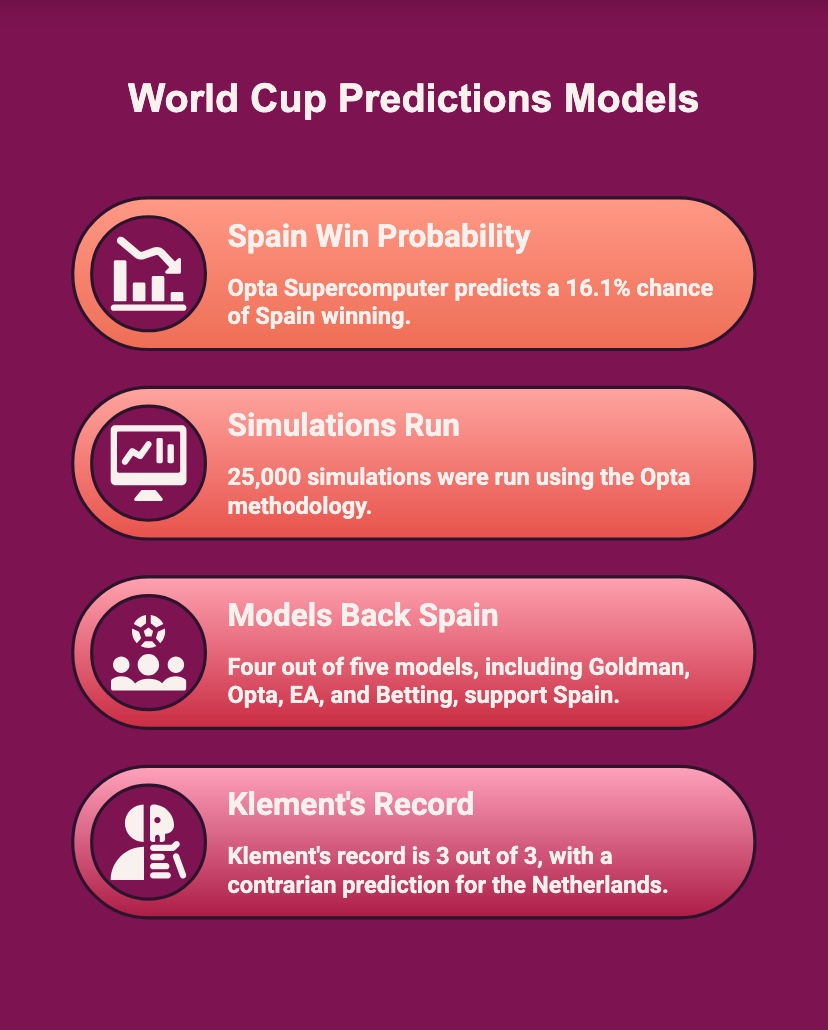
The predictive models are largely aligned in favor of Spain winning the 2026 World Cup, with four of the five leading forecasting systems backing them to lift the trophy. As a betting man it’s safer to wager for Spain for the safe bet but if you’re feeling risky or ‘lucky’, the Netherlands is the outlier pick.