




Kenya’s ICT regulator has published draft regulations that will have unused mobile phone numbers flagged for deactivation after 3 months.
According to the Communications Authority of Kenya (CA) draft guidelines, “Number deactivation and recycling shall be triggered when a number records no revenue-generating activity, such as making/receiving a call, sending/receiving an SMS, using data, topping up airtime, or using the number for value-added services, for a period of 3 months.”
The CA insists that mobile number recycling is important, as the resource is not infinite.
“Given the finite nature of the numbering resources, deactivation and recycling of inactive and unused numbers is one of the practices in numbering, naming, addressing, and identification (NNAI) management. Globally, regulators are supposed to ensure that assigned numbers are prudently used before additional assignments can be issued,” the CA writes.
Part of this regulatory overhaul was triggered by a High Court ruling earlier this year that declared phone numbers a constitutionally protected digital identity.
The ruling set out three conditions telecoms must meet before any number can be reassigned:
- Verifiable consent from the original owner where possible
- A documented verification process and public notice period where the owner cannot be reached
- Technical safeguards to stop a new SIM holder from receiving the previous owner’s messages, one-time passwords, or financial alerts
READ: Kenyan Court Rules Safaricom, DTB Must Pay Customer KES 4.4M After SIM Swap Fraud
Kenya’s attorney general was given six months to put protective measures in place, and the CA’s new guidelines take effect on September 19, 2026, almost as the court’s deadline lapses.
What the CA is Proposing on Mobile Number Deactivation
The CA’s regulations are drafted in the spirit of the court ruling and are set to be implemented in a multi-stage process rather than an abrupt cut-off.
Firstly, a number is flagged once it records no revenue-generating activity, no calls, texts, data use, airtime top-ups, or value-added service usage for three months.
READ: How to Top Up Airtel Airtime from M-Pesa without Charges
After the 3 months, service providers must then attempt to notify the subscriber using the contact details collected at registration, and the notification window runs for a further three months.
This brings the total inactivity period to roughly 6 months before the recycling process of a flagged-as-dormant mobile number can proceed.
In addition, 30 days before that window closes, providers must publish a list of numbers at risk of deactivation on their websites, in other media, and in a nationally circulated newspaper.
Telcos in the country will repeat the process quarterly. Every notice must include the USSD code *106#, which subscribers can dial to check whether their number is active, suspended, under recycling, or already deactivated.
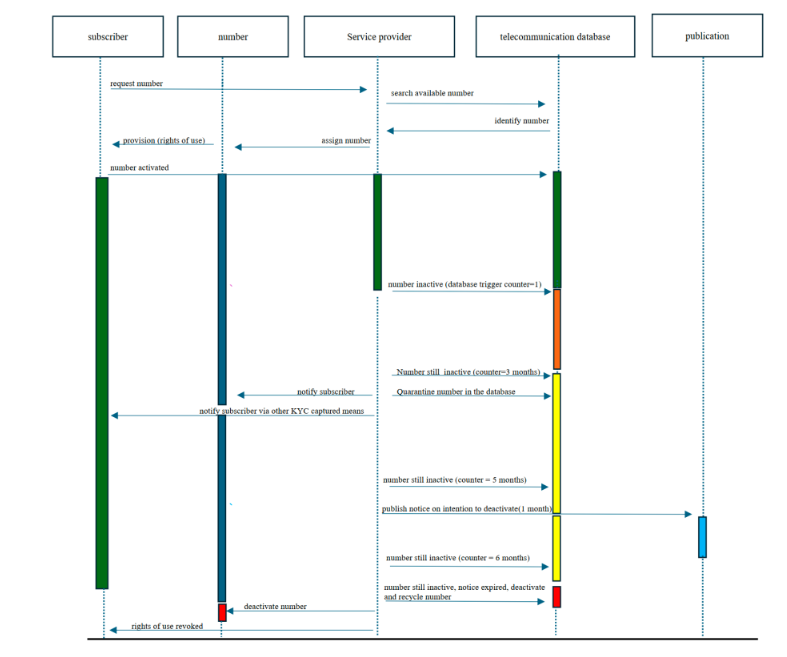
For data protection and privacy purposes, once the notice period lapses and the number is still dormant, Kenyan telcos must securely archive the previous owner’s personal data, cached data, and associated services so that none of it is accessible to or inherited by whoever receives the recycled number.
This is in line with what the court ruling had stated, “When mobile digital identity is lost through reallocation or recycling without interrogating the reasons behind the long period of non-use or inactivity, it creates an avenue for unauthorized disclosure of delicate information such as the person’s family or financial affairs to third parties.”
Cynthia C. Sigei, Data Protection and Privacy Manager at SBM Kenya, echoes these sentiments in her support for the proposed regulations.
She stated, “As mobile numbers increasingly serve not only as communication channels but also as digital identifiers linked to financial services, authentication, and customer onboarding (KYC), strengthening safeguards around number recycling is critical for protecting consumers and maintaining confidence in digital ecosystems.”
Mobile Number Deactivation for Prisoners and Indisposed Individuals
The guidelines respond to the court’s concern about incarcerated people. Under a new whitelisting mechanism, the Commissioner General of Prisons must, within three months of someone being jailed for more than six months (after appeals are exhausted), submit the convict’s number for whitelisting so it is protected from the deactivation process entirely.
The same protection extends to suspects denied bail who are likely to be on remand for more than six months.
Aside from prisoners, anyone, including a caregiver, can request that a subscriber’s number be whitelisted if that person is likely to be unable to use it for more than six months due to being indisposed, provided the request is made in person with original identification documents.
Such whitelisting lasts one year and is renewable, as long as the number remains inactive throughout.