




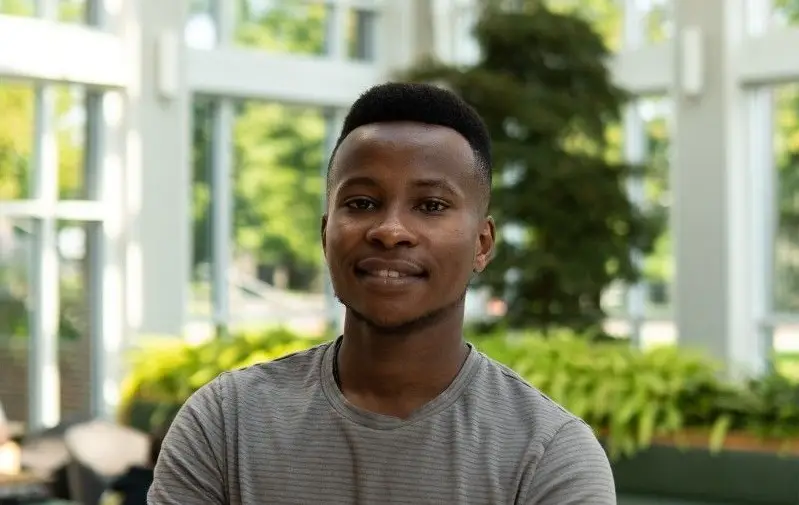
Gibson Njine spent about nineteen months building software to solve a problem most people just put up with: when a group eats together the bill gets split evenly, and whoever ordered least ends up paying for whoever ordered most.
He co-founded Celipa in late 2021, in his second year at Babson College in Massachusetts, with two classmates, Mpho Montsho and Emory Clark.
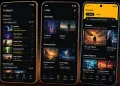
One diner photographed the receipt, while the others joined the same digital copy by scanning a QR code. They then selected what they had ordered, and the app calculated how much each person owed.
“We used Amazon’s document service to read the receipt. That part’s a solved problem and I wouldn’t claim otherwise,” Njine says.
“The difficulty is what comes after. You’ve got a list of items and a printed total and four people on four phones all claiming things at once. Two of them tap the same plate of fries within about a second of each other. And then, well, somebody has to decide what the app does about that. There isn’t an obvious answer.”
Celipa handled it with a real-time layer that kept the shared receipt consistent across every device viewing it, so a claim made on one phone showed up immediately on the others. Njine built it across the first half of 2022.
Splitting It Properly
Most bill-splitting software divides tax and tip equally among everyone. Celipa instead divided them based on what each person ordered. So, if your food made up 15% of the bill, you paid 15% of the tax and tip.
“It’s more work, which is probably why nobody does it,” Njine says. “You have to work out each person’s share of the subtotal before you can do anything else. But splitting the tax evenly is just wrong. It changes the answer for basically any table where people ordered different things.”
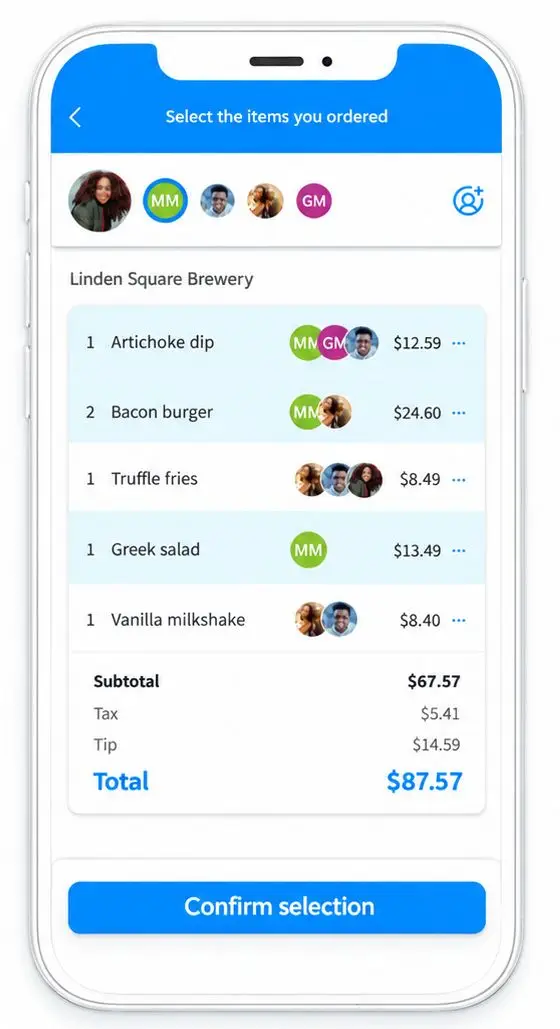
He shipped the feature in November 2022. Earlier that year, he had added quantity-aware claiming, which allowed a line item for three units of something to be divided based on how many units each person took, rather than simply splitting it by the number of people.
Njine worked on the backend, administrative dashboard and mobile app.
Apple approved Celipa for the App Store on September 29, 2022. Apple’s analytics show 617 first-time downloads. The conversion rate, which is the percentage of people who viewed the product page and then installed the app, averaged 54.67%.
The median conversion rate on the App Store is between 2-5%
Testing It on Students
The team’s first focus group was planned for early March 2023, but it was cancelled that morning because of snow. The session was rescheduled for Friday, March 24 at 2:30 PM in Horn Commons 101.
Participants were asked to bring two to four friends who had not used the app so the team could get feedback from new users. They were also told to bring an iPhone. Snacks would be provided.
But according to Njine, the sessions revealed that the main concerns were not really about the technology.
“People would say it’s easy, and then when you pushed them it turned out easy wasn’t the point. Splitting a bill is awkward and everyone pretends it isn’t. Somebody has to be the one who says, actually, I only had the soup, and nobody wants to be that person. So the table splits it evenly and a couple of people quietly pay for everyone else’s drinks.”
“What the app did was take that conversation away. You tap what you had, the math happens, nobody has to say anything out loud. I think that’s what people actually liked. I’m not sure most of them noticed the receipt scanning.”
Celipa received funding from Babson College’s Butler Launch Pad, part of the Arthur M. Blank Center for Entrepreneurship. The program selected Celipa for its seed fund in two consecutive cycles in 2022. The company also received cloud credits through Babson’s Launchpad program.
Zhi Li, a software development lecturer at Babson, taught Njine in his Web Technologies course in the autumn of 2022. Celipa was not a class assignment, and Li was not involved in building it. However, he questioned Njine extensively about how the system was designed and built.
Li later wrote that Njine was able to explain the architecture at different levels, from the data model to individual edge cases, without relying on a collaborator.
In Li’s experience, this is one of the strongest ways an instructor can determine whether a student is the author of a project. Li has taught more than 1,000 students over 12 years.
Njine graduated magna cum laude in December 2023. He now works as a software engineer at Microsoft in Redmond, Washington, where he focuses on back-end platforms and cloud infrastructure.