






Kenya’s telecommunications sector has posted strong financial results even as employment levels show signs of strain.
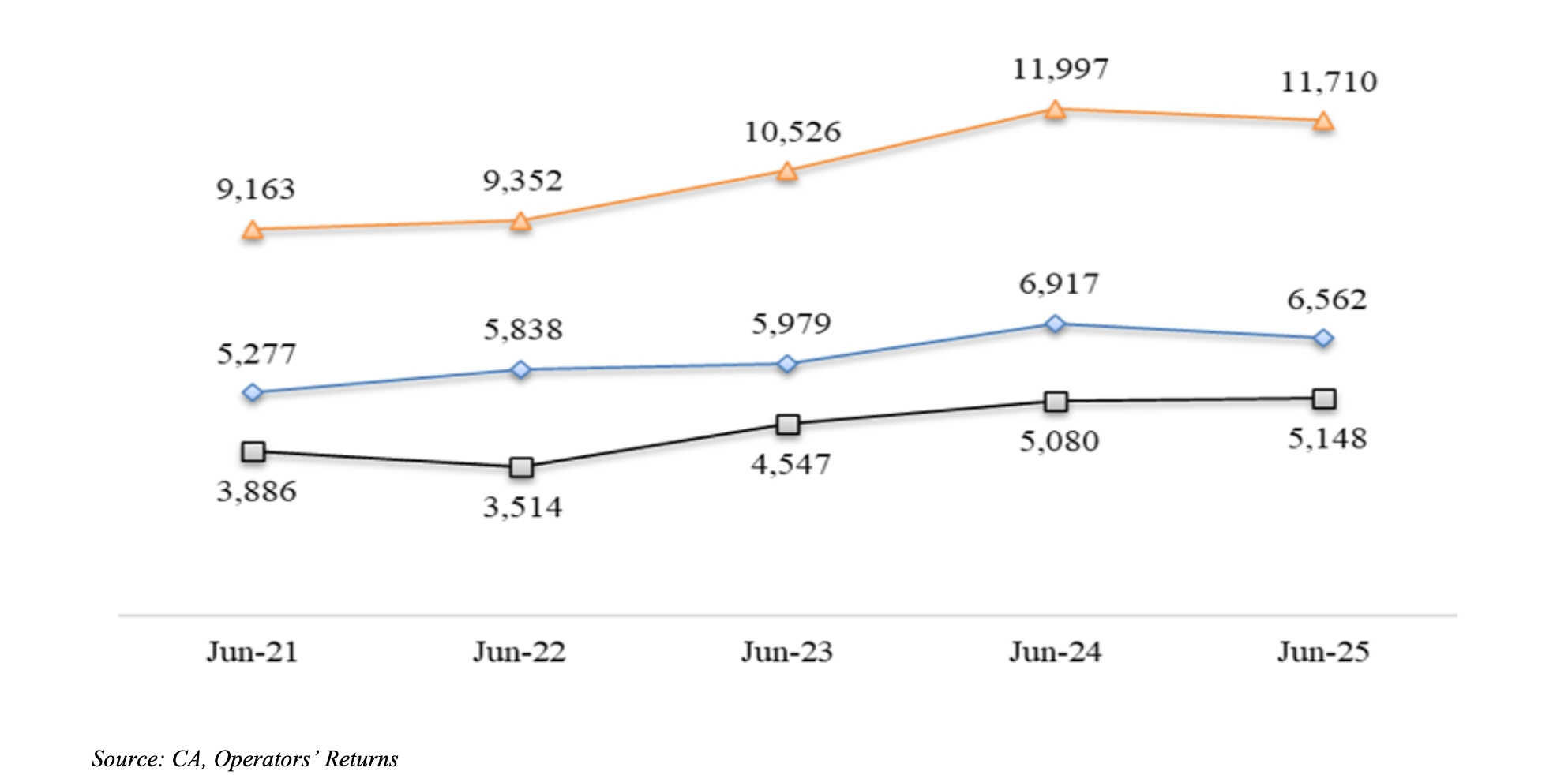
According to the latest fourth quarter sector statistics report from the Communications Authority (CA), the telco industry’s revenues climbed by 10.7% in 2024, reaching KES 425.5 billion, yet jobs in the mobile sub-sector dipped by 2.4% over the same period.
As of June 2025, the number of people employed by mobile network operators and virtual network operators stood at 11,710, down from 111,997 in the same period last year.
This comes at a time when the industry is experiencing record demand for mobile data, money services, and broadband. Analysts say the paradox highlights how automation, outsourcing, and efficiency-driven restructuring are reshaping the workforce behind one of Kenya’s fastest-growing sectors.
Mobile money subscriptions grew to 47.7 million, representing a penetration rate of 91%. Similarly, mobile broadband subscriptions surged by 15.7% in the last quarter alone to 45.8 million, driven largely by the expansion of 4G and 5G networks and increased smartphone adoption.
Yet, this growth in service uptake has not translated into job creation, suggesting that digital platforms and AI are taking over roles once handled by human workers.
The report notes that “other services” such as mobile money, roaming, and bulk SMS were the biggest revenue drivers, contributing 41.1% of the sector’s earnings.
As mobile operators increasingly rely on technology to deliver these services, traditional roles such as customer support, field operations, and distribution have come under pressure.
Companies are also outsourcing functions like network maintenance and call centers, further reducing in-house staff needs.
Reskilling has become a buzzword in the telco sector as firms push employees to adapt to emerging technologies. The shift is most visible in areas like fintech integrations and data management, where operators require fewer but more highly skilled workers.
For many employees, the challenge lies in keeping up with the pace of change, as the industry priorities digital-first strategies to cut costs and boost margins.