






The Communications Authority of Kenya just released its 2024/25 customer satisfaction report, and the numbers tell a story that millions of Kenyans already know from experience: the country’s mobile networks are struggling with basic service delivery.
The comprehensive survey, conducted by Strategic Synergy Consultants, examined customer experiences across four major providers: Safaricom, Airtel, Jamii, and Telkom Kenya, and revealed systemic problems that go beyond occasional dropped calls.
Crisis Coverage
Network coverage remains the single biggest complaint across all providers. Nearly two-thirds of Airtel customers (64.8%) report poor coverage as their main issue, followed by Jamii at 36%, Telkom Kenya at 31.7%, and Safaricom at 25.7%.
Among Airtel users, 14.3% report experiencing weak or no signal “all the time,” with another 12.5% facing issues “most of the time.” Jamii shows an even more concerning pattern, with 27.6% of customers reporting constant signal problems.
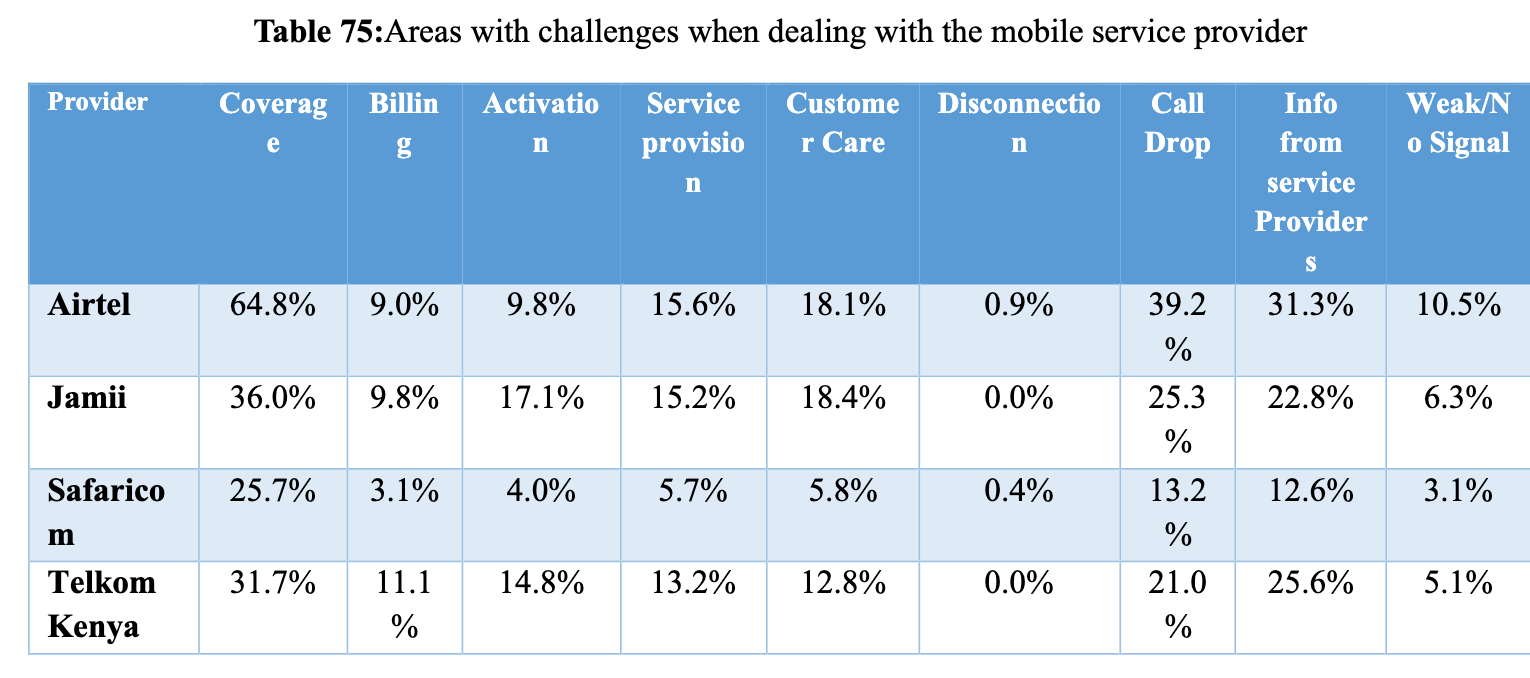
Call drops follow a similar pattern. Airtel leads in customer complaints at 39.2%, while Jamii records 25.3% and Telkom Kenya 21%. Safaricom performs better at 13.2%, but that’s still more than 1 in 10 customers regularly experiencing interrupted calls.
Despite these quality issues, pricing remains the primary factor in choosing a provider. Nearly half of Airtel customers (47.1%) cite affordability as their main reason for selection, compared to just 19.6% for Safaricom.
Kenyans are essentially choosing between paying less for unreliable service or paying more for better coverage.
This creates a market dynamic where providers competing on price have less incentive to invest in network infrastructure, while the premium provider faces limited pressure to reduce costs.
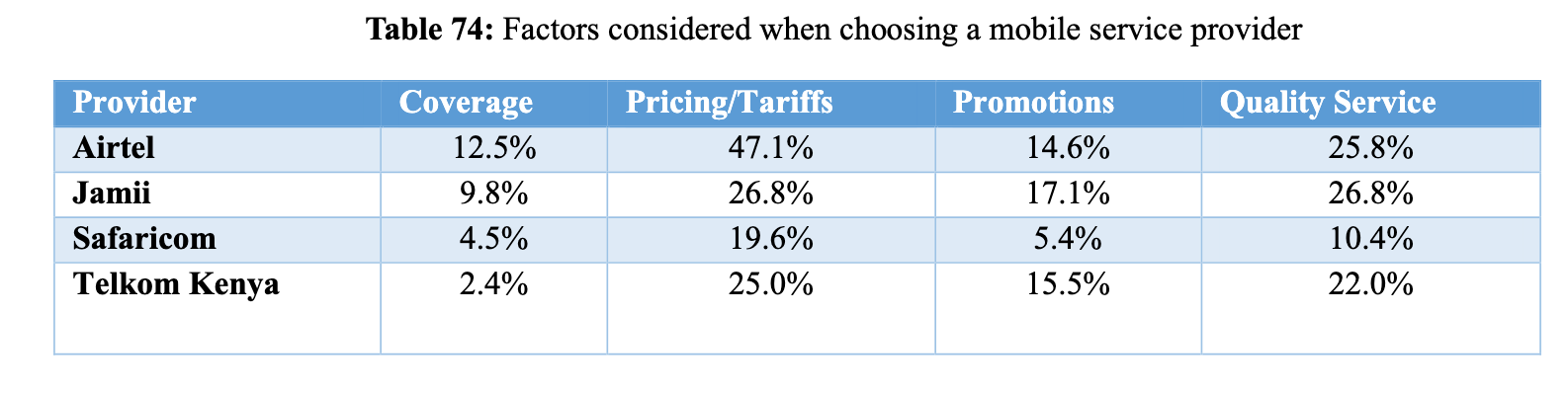
The survey found that Safaricom customers perceive the service as expensive but are willing to pay for superior network stability.
Deeper Problems in Mobile Data
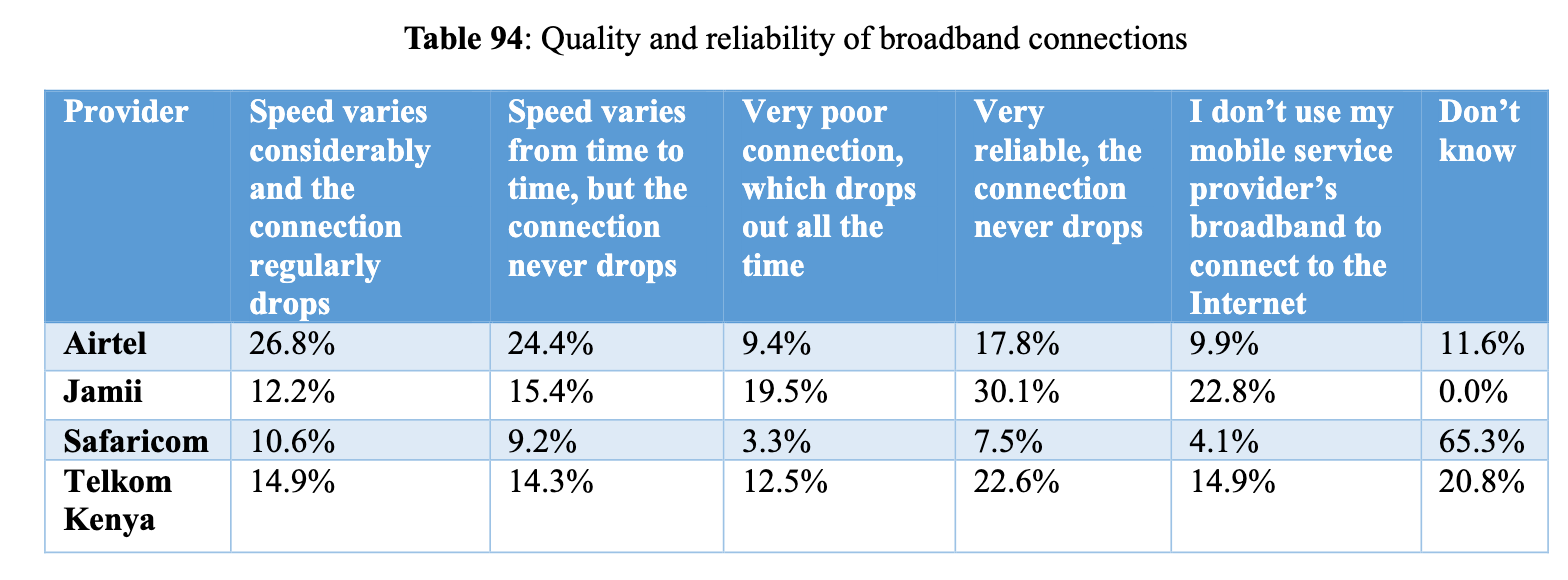
Mobile data services show equally troubling patterns. When asked about broadband reliability, 26.8% of Airtel customers report that “speed varies considerably and the connection regularly drops,” while 9.4% describe their connection as “very poor, dropping out all the time.” Jamii performs worse, with 19.5% rating their connection as very poor.
Evening internet slowdowns emerged as a recurring complaint across providers, suggesting network congestion issues that operators haven’t adequately addressed.
One Safaricom customer said that “internet is too slow in the evening,” while Airtel users reported speeds dropping “from 4G to 3G” during peak hours.
In addition, multiple customers across providers reported that bundles deplete faster than expected, with one noting, “I purchased 5 days unlimited bundles but they depleted within 2 hours.”
This points to either inadequate transparency in data measurement or technical issues with how bundles are tracked and consumed.
Customer Service Is Far From Adequate
The survey also uncovered a customer service accessibility problem that compounds technical issues. Multiple Safaricom customers, who are ironically users of the provider with the best technical performance, complained about difficulty reaching support.
One user stated, “It’s hard to get through to Safaricom when I need to speak to an agent when the help I need is not on the self-service menu options.”
While 78.9% of Safaricom customers know how to file complaints, and the company scores highest in complaint handling satisfaction at 69.8%, customers still report “too much waiting time before my call is picked up by a customer service agent.”
Jamii shows the worst customer service performance, with satisfaction scores at just 62.2%. The survey found that only 18.7% of Jamii customers rate staff as polite and knowledgeable, compared to 81.9% for Safaricom.
This suggests that budget providers are cutting costs not just in infrastructure but in human resources as well.
The Communications Authority itself received mixed reviews from licensees and stakeholders. The overall customer satisfaction index stands at 73.8%, which sounds acceptable until you examine the components.
Satisfaction with how CA handles disputes scored just 13.3%, a devastatingly low figure that suggests the regulator’s enforcement mechanisms are ineffective.
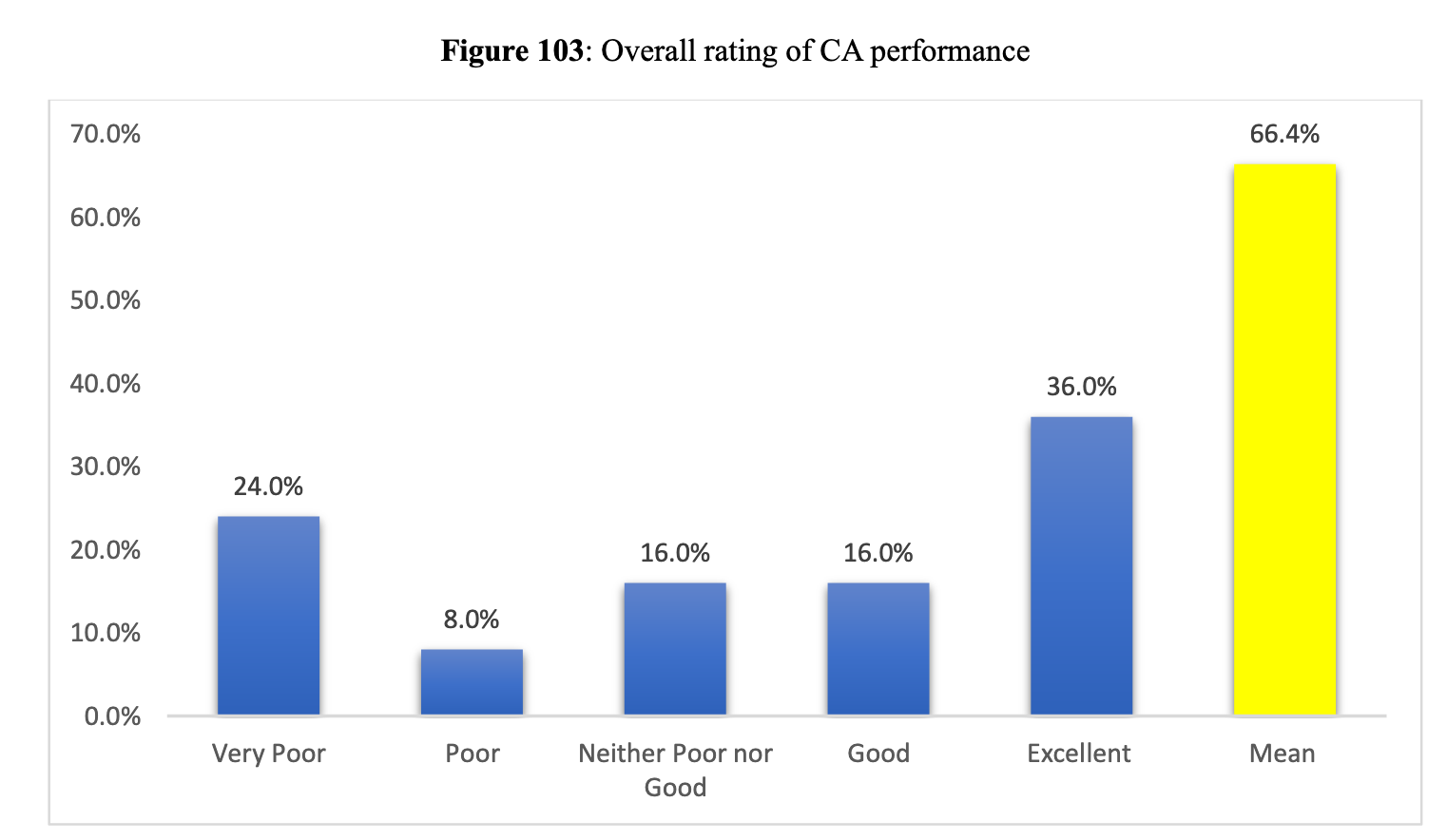
Licensees rated CA’s performance in resolving complaints within 30 days at only 33.3% satisfaction. Given that CA is supposed to be the referee ensuring fair play and protecting consumers, these numbers indicate the regulator may lack either the authority or the will to enforce its own standards.
In fact, 68% of consumers dealing directly with CA regarding complaints were unaware of the customer service charter that’s supposed to outline their rights and CA’s obligations.
E-Commerce Still Lags Behind
Buried in the report is data showing that only 29.1% of Kenyans participate in e-commerce, despite the country’s reputation as a mobile money pioneer.
The barriers are all too familiar, including high delivery costs (43.6%), fraud concerns (41.7%), and poor internet connectivity (35%).
What’s more concerning is the payment failure rate. Nearly half of e-commerce users (47.5%) report experiencing payment failures “sometimes,” with another 40.6% reporting them “rarely.”
This suggests that Kenya’s celebrated mobile money infrastructure, while revolutionary for peer-to-peer transfers, hasn’t translated into reliable e-commerce infrastructure.
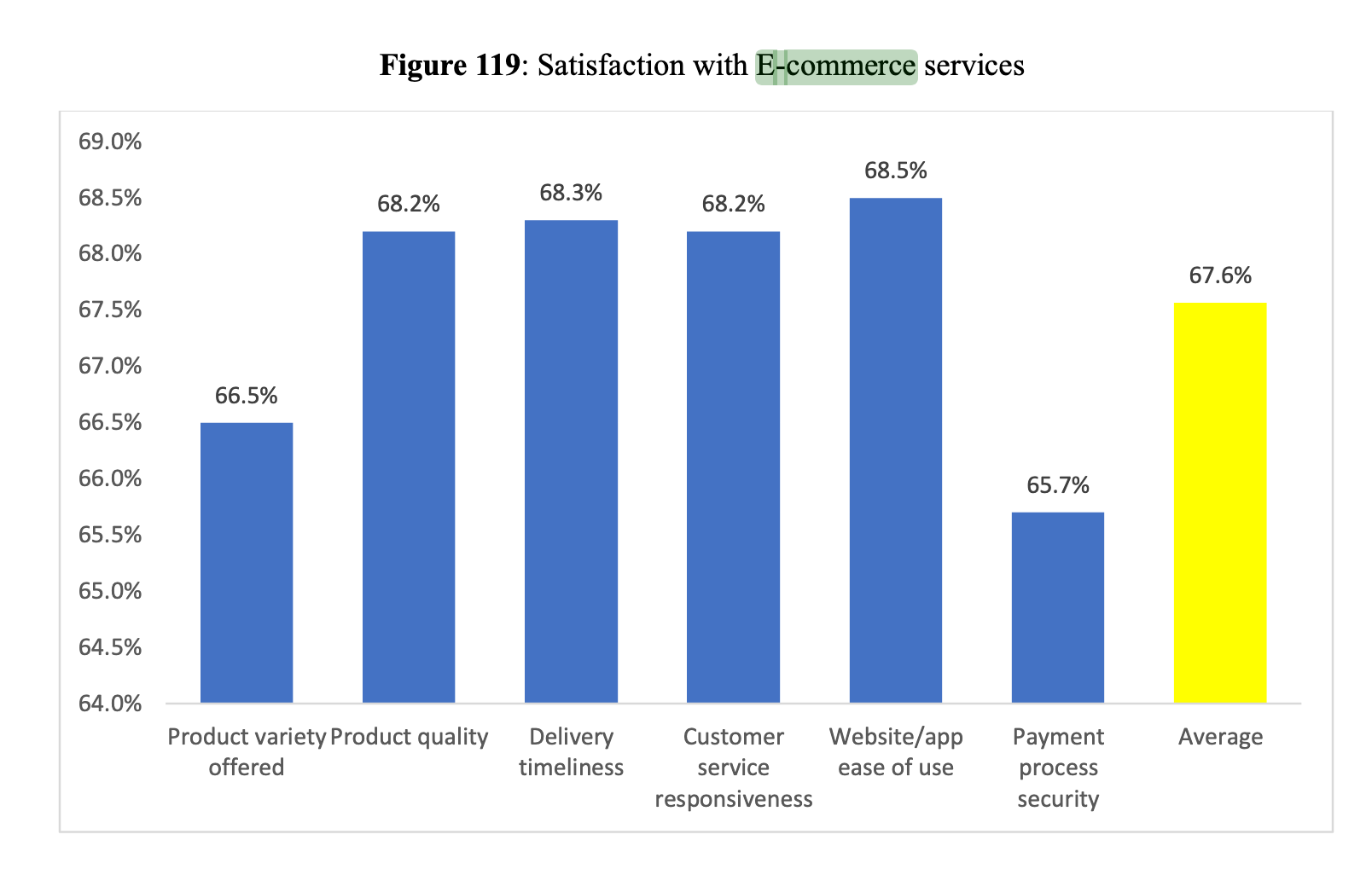
The survey found that 42.5% of e-commerce users only “always” receive clear and accurate billing, meaning more than half sometimes or never do.
For a country that’s positioned itself as a fintech leader, these numbers reveal some major gaps in the digital economy’s foundation.
What’s the Way Forward?
The report makes dozens of recommendations, but several stand out as critical. First, network reliability must take precedence over expansion. Providers need to fix coverage in areas they claim to serve before adding new territories.
The data shows customers would rather have consistent service in fewer locations than spotty service everywhere.
Second, pricing transparency needs serious attention. The finding that only 29.7% of licensees are satisfied with CA’s pricing of services, with specific complaints about broadcasting and frequency costs, suggests the regulatory fee structure may be hindering rather than helping market development.
Third, the dispute resolution mechanism needs a complete overhaul. A 13.3% satisfaction rating isn’t just bad; it indicates the system is essentially non-functional. CA needs enforcement teeth, or its role becomes purely ceremonial.
Fourth, customer service must be treated as infrastructure, not overhead. The correlation between network quality and customer service quality suggests providers view both as cost centers to minimize rather than as competitive differentiators to maximize.
For ordinary Kenyans, the report confirms what daily experience already teaches: you’re choosing between bad options. Pay less and deal with constant technical problems, or pay more for better (but not great) service with customer support that’s often inaccessible.
The e-commerce findings are perhaps most troubling for the country. If nearly half of online transactions fail sometimes, if most users don’t receive consistent billing information, and if fraud remains a top-three concern, then the foundation for a digital economy is shakier than the success of M-Pesa might suggest.
Kenya’s telecommunications sector is operating below the standards a middle-income country should expect. The technology exists to provide reliable coverage, stable broadband, and responsive customer service.
What’s missing isn’t technical capability but apparently the competitive or regulatory pressure to deliver it.
As consumers, we can expect continued frustration until either market forces or regulatory intervention compel providers to prioritize service quality over subscriber acquisition. Unfortunately, the data suggests neither is happening quickly enough.