





CcHUB (short for Co-creation Hub) released its 2025 impact report, and although the numbers might be the focus, the more interesting story is in the method.
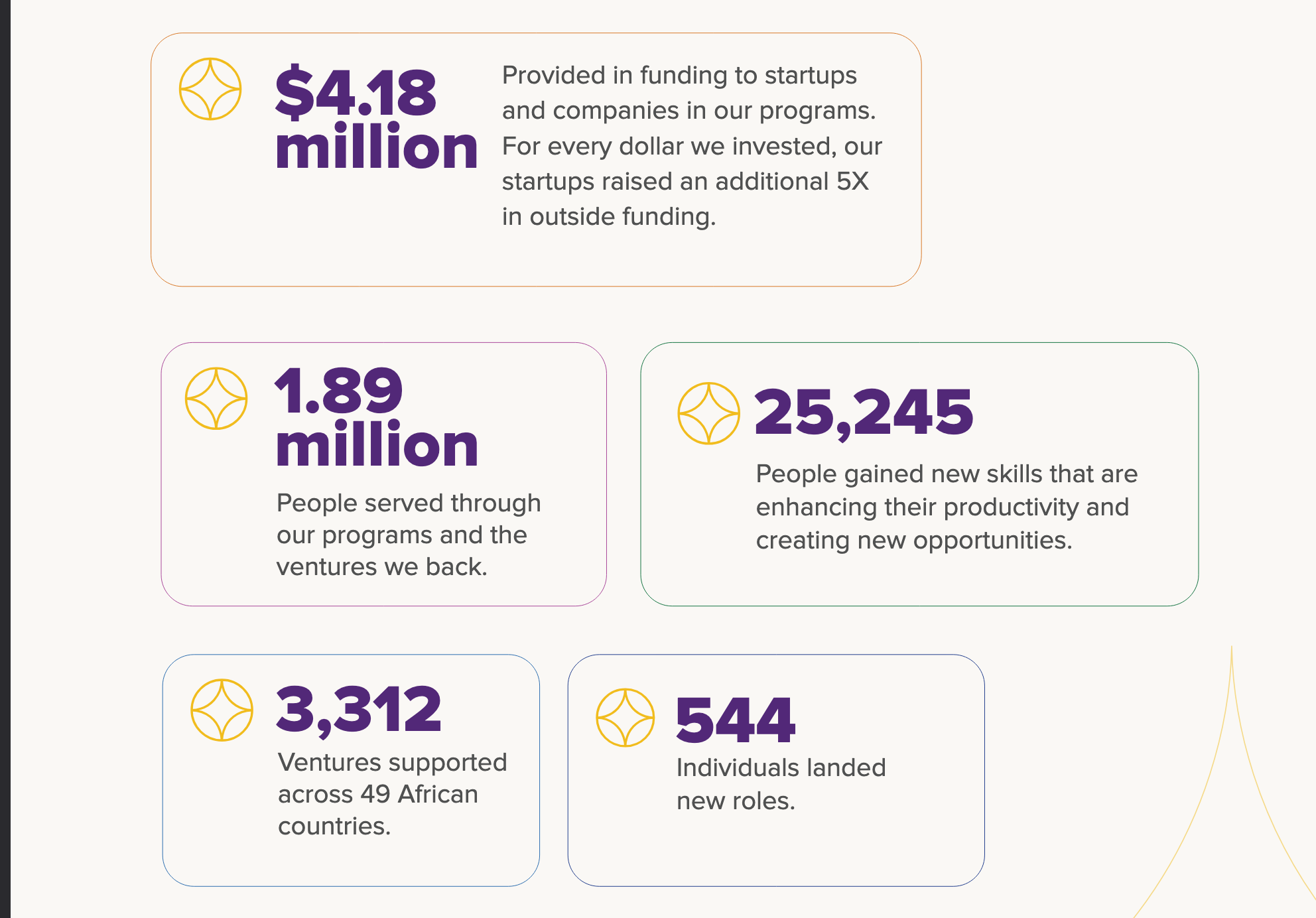
The organization, which runs hubs in Lagos, Nairobi, Kigali, and Windhoek, reached 1.89 million people in 2025, supported 3,312 ventures across 49 African countries, and disbursed $4.18 million in funding to startups.
For every dollar CcHUB invested, its portfolio companies raised five more from outside sources. That 5x leverage ratio is the clearest signal that what CcHUB is building has real market credibility, not just grant dependency.
What makes CcHUB interesting from a tech and systems perspective is they don’t just build the products; they also build the conditions that make products possible, and that distinction matters enormously.
The AI and Digital Public Infrastructure Health Program
This is probably CcHUB’s most technically ambitious work in 2025. Supported by the Gates Foundation, the program brought 9 health startups into sandbox environments where they could build and test solutions on actual digital public infrastructure.
Not mock systems, not controlled pilots, but real DPI.
The result in under nine months is 6 interoperable, AI-enabled health products, and two of them illustrate what “designing for a connected ecosystem” actually means in practice.
God’s Eye, built by Eight Medical, uses AI to assess emergency urgency, dispatch the nearest ambulance, track real-time hospital bed availability, and process digital payments.
It’s accessible through mobile, WhatsApp, USSD, and voice, which is a deliberate design choice to reduce smartphone dependency in a country where emergency response has historically been a coordination failure, not a resource failure.
Mediloan, by MyItura, embeds AI-powered credit decision-making at the point of care. The problem it solves is specific and costly: patients in Nigeria frequently delay or skip treatment because they can’t pay upfront.
Mediloan’s system lets patients receive treatment immediately while providers get paid, using AI to make credit decisions in real time.
By the end of 2025, it had onboarded 25 primary healthcare facilities, served 600+ users, processed $16,000 in credit requests, and committed $32,000+ to its lending pool.
These two products are worth paying attention to together because they’re designed to share infrastructure and operate in a common data environment.
That’s not a standard feature of African health tech, where most products are built as standalone tools that can’t talk to each other.
Beyond the products, CcHUB contributed to the Kwara State Digital Health Roadmap, currently with the state government, which would integrate digital health into primary care for 3.5 million residents.
In Kenya, they designed a health financing pathway for hospitals facing cash flow shortfalls, building investment cases to attract private capital.
EdTech at Scale
CcHUB’s education work in 2025 ran through its re:learn program and covered two tracks simultaneously: helping teachers actually use technology in classrooms and helping EdTech founders build products grounded in classroom realities.
Of 800 teachers assessed, 90% reported using at least one EdTech tool in their classrooms, and 81% reported increased professional confidence. These come from a community of 2,000 teachers connected through the Teachers Lounge peer learning network.
The program also saw 15 new EdTech products launched, 27 startups accelerated across Nigeria and Kenya, and 48 portfolio startups from prior years continuing to scale, reaching an additional 1.5 million users.
Two products from CcHUB’s higher education innovation ecosystem demonstrate what student-led tech can look like when it’s built around real learner needs.
LeAi is a sprint-learning platform for university students: AI-powered, mobile-first, and designed for studying in short bursts between lectures, with past exam question practice built in. It had 3,000 beta users by 2025.
Okaluli is a WhatsApp-based learning tool for students in rural areas without computer access. It had 2,400 active users and delivered 300,000+ messages.
READ: iHUB Opens Applications for Fourth EdTech Fellowship Cohort
Both came out of CcHUB’s work with 70 higher education institutions across Nigeria, Kenya, and Namibia, backed by $300,000 disbursed to student innovators since 2022.
The Creative Industries
This is where CcHUB’s work gets less obvious but no less interesting. The organization’s thesis is that African creative industries have a talent surplus and a business infrastructure deficit.
The gap isn’t in creativity but in pricing strategy, legal structure, market access, and financial systems.
640 women launched or scaled ventures through CcHUB’s creative economy programs in 2025, across 16 cohorts covering fashion, film, music, design, media, and the arts.
One example is Joy Obuya, founder of fashion brand Nawiri. Obuya went through the Fashionomics Africa Accelerator (funded by the African Development Bank) and restructured her pricing based on actual cost analysis, something she hadn’t done before. Revenue grew from $12,000 in year one to a forecast of $140,000+ by 2025.
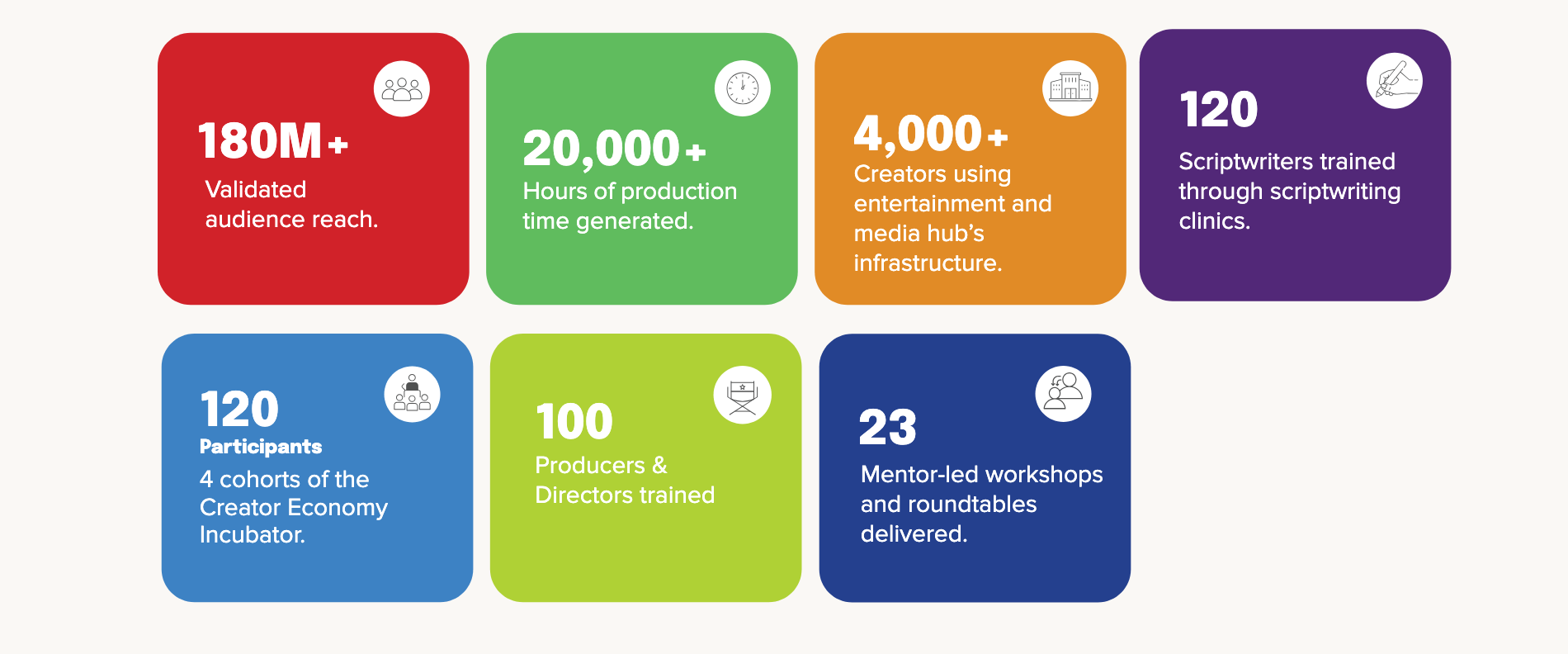
On the media side, the Gates Foundation-funded Entertainment and Media Hubs program generated 180M+ validated audience reach, trained 100 producers and directors, trained 120 scriptwriters, and had 4,000+ creators using hub infrastructure.
READ: Nigeria’s CcHUB Acquires Kenya’s iHub For an Undisclosed Fee
The Infrastructure Play
CcHUB describes its strategy through eight levers:
- Academic/Research-based Innovation
- Civic and Digital Resilience
- Community and Ecosystems
- Innovation Hub Strengthening
- Investment
- Research and Human-Centered Design
- Support for Startups
- Workforce Development
The workforce numbers include 25,245 individuals trained across skills programs, 27 specialized curricula developed across AI, blockchain, data science, and game development, and 544 verified job placements.
Meanwhile, the community infrastructure records 242 events hosted across the continent, 513 new coworking members across Nigeria and Kenya, and a Kigali hub that co-locates AI researchers, product managers, and startup founders.
Chpter, a WhatsApp-based business sales and CRM tool, came through the Spark Accelerator via iHUB in Kenya, refined its Safaricom positioning, secured partnerships with ABSA Bank and Co-operative Bank, became a Meta business partner, expanded into Uganda, Nigeria, and Tanzania, and raised $1 million.
Ecobarter, a plastic recycling rewards platform, used the Global Cleantech Innovation Program to gain stakeholder access that eventually contributed to backing from UNIDO and the Government of Japan.
Koolboks, a cold storage startup, won the national Cleantech competition, represented Nigeria in Vienna, and later closed an $11 million Series A.
The honest version of CcHUB’s model is they are building the connective tissue between talent, capital, government systems, and markets that African innovators can’t build alone and can’t buy their way into easily.
Sandbox environments let health startups test on real infrastructure before they’re forced to deploy at scale. Accelerators open market access that would otherwise cost founders years of self-funded hustle to reach.
The hub network brings enough people together in one place so useful interactions can happen naturally.
The 1.89 million people reached through portfolio ventures and programs is the output CcHUB points to as evidence that their model compounds beyond direct delivery.
The 25,245 people directly trained is what they controlled. The gap between those two numbers is the ecosystem working. Whether that model scales across the continent and survives funding cycles is the open question.
All the same, in 2025, it produced an AI-powered emergency dispatch system, a real-time healthcare credit layer, student-built learning tools with hundreds of thousands of users, and a pipeline of creative businesses with international market access.
That’s a reasonably concrete answer to what “building infrastructure for African innovation” actually looks like.