




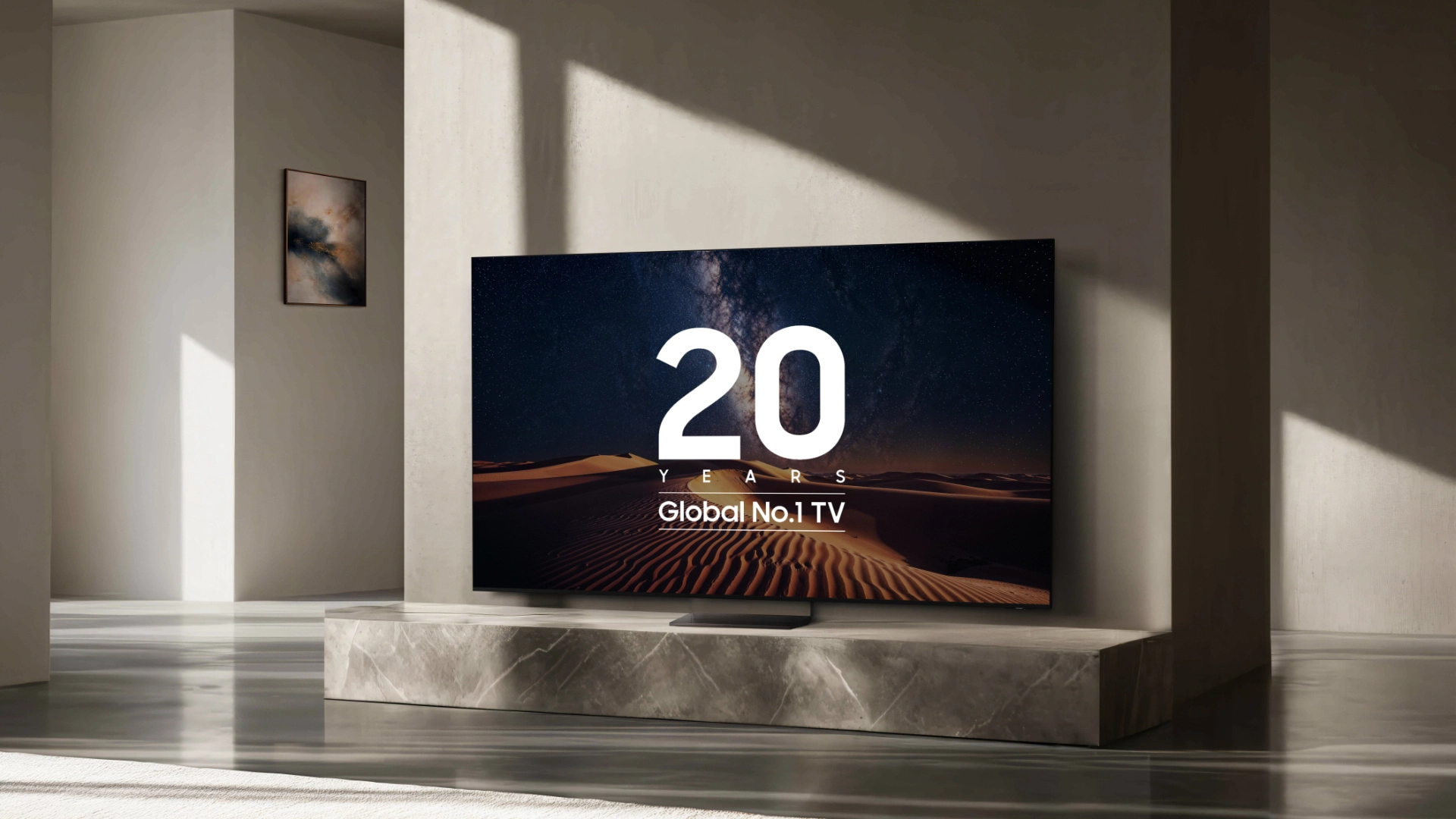
Samsung just hit a milestone that no other TV maker has come close to: 20 consecutive years as the world’s best-selling television brand.
The company has held the top spot globally since 2006, and in 2025, it commanded 29.1% of the entire global TV market, according to research firm Omdia. That’s roughly 1 in 3 TVs sold worldwide bearing a Samsung logo.
For TVs priced above $2,500, Samsung holds a 54.3% market share, meaning more than half of all premium TVs sold are Samsung sets.
READ: Sony Hands Majority Control of TV Business to China’s TCL
At the $1,500-and-up tier, it controls 52.2%. These are the segments that matter most for profitability, and Samsung is essentially dominant in both.
The run started in 2006 with the Bordeaux TV, a set that stood out primarily for its design at a time when most TVs were utilitarian black boxes.
From there, Samsung consistently moved first or fast on every major shift in the industry. It pushed LED backlighting into the mainstream in 2009, making TVs thinner and more power-efficient.
In 2011, it introduced Smart TVs, turning the television into an internet-connected platform rather than just a screen. By 2017, it launched The Frame, a TV designed to display digital art when you’re not watching anything, essentially creating an entirely new product category.
That same year, Samsung introduced QLED, its quantum dot display technology, which improved color accuracy and brightness over standard LED panels.
In 2018, it brought 8K resolution to market with 33 million pixels, four times the density of 4K. Then in 2020, it introduced Micro LED, a self-emissive display technology that doesn’t rely on a backlight at all, targeting the ultra-large, ultra-premium segment of the market.
Going forward, Samsung plans to expand its Micro LED lineup, offer Mini LED TVs in more sizes and price ranges, and add AI features that automatically adjust picture and sound based on what you are watching.
READ: Samsung Unveils 130-Inch Micro RGB TV at CES 2026
20 years at the top of any consumer electronics category is rare. TVs are expensive, long-lasting purchases, and brand loyalty tends to be sticky.
Samsung has managed to stay ahead through a mix of being early on new technologies and maintaining a wide enough product range to compete across almost every price tier, from mid-range sets to $100,000+ Micro LED walls.
No other TV brand has come close to matching that streak.