








In today’s world of artificial intelligence (AI) and large language models (LLMs), what is largely lacking in the conversation on LLM launches and advancements is Sub-Saharan Africa.
The little eye-catching LLM innovation on the continent could be explained by limited, robust foundational research. A data-driven report on AI found that only 0.83% of total AI publications between 2013 and 2024 were from sub-Saharan Africa.
In the report, North Africa is bundled together with the Middle East, and this region had a significantly better contribution than Sub-Saharan Africa with 4.27%.
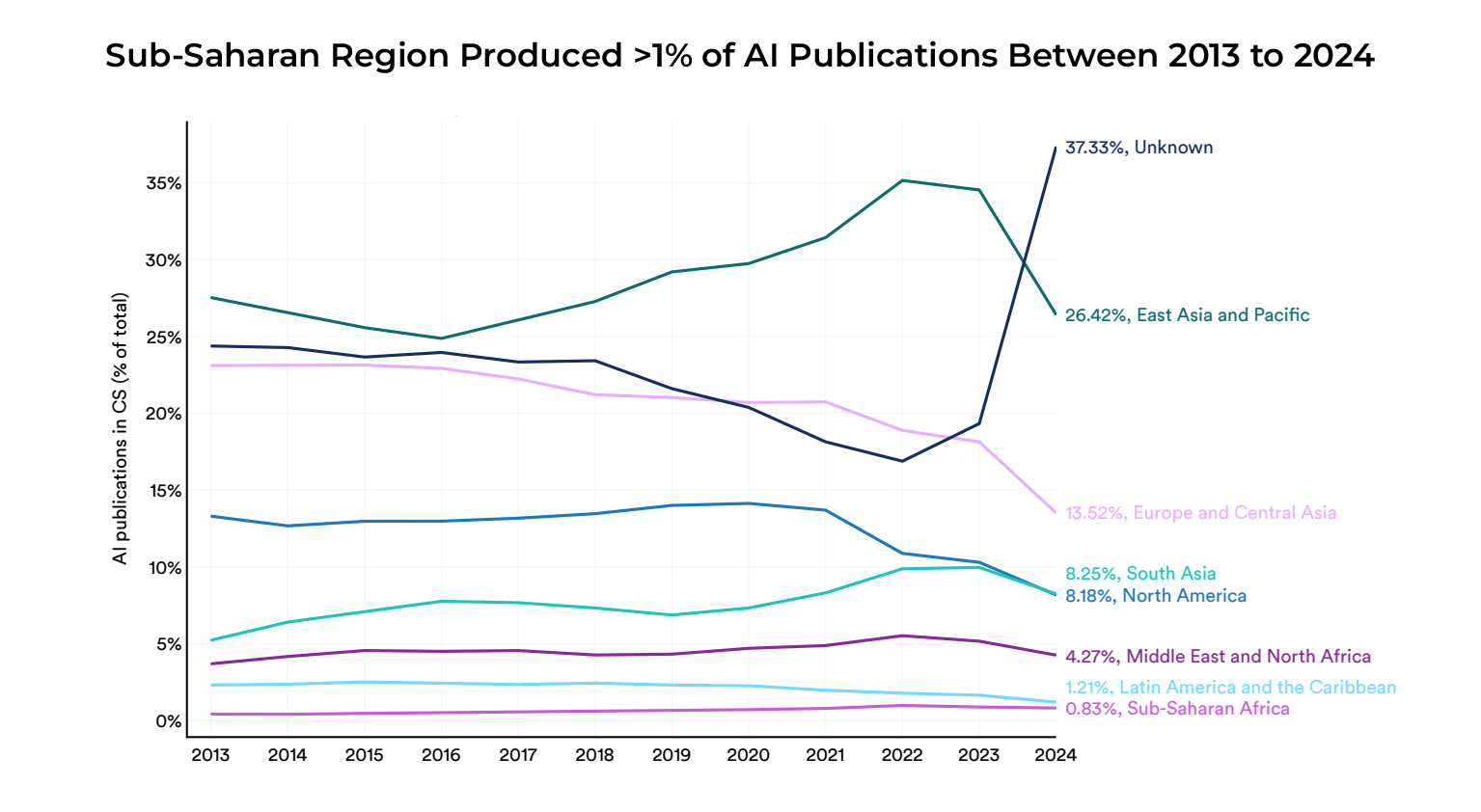
This geographic distribution of publications and citations shows that a relatively small number of countries account for a disproportionate share of activity.
As African nations like South Africa, Kenya, and Nigeria draft AI policies, the governments should note that Sub-Saharan Africa needs much more AI research too.
READ: Senate Introduces an AI Bill That Proposes an AI Commissioner
East Asia and the Pacific region lead in terms of publication volume, contributing 26.42% in 2024, but down from its high of 35% in 2022. China is a factor in the region’s dominance, having accounted for 17.8% of AI publications in 2024.
Regarding global impact, Chinese AI research represented 20.6% of all citations in 2024. European and American publications followed, accounting for 19.5% and 12.6% of the total share, respectively.
Growth in AI Publications and Expertise
In the 10 years that were the focus of the report, AI publications more than doubled, increasing from roughly 102,000 to about 258,000.
“AI research now makes up a substantial portion of the broader computer science ecosystem, accounting for 40.9% of all computer science publications in OpenAlex,” reads part of the AI Index 2026 Report.
Most AI research today is found in journals, which claimed a 62.8% share of publications in 2024, compared to 23.8% for conferences. While both have seen total numbers climb since 2013, their relative importance in the field has evolved.
There is also a major surge in high-level expertise; AI PhD grads in North America increased by 22% over the last two years.
Interestingly, despite the high salaries associated with AI companies, those new graduates are choosing to stay in academia rather than heading off to industry.
China closed the gap to US LLM models, with DeepSeek coming close in early 2025. The US still has the better models with OpenAI’s ChatGPT, Anthropic’s Claude, and Google’s Gemini among the top.
As of March 2026, Claude’s top model has a 2.7% lead on the rest of the models.
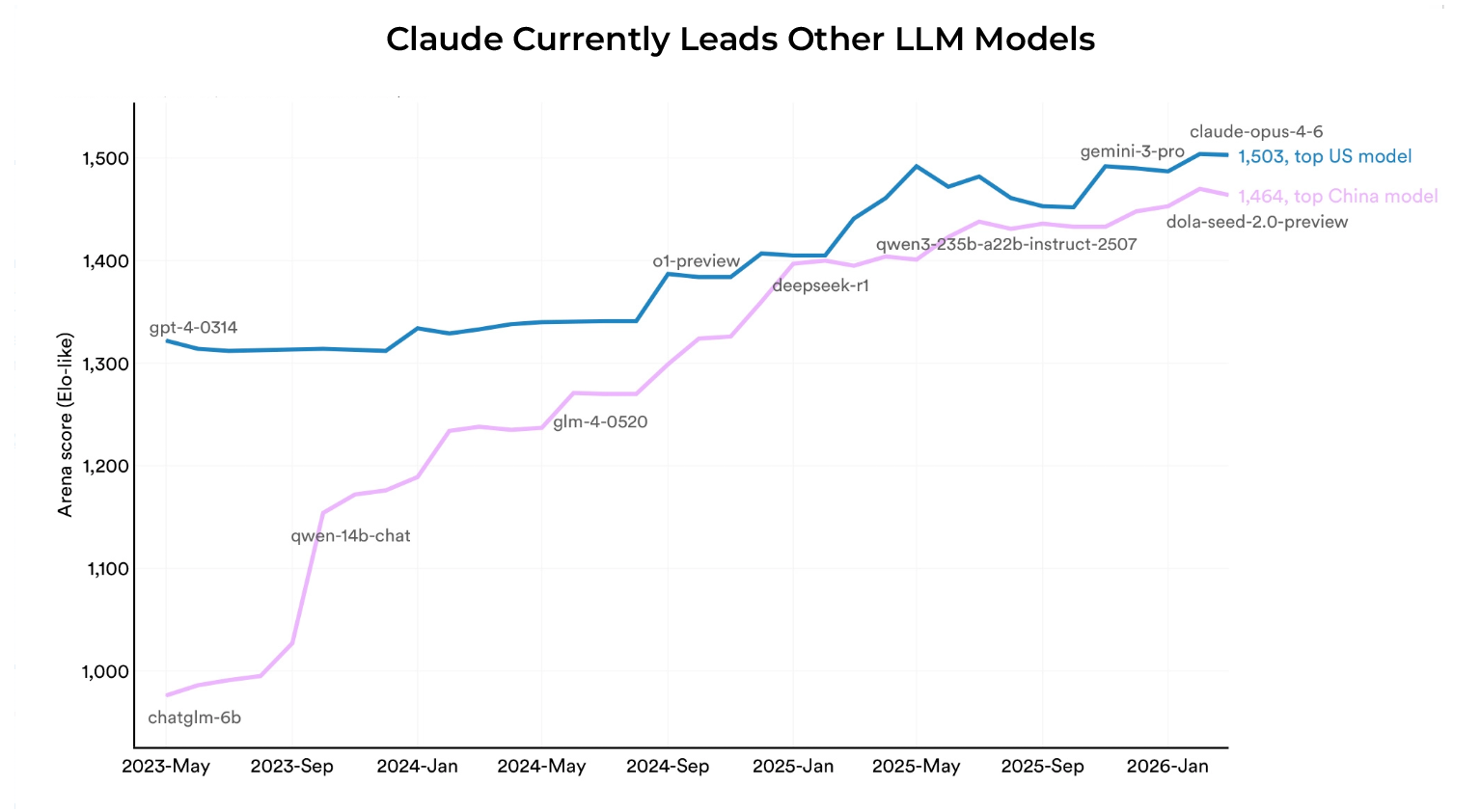
According to the Stanford University report, “The U.S. still produces more top-tier AI models and higher-impact patents, while China leads in publication volume, citations, patent output, and industrial robot installations.”