







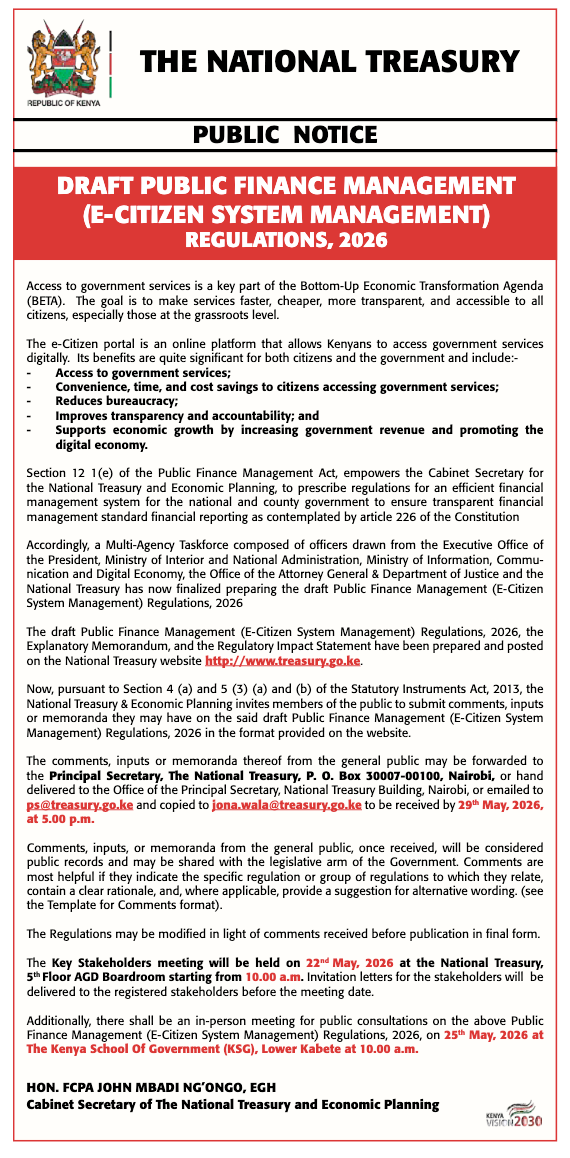
The National Treasury has published a public notice inviting Kenyans to comment on the Draft Public Finance Management (e-Citizen System Management) Regulations, 2026, the same regulations that would introduce a tiered convenience fee on government services accessed through eCitizen.
The notice, signed by Cabinet Secretary John Mbadi, sets a deadline of May 29, 2026, for submissions. A key stakeholders’ meeting is scheduled for May 22 at Treasury headquarters, followed by a public consultation at the Kenya School of Government on May 25.
On the surface, this looks like the government getting it right. One of the central reasons the High Court struck down the original flat KES 50 convenience fee in April 2025 was that it had been introduced without public participation.
Justice Chacha Mwita described the charge as irrational and unconscionable, imposed without any clear explanation of where the money went or what it funded.
The government is now doing what it was told to do: putting the fee in a legal framework and opening it to public input before gazetting it.
After the Court of Appeal dismissed the government’s bid to suspend the High Court ruling in November 2025, Attorney General Dorcas Oduor directed CS Mbadi to comply with the order halting collection of the KES 50 fee.
That directive came after a contempt of court application was filed against senior government officials accused of continuing to collect the fee regardless.
The government collected fees it had been told were illegal, then sought to retroactively legitimize them through new regulations.
The new tiered structure, which ranges from KES 5 for transactions between KES 100 and KES 499, up to KES 100 for transactions above KES 100,000, is presented as a more rational approach. That may be true.
A tiered fee is harder to challenge on fairness grounds than a flat charge applied regardless of service cost, but the regulations do not answer the question that courts and critics have kept asking: who exactly benefits?
READ: Parents No Longer Forced to Pay School Fees Via eCitizen
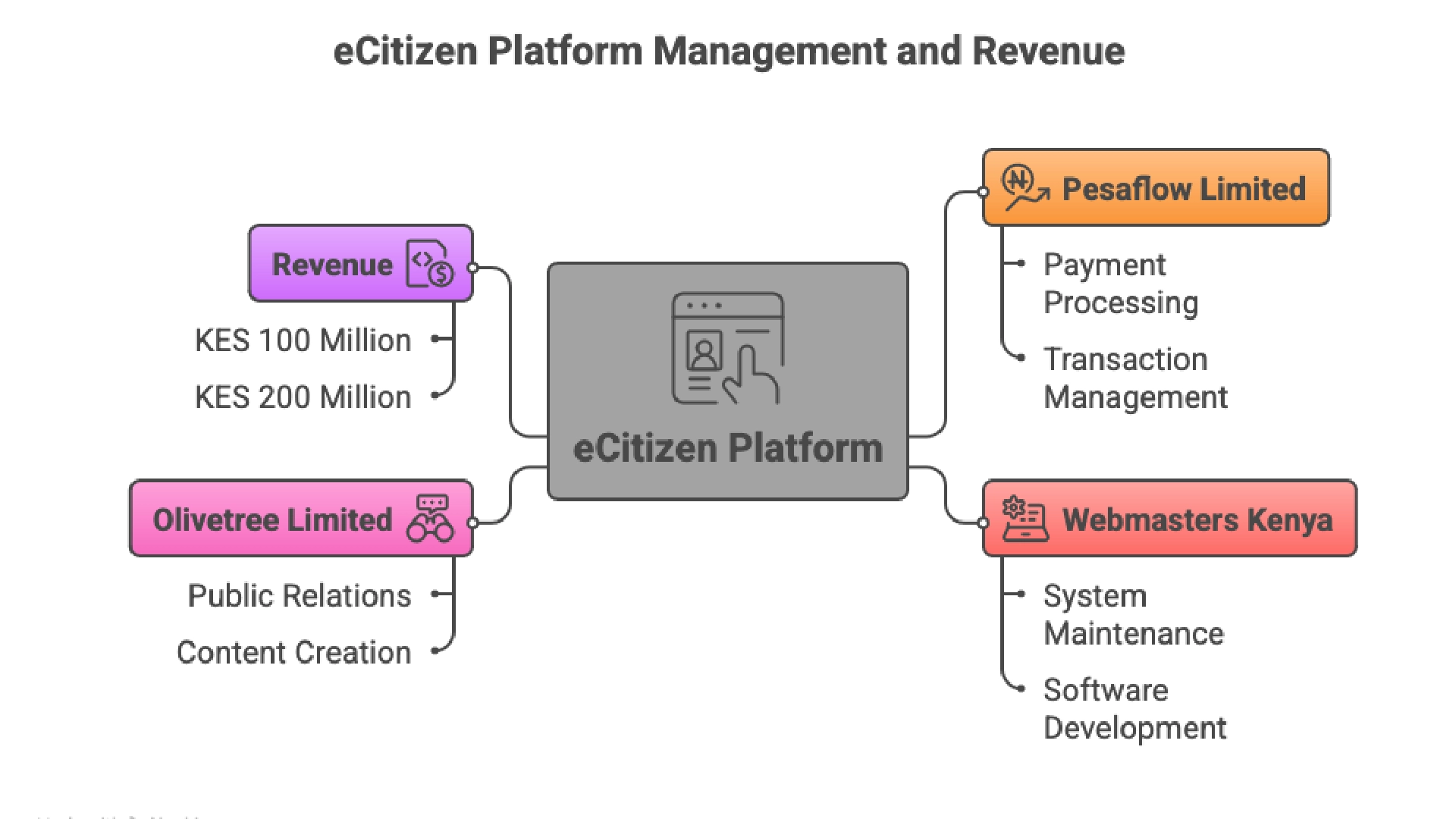
Three private companies run the eCitizen platform. Pesaflow Limited handles payment aggregation; Webmasters Kenya manages technical operations, and Olivetree Limited handles communications.
Together, these firms earned an estimated KES 100 million to KES 200 million a month under a maintenance contract with the government.
The new regulations centralize all government revenue collection through eCitizen and require both national and county entities to wind down their own revenue bank accounts.
That is a significant consolidation of public financial flows through a platform that the Auditor-General has already flagged for limited government oversight and an absence of backup systems.
READ: e-Citizen to Display Commercial Ads in Aggressive Revenue Drive
The public notice is the right procedural step, but participation only matters if the submissions can meaningfully change the outcome.
The consultations are scheduled less than three weeks away, and the fee structure and the companies that benefit from it appear settled. Whether anyone inside the Treasury is actually listening is a whole other question.