






Kenya’s total active internet bandwidth grew by 16.4%, reaching over 28,130 Gbps. Between January and March 2026, SEACOM was the major contributor to this jump in bandwidth.
SEACOM, the undersea cable provider, raised its active capacity by 53.3%, scaling from 6,850 Gbps to 10,500 Gbps. In addition, the company recently upgraded its Nairobi-to-Kampala fiber route via Kisumu.
Every other submarine cable company serving Kenya, except for TEAMS, also raised its capacity, according to the latest Communications Authority of Kenya (CA) report.
| Subsea Cable | Oct-Dec 25 Capacity (Gbps) | Jan-Mar 26 Capacity (Gbps) | Quarterly Growth (%) |
| SEACOM | 6,850.000 | 10,500.000 | 53.3% |
| EASSY | 6,310.000 | 6,500.000 | 3.0% |
| PEACE | 3,638.000 | 3,738.000 | 2.7% |
| Lion 2 | 1,100.000 | 1,119.000 | 1.7% |
| DARE 1 | 2,200.000 | 2,210.000 | 0.5% |
| TEAMS | 4,063.000 | 4,063.000 | 0.0% |
While the total available international internet bandwidth grew by 16.4%, the actual utilized bandwidth only grew by a steady 3.0% to about 17,758 Gbps.
This 63% utilization means Kenya has headroom left for future demand.
READ: How Kenyans Connect to the Internet From Submarine Cable Infrastructure, ISPs to Personal Devices
More available internet bandwidth gives internet service providers (ISPs) more capacity to offer faster speeds and smoother streaming, even during busy times when many people are online.
Kenya’s Growing Internet Sector
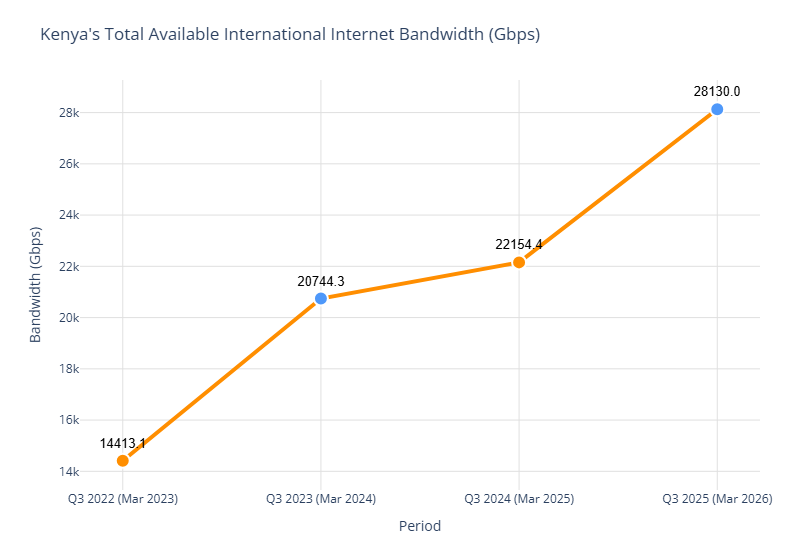
The size of the “digital highway” connecting Kenya to the rest of the world has been growing. At the end of March 2023, it was 14,413.053 Gbps; the capacity grew to 20,744.338 Gbps over the next 12 months.
It was 22,154.438 Gbps at the end of March 2025 before growing to the current 28,130 Gbps in the last 12 months.
When international bandwidth capacity grows, the cost per gigabyte of data typically drops. Over time, these savings usually trickle down to consumers and businesses in the form of cheaper data bundles and home fiber packages.
This has been witnessed in the last year with Safaricom introducing cheaper home fiber packages, Jamii Telcom introducing cheaper plans, and the entry of Savanna Fiber, which led to a price tug-of-war.