




Kimi K3, the newest model from Chinese startup Moonshot AI, has landed with enough force to get people in Silicon Valley talking again about how close China’s AI labs are getting to the US frontier.
The model was introduced on July 17, and Moonshot is planning to release the actual model weights on July 27, meaning developers will be able to download it, inspect how it works, and modify it for their own purposes.
That openness sets it apart from proprietary systems like Anthropic’s Claude or OpenAI’s GPT models, where the underlying weights stay locked away.
Kimi K3 has 2.8 trillion parameters, the internal values a model tunes during training to generate its responses. That makes it the largest open-weight model ever released, roughly double the size of the next biggest competitor.
It doesn’t run all 2.8 trillion parameters at once, though. It uses a mixture-of-experts design, splitting itself into 896 smaller expert subnetworks and activating only a portion of them for any given task.
That’s the trick that lets it perform at a high level without requiring an absurd amount of computing power to run.
It also comes with a one million token context window, meaning it can take in an enormous amount of text, code, or other material in a single prompt, along with native image and video understanding.
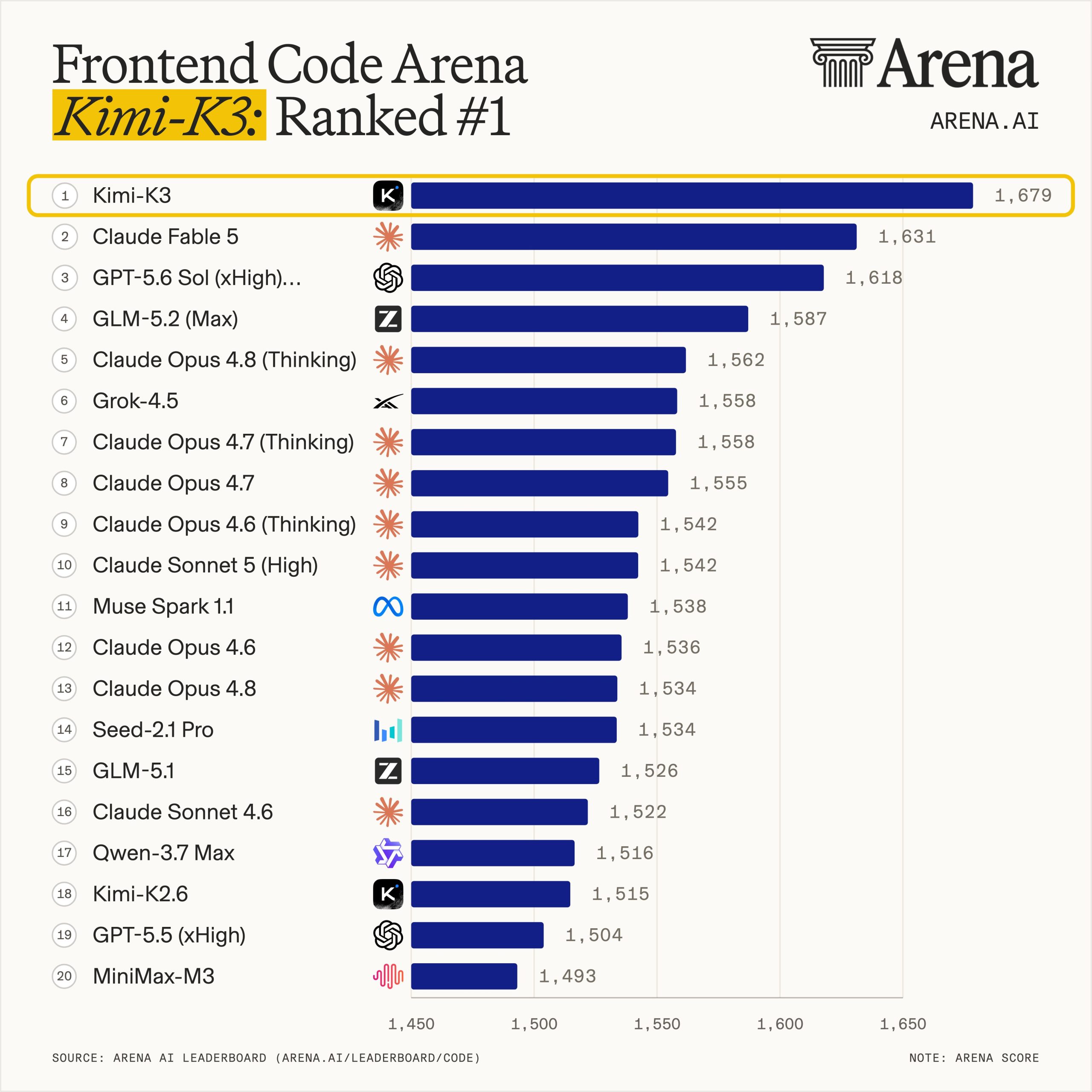
On benchmarks, Kimi K3 is strong, especially at coding and writing. It topped Arena.ai’s Frontend Code leaderboard, edging out Anthropic’s Claude Fable 5, and came out ahead of Fable 5 on a script-writing benchmark that scores models the same way chess players are ranked.
On a broader composite score covering reasoning, coding, agentic tasks, and general knowledge, though, Kimi K3 lands just a few points behind Fable 5 and GPT-5.6 Sol, putting it in third place among frontier models rather than first overall.
Price is where K3 really stands out. It costs $3 per million input tokens and $15 per million output tokens, which is far cheaper than GPT-5.6 Sol or Fable 5, and notably, it charges the same rate as Anthropic‘s own mid-tier Sonnet 5 model while delivering performance much closer to the top tier.
For companies that need to run huge volumes of AI tasks, that gap between near-frontier performance and mid-tier pricing is a big deal, since compute costs add up fast at scale.
There is a real catch, though. K3’s hallucination rate, meaning how often it confidently produces an answer that’s simply wrong, jumped noticeably compared to its predecessor, K2.6, rising from about 39% to 51% on a benchmark designed to measure exactly that.
Moonshot’s own documentation also warns that the model can be excessively proactive, sometimes making decisions on a user’s behalf during longer autonomous tasks without being asked to.
So while it’s gotten better at getting things right, it’s also gotten more confident about getting things wrong.
The bigger story here is what Kimi K3 represents for the ongoing US-China AI race. Chinese labs, including Moonshot and DeepSeek, have leaned into open-weight releases, while American labs have mostly kept their top models closed off.
That strategy has been paying off for adoption, since developers can inspect and build directly on top of these models rather than working through an API blindly.
It’s also increasing pressure on US companies to justify charging premium prices for closed systems that aren’t running away from the competition the way they once were.
What makes this important is that Moonshot achieved it while facing real hardware constraints. US export controls have restricted Chinese firms from buying the most advanced Nvidia chips, and Moonshot has confirmed some of its earlier models were trained on now-restricted hardware.
Rather than just throwing more chips at the problem, the company leaned on architectural efficiency, including new techniques that speed up processing on long sequences and improve training efficiency without a big jump in compute cost.
Bank of America analysts noted this as proof that smart engineering can still produce major gains even without access to the newest chips.
Whether that’s evidence that export controls are working as intended or evidence that they simply aren’t stopping China‘s progress is a question policymakers in Washington haven’t settled, and K3’s release is likely to sharpen that debate rather than resolve it.
For now, the model is available for free on Kimi’s own website, though demand has reportedly overwhelmed the servers, making it unreliable to use there.
The more practical way to try it is through a paid subscription or the API, with the full model weights becoming available to developers and enterprises on July 27.
Even then, running a model this large will require serious infrastructure, since no domestically available consumer hardware is currently capable of handling something this size on its own.