





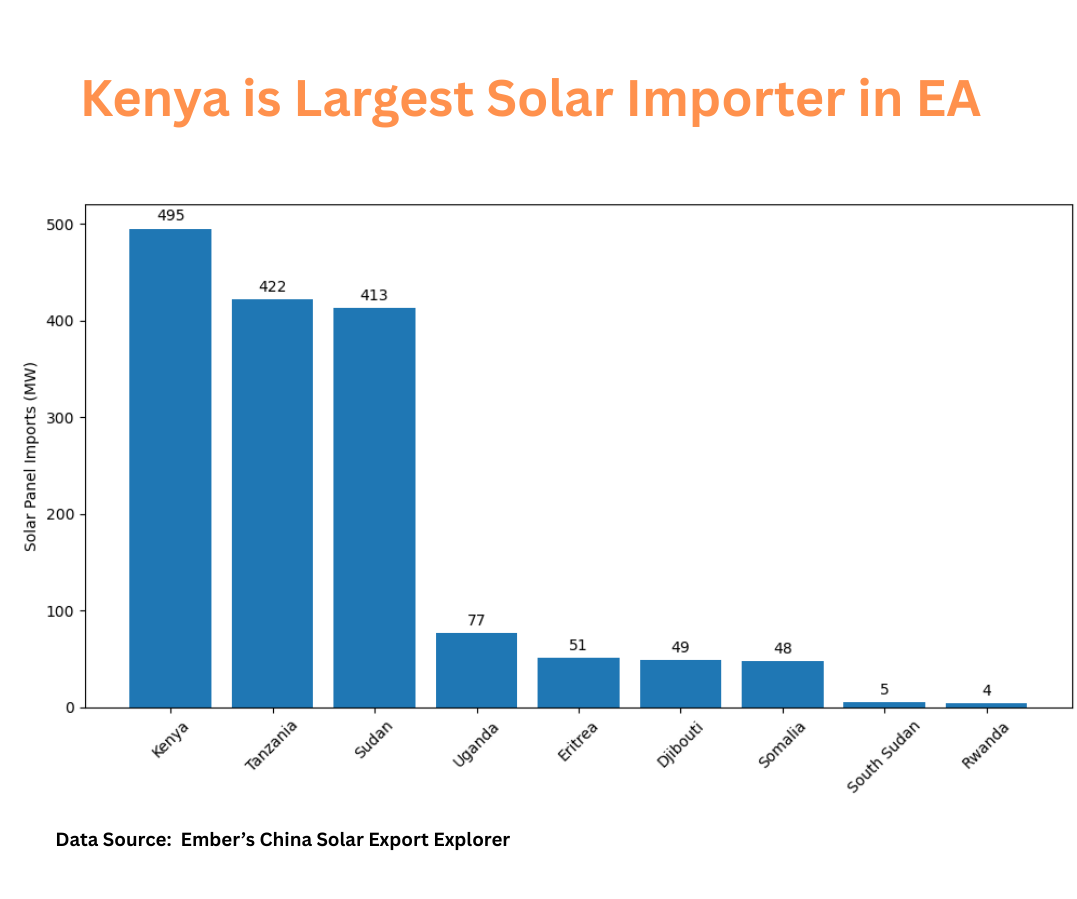
Kenya is the largest importer of solar panels in the Eastern African (EA) region. In terms of capacity, the country imported 495 megawatts of solar panels in the 12 months to June 2025.
This surge in imports is part of a steady trend, with data showing a consistent increase since 2021, when the country imported 200 megawatts. That translates to an import growth rate of 147.5% in 4 years.
Between 2013 and 2023, electricity access in Kenya grew from 37% to 79%, with solar solutions responsible for over 20% of that increase. More than 3 million households in Kenya now rely on off-grid solar products for their lighting, business, and farming needs.
Tanzania, Kenya’s neighbor to the south, is a close second in EA, having imported 422 megawatts of solar panels during the referenced period. Sudan, a country currently in civil strife, also registered an impressive 413 megawatts of solar panel imports.
These three countries stand out in Eastern Africa and are among the 20 other African countries that imported more than 100 megawatts of solar panels.
However, the rest of the region has been left behind. Ethiopia imported 89 MW, Uganda 77 MW, and Eritrea 51 MW. South Sudan and Rwanda are much further behind in imports, having recorded 5 MW and 4 MW, respectively.
Solar Panel Imports Surge in Africa
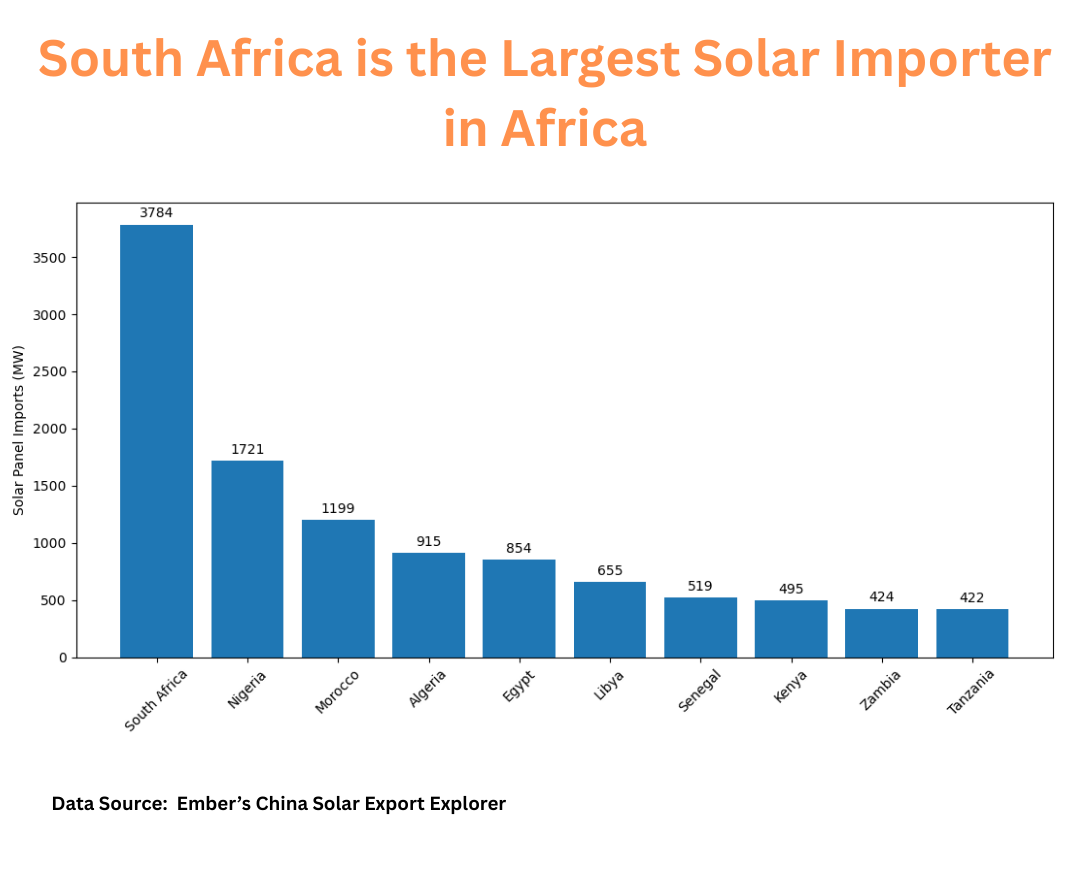
South Africa is the leading importer of solar panels in Africa. The country’s main power utility, Eskom, has experienced some grid troubles, leading residents to seek alternative power sources.
Last year, South Africa imported 3,784 MW of solar panels, and the country is now working to add 6 GW of solar capacity by 2030.
Meanwhile, Nigeria recorded 1,721 MW of imports. The West African nation’s chronic electricity crisis drives demand for solar power, as diesel generators continue to outproduce the grid.
According to the report by Ember, the significant savings on diesel in Nigeria mean that a solar panel can pay for itself in only six months.
“Bottom-up energy transitions fuelled by cheap solar are no longer a choice – they’re our future,” says Muhammad Mustafa Amjad, the Program Director at Renewables First.
Based on the report, some countries experienced exceptionally high growth rates, which serves as evidence for Amjad’s statement. In the 12 months leading up to June 2025, Algeria’s growth increased by 33 times, reaching the current 915 MW.
During the same period, Zambia’s growth was eight times higher, reaching 424 MW, a significant increase, as the country has been turning to solar to counteract recent droughts that have disrupted its hydroelectricity generation.
Botswana’s growth was seven times higher, while Liberia, DRC, Benin, and Angola all more than tripled their growth.
Why It’s All Coming from China
This record importation of solar panels has China as the main source market. Imports from the Asian giant surged by 60% in the last 12 months, reaching 15,032 MW.
In the last 18 months, solar panel prices have dropped by 40% to 50%, making solar energy a more affordable option. It now costs as little as three US cents per kilowatt-hour, which is cheaper than diesel and many electricity tariffs in Africa.
There are a few reasons for the price drop and China’s shift to the African market. A major factor is the overproduction of solar panels in Europe, along with the U.S. government’s restrictions on importing Chinese-made panels.
These issues are forcing China, which produces 80% of the world’s solar panels, to aggressively seek new markets. Africa is an easy destination as its solar solutions production cannot match demand.
Currently, domestic solar panel manufacturing on the continent is limited. Morocco recently doubled its manufacturing to 1 GW per year, matching South Africa’s capacity, while smaller manufacturing lines also exist in countries like Egypt and Nigeria.