






In the last three years, generative AI has been captivating the tech world, and its ability to analyse massive datasets and make smart decisions is driving its integration into more and more Software as a Service (SaaS) products.
Zoho’s Zia LLM is one example of this kind of integration. The technology company, which has a growing presence in Africa, didn’t simply join the recent wave of AI hype.
“Zia has been around for close to 13 years now. We have been giving it to our customers. This is part of our team’s ideology or their vision,” said Veerakumar Natarajan, Country Head for Zoho Kenya, in an interview with Techweez.
Zia LLM, however, represents its most advanced effort so far to embed AI directly into enterprise software for the African market. Operating in over 150 countries, Zoho provides all its users access to its AI, which is still undergoing training and is in early access mode.
“We still have to train it. We still have more work to do, but it is already helping the customers,” Natarajan explained.
A major concern with AI large language models (LLMs) is the source and use of their training data. In the case of Zia LLM, it was built and trained using Nvidia’s AI-accelerated platform and initially utilized generic public data.
However, to fit local Kenyan companies and perform in a B2B context, the company has taken a different training approach, where the agents adapt to individual customer data, ensuring localized and secure AI services.
Natarajan notes, “If you are one of our customers from Kenya, the AI agent comes with training from global data and starts to work on your data only.”
“With the RAC, Retrievable Augmented Capabilities, customers can generate the results specific to the company,” he adds. The aim is for the agents to act contextually on content across a company’s entire product suite.
Zia Agents Early Adopters in Kenya
In Kenya, Zoho’s gateway to the East African market, several companies have become early adopters of Zia’s 25 pre-built AI agents. As an enterprise software provider, Zoho serves various industries, with different sectors finding unique applications for the AI agents.
For instance, in insurance, Zia-powered chatbots improve customer engagement and call center efficiency. In IT hardware sales, predictive analytics help identify promising customers.
Consultancies use Zia to better understand client needs, sales and marketing teams use Zia to score leads and optimize revenue, and the agents are also being used in fintech and HR industries.
Currently, SMEs with a workforce of about 20 employees make up about 50 to 70% of the company’s revenue. However, rapid AI early adopters are mid-market companies. “Mid-market of about 100-200 employees in a company, those are the ones who are adopting it very well.”
The company is not charging an extra fee to use its AI agents. However, because running AI systems is expensive, Veerakumar Natarajan has not committed to any specific payment model for the future.
Zoho is expected to launch the full advanced Zia LLM in Kenya by the end of this year.
Data Storage and Latency Concerns
Kenyan customers’ data is stored in the USA rather than locally. The company says it complies with international and regional laws such as the Data Protection Act 2019 and GDPR. It also builds and owns all its data centers to safeguard customer privacy and maintain Zoho’s independence.
“We don’t go through third-party vendors like AWS or Google or anyone else, or even the co-location within the region.”
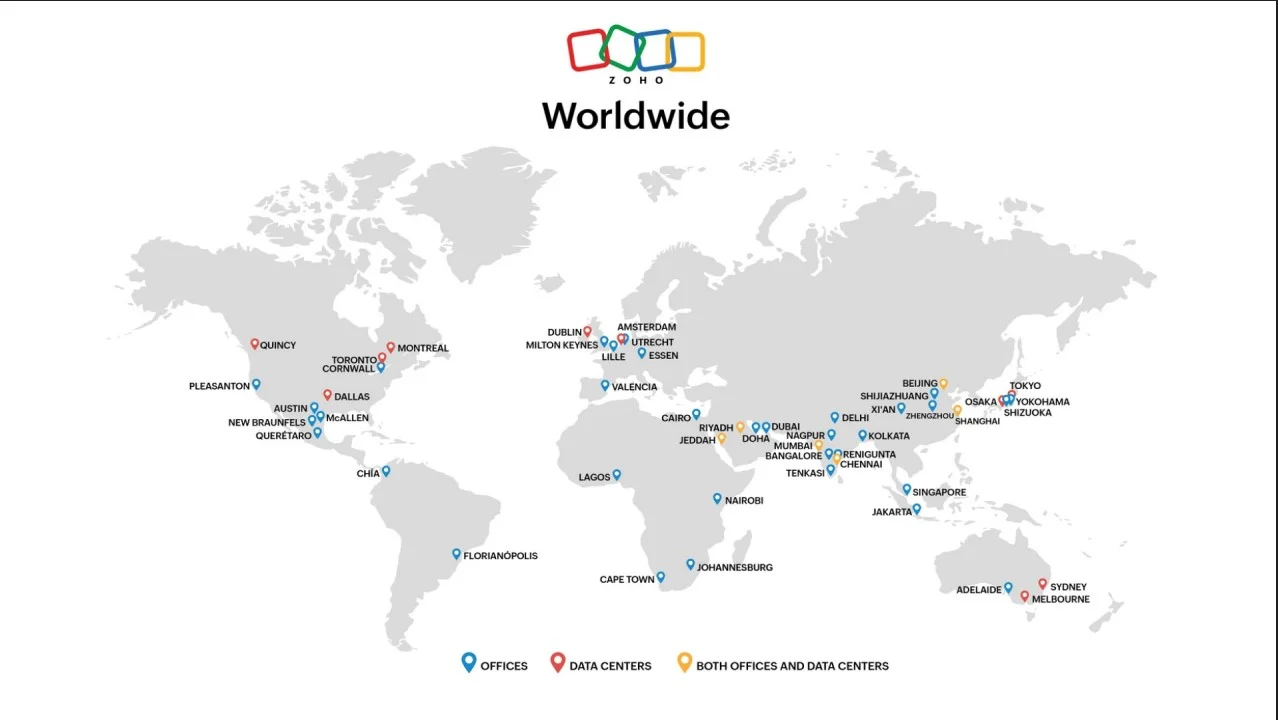
According to Natarajan, Zoho does not yet have a data center in Kenya or anywhere in Africa, but the company has invested in resources and infrastructure to greatly reduce latency for its African customers, cutting it from about 7% to almost negligible levels.