






Kenya’s path to a connected economy has encountered a slowdown. The latest Communications Authority (CA) sector statistics reveal that Machine-to-Machine (M2M) subscriptions, which power Internet of Things (IoT) services, fell by 9.9% in the quarter ending June 2025.
Active M2M SIMs dropped to 1.79 million from 1.99 million reported in March 2025.
Despite this decline, the report shows a modest 2.7% growth compared to the same period in 2024, when the country had 1.74 million M2M connections.
This suggests that IoT adoption is not collapsing but experiencing uneven progress, with momentum slowing in the short term even as the long-term outlook remains slightly positive.
M2M SIMs power a wide range of services, from smart electricity and water meters to fleet tracking, vehicle telemetry, and connected home devices.
The slowdown may reflect delays in utility smart meter rollouts, high device and connectivity costs, and enterprises holding back as they weigh 5G-driven IoT opportunities.
Gaps in regulation and interoperability standards may also be adding friction to scaling IoT across sectors.
Contrasting Market Trends
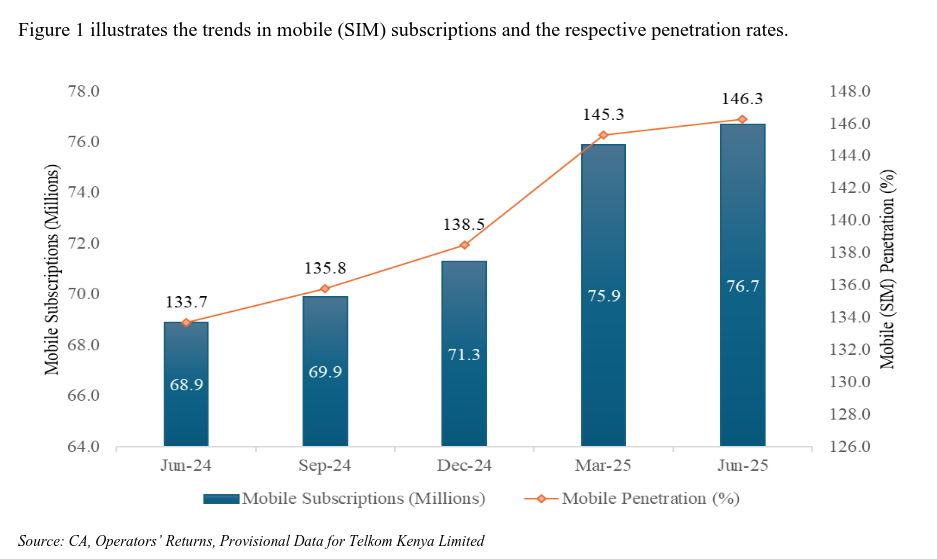
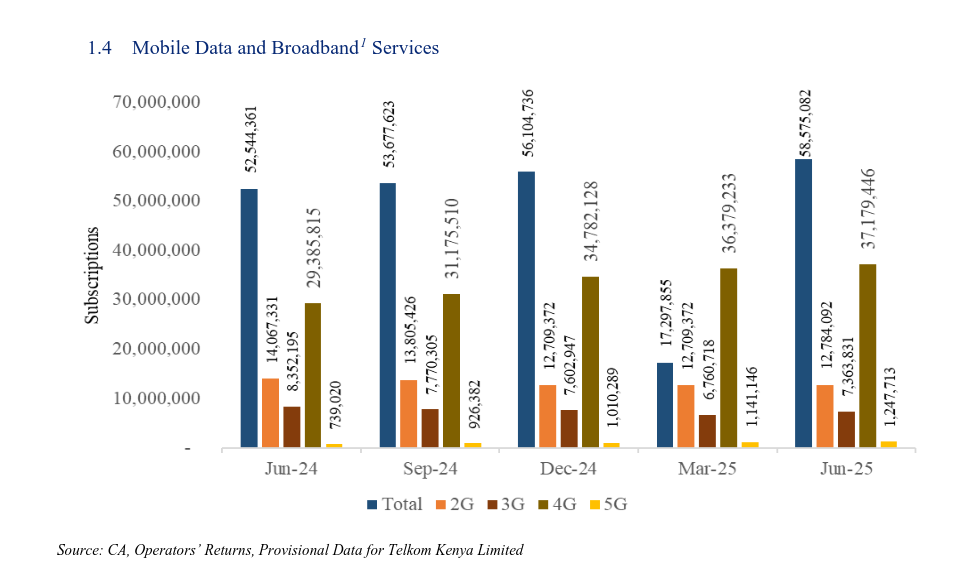
The decline in IoT adoption stands in sharp contrast to other segments of Kenya’s telecom market, which continue to post robust growth.
As of June 2025, the country recorded 76.7 million SIM subscriptions, 47.7 million mobile money accounts translating to 91% penetration, and 58.5 million internet subscriptions, dominated by 4G.
While consumer services thrive, enterprise-level IoT adoption remains more complex and slower to scale.
Without widespread IoT adoption, utilities may lose out on efficiency gains, logistics firms risk falling behind in competitiveness, and smart city ambitions could face delays.
The dip in M2M subscriptions could ripple across Kenya’s digital transformation agenda.
Experts argue that Kenya can reignite IoT momentum by strengthening public-private partnerships to accelerate deployments in energy, water, and transport and by creating more affordable connectivity models.
With 5G networks expanding, new opportunities for low-latency, large-scale IoT deployments could give the sector the boost it needs.
For now, Kenya’s IoT ecosystem remains at a crossroads. At 1.79 million active connections, the market is still growing compared to last year, but it has lost pace in the short term.