






Wikipedia appears to have taken a thinly veiled swipe at Elon Musk’s newly launched Grokipedia, the AI-powered encyclopedia developed by his company xAI.
In its latest fundraising campaign, the non-profit platform reminded users that it remains a human-driven project, not a billionaire-owned tech experiment.
In a pop-up message displayed to U.S. visitors, Wikipedia emphasized its grassroots origins and independence from corporate or ideological influence.
“After nearly 25 years, Wikipedia is still the internet we were promised, created by people, not by machines. It’s not perfect, but it’s not here to push a point of view,” the message read. “It’s owned by a non-profit, not a giant technology company or a billionaire.”
While Wikipedia didn’t mention Elon Musk or Grokipedia directly, the timing and wording of its message have been widely interpreted as a jab at Musk, whose net worth hovers around $500 billion.
The billionaire entrepreneur recently introduced Grokipedia as an AI-driven alternative to Wikipedia, claiming it would provide more transparent and “truth-seeking” content powered by the Grok large language model.
The Clash Between Human and Machine Knowledge
Wikipedia, founded in 2001, has built its massive database through the voluntary efforts of millions of human editors worldwide. Its open-source model relies on collaborative writing, human moderation, and a community-led structure to ensure neutrality and reliability.
Grokipedia, on the other hand, employs AI-generated and AI-edited entries, which users can modify in real time. The platform combines automation with crowdsourced oversight, allowing users to flag errors and track edit histories.
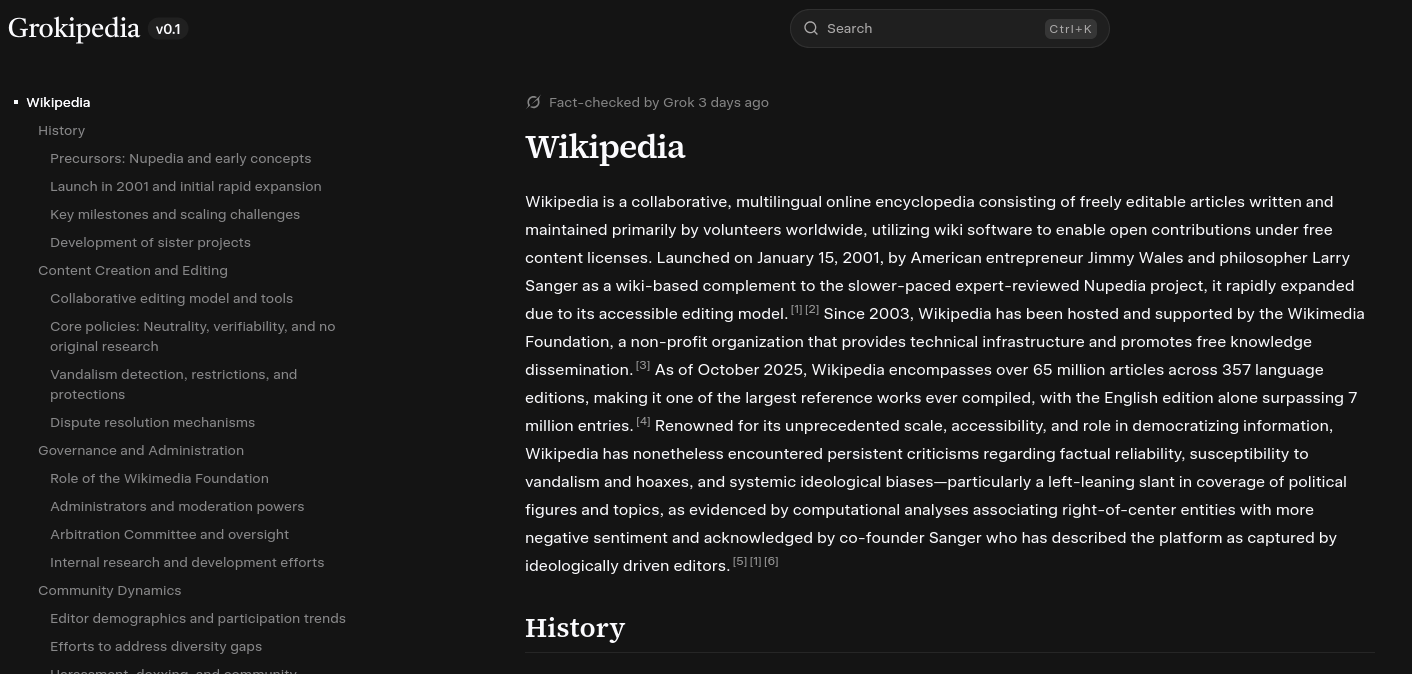
However, it has already drawn controversy for pushing biased or factually questionable content, including far-right narratives and disputed claims related to health and gender.
Critics argue that while Grokipedia’s AI foundation could revolutionize information accessibility, it also risks amplifying misinformation, something Wikipedia has long battled through human moderation and fact-checking processes.