






The Communications Authority of Kenya has rolled out two comprehensive frameworks that fundamentally change how telecom companies, broadcasters, and postal services must think about their environmental footprint.
These regulatory requirements touch everything from where you can put a cell tower to how postal workers deliver packages.
The ESIA guidelines and carbon reduction framework are Kenya’s response to international commitments made through the Paris Climate Agreement and standards set by the International Telecommunication Union.
The target of ITU’s L.1470 standard is that the ICT sector worldwide needs to cut greenhouse gas emissions by 45% between 2020 and 2030. It appears Kenya is taking this seriously enough to embed these requirements into its licensing and approval processes.
The Environmental Review Process
Before any company can install a cell tower, data center, or broadcast facility in Kenya, they need environmental clearance from the National Environmental Management Authority. But now there’s an additional layer.
Communications Authority, as the lead agency for ICT matters, evaluates these projects against specific environmental criteria that go well beyond standard environmental assessments.
Companies must provide satellite maps with exact coordinates, elevation drawings showing tower height and design, and measurements of electromagnetic field exposure at five different distances from the installation.
These EMF measurements must follow International Commission for Non-Ionizing Radiation Protection guidelines and capture electric field strength, magnetic field strength, and power density both before and after installation.
Visual impact gets particular attention as towers and equipment need to blend into their surroundings, especially in protected areas like national parks. The regulations push for camouflaged designs that minimize the industrial appearance of telecom infrastructure.
Infrastructure Sharing Is Now Mandatory
One of the most significant changes is the requirement for site sharing and co-location. If existing infrastructure exists in an area, new applicants must use it unless they can prove it’s technically impossible. This means sharing towers, physical space, buildings, and even power sources.
Companies that refuse to share must justify their decision in writing to the requesting operator. For broadcast towers specifically, they must be located at designated broadcast transmitter sites.
READ: New Rules Could Force ISPs and Telcos to Share Towers and Cables
The environmental impact assessment must include the distance in meters and degrees to the nearest existing site if the applicant isn’t sharing.
This requirement tackles a visible problem in Kenya’s urban areas, where multiple telecom operators have erected separate towers in close proximity, creating visual pollution and unnecessary environmental impact.
The Reality of Carbon Footprint
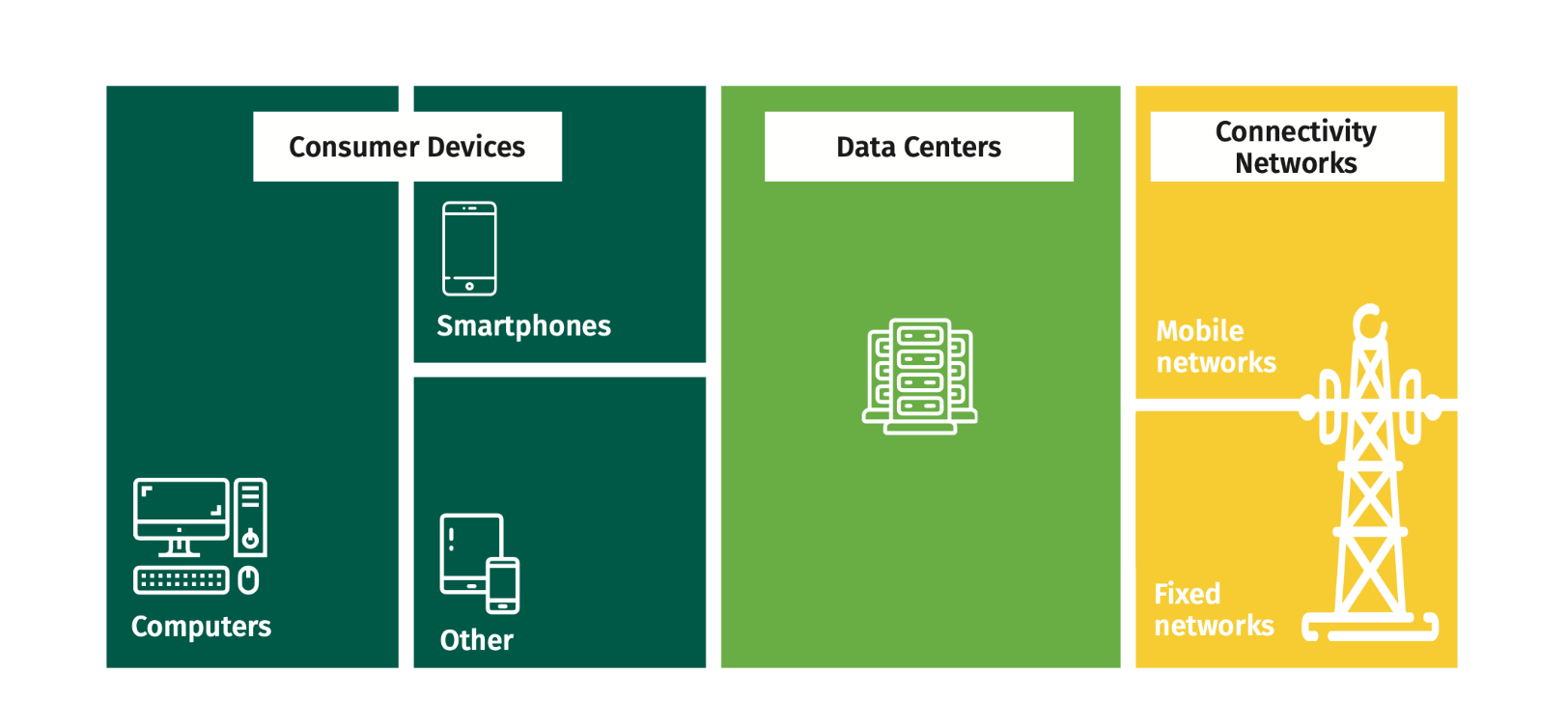
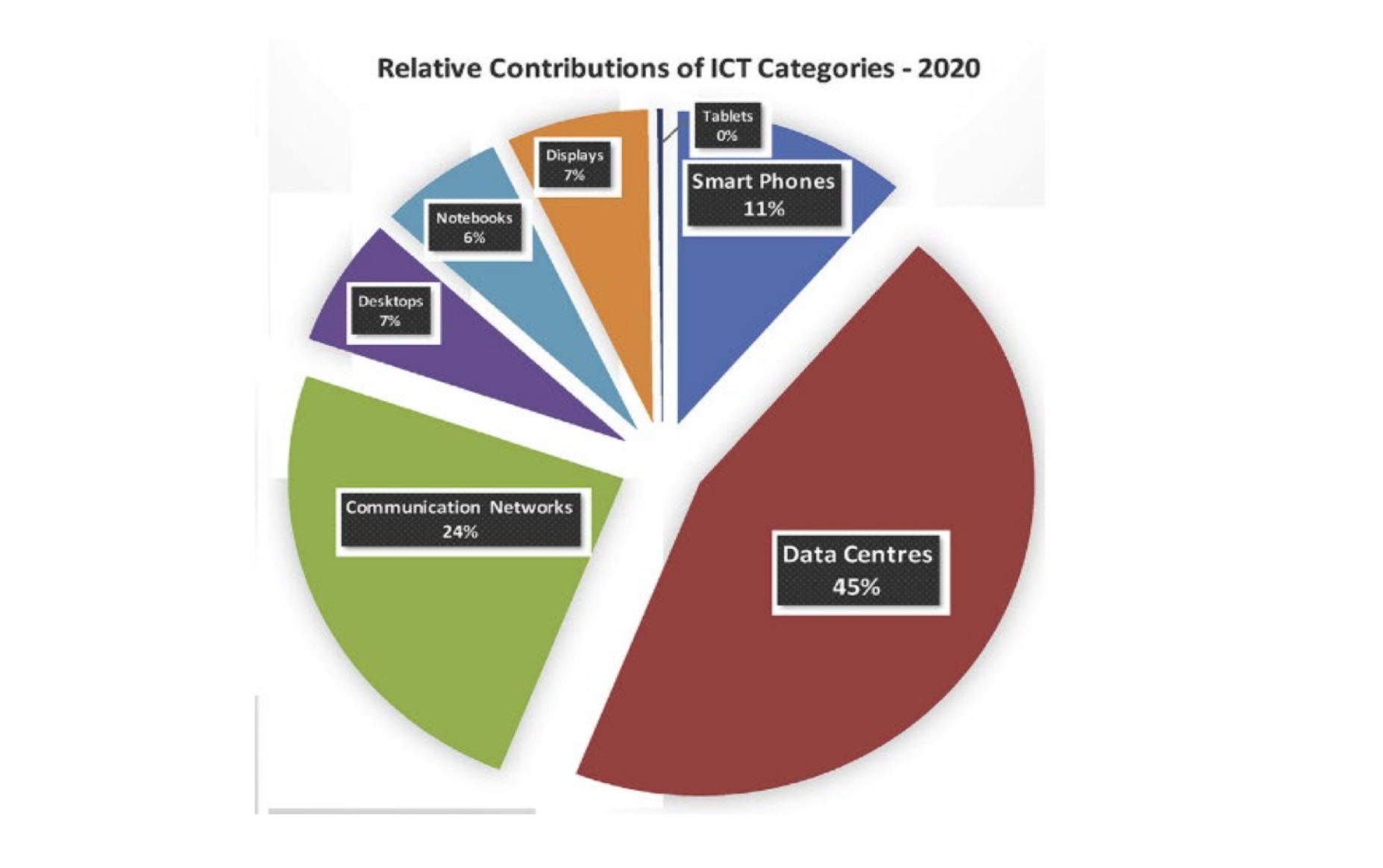
The frameworks break down exactly where carbon emissions come from in the ICT sector. Data centers contribute 45% of the sector’s carbon footprint, networks account for 24%, and user devices make up 31%.
Globally, ICT contributes about 3% of total carbon emissions, roughly one metric gigatonne.
More people use ICT services every year, making the problem worse. Device prices keep dropping, so people own multiple gadgets. Each new generation of technology demands more power.
3G phones need more juice than 2G phones, 4G more than 3G, and 5G more still. We’ve shifted to “always-on” usage patterns, and people hoard digital content instead of deleting it.
The postal and courier sector has its own carbon issues. Delivery vehicles burn fossil fuel. Sorting facilities run on electricity. Packaging materials require manufacturing and transportation. Even producing stamps generates emissions.
Practical Carbon Reduction Measures
The carbon reduction framework requires companies to report annually on specific metrics. For telecom operators, that means tracking how many sites run on green power, how many are shared with other operators, how many use smart technology for energy management, and how many services are hosted in cloud or public data centers rather than private server rooms.
Postal and courier operators must report on outlets using solar or wind power, the number of electric delivery vehicles or bicycles in their fleet, and how many items are sent using franking machines instead of physical stamps.
CA encourages postal operators to register on OSCAR, the Universal Postal Union’s Online Solution for Carbon Analysis and Reporting. This free platform uses questionnaires to calculate a company’s CO₂ contribution and compares it against industry averages.
Community Engagement Gets Structure
Before starting any project, companies must educate affected communities about the proposed installation, covering both positive and negative impacts. All training materials must be attached to the environmental assessment.
Community input must also be verifiable. That means names, identification details, mobile phone contacts, and signatures. The Authority wants to see documented opinions from residents, resident associations, businesses, local NGOs, and government officials about their concerns and how those concerns will be addressed.
The template provided in the guidelines asks people whether they support, oppose, or feel neutral about a project. It asks about concerns ranging from visual impact to health and safety to property values. It asks what benefits people expect and how they want to receive project updates.
Technology as a Solution
The frameworks acknowledge that while ICT contributes to carbon emissions, it also helps reduce them elsewhere. Online banking, e-government, e-learning, and e-commerce cut the need for physical travel.
Smart buildings and smart cities use sensors to optimize energy consumption. Virtualization reduces the need for physical servers, and cloud computing lets multiple organizations share infrastructure instead of each maintaining their own.
These aren’t theoretical benefits, as the regulations actively push companies toward these solutions by making them part of the approval criteria for new projects.
Compliance and Standards
Every environmental assessment must demonstrate compliance with ISO 14001, the international standard for environmental management systems.
This means having an environmental policy, setting environmental targets, running environmental programs, and assigning specific responsibilities for environmental sustainability across construction, operation, and decommissioning phases.
Companies must also comply with Kenya’s Climate Change Act of 2025 and submit detailed e-waste management plans that follow a hierarchy: avoid, reduce, mitigate, then offset.
CA will verify reported data periodically. The framework operates on principles of innovation, industry-driven effort, technology neutrality, and progressive achievement of targets.
Companies set their own reduction goals, but those goals must align with the UN target of net zero emissions by 2050.
What This Means in Practice
These requirements change the economics and logistics of operating in Kenya’s ICT sector. Building a new cell site now requires extensive documentation proving you can’t share existing infrastructure.
Running a data center means demonstrating energy efficiency measures. Operating a delivery fleet means justifying why you’re not using electric vehicles or bicycles for last-mile delivery.
The regulations push real costs onto operators but also create opportunities. Companies investing in solar power, smart energy management, and infrastructure sharing get regulatory approval more easily.
Those clinging to old models face more scrutiny and potentially longer approval times.