







A proposed amendment to Kenya’s public participation framework is drawing quiet concern in legal and civil society circles, and it deserves far more public attention than it is getting.
The change is technical, narrow in its wording, and precisely calibrated to be easy to dismiss as administrative housekeeping. It is not.
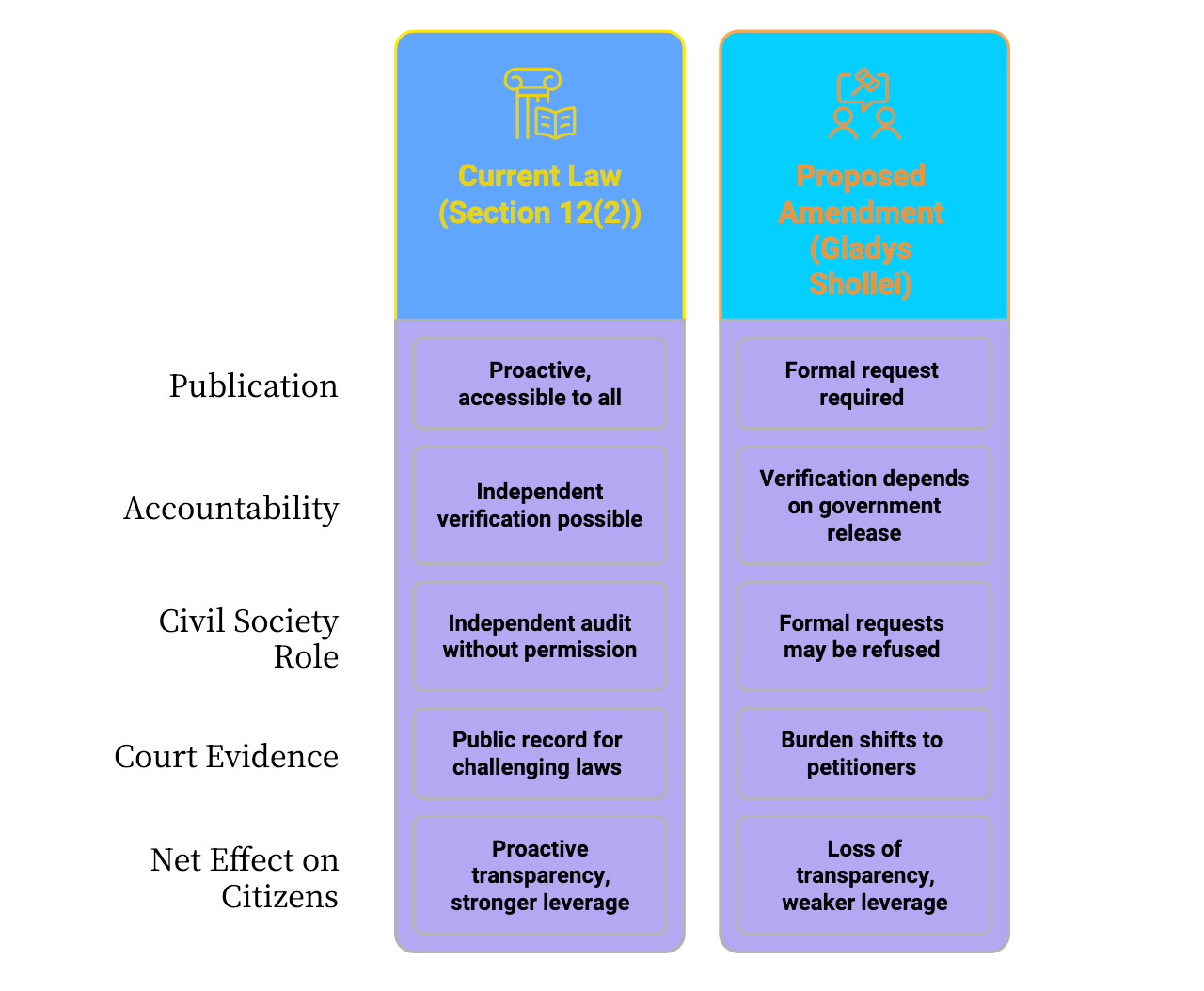
Gladys Shollei, the Deputy Speaker of the National Assembly and Uasin Gishu Woman Representative, has proposed striking out the requirement under Section 12(2) of the existing framework that compels responsible authorities to publish the outcomes of public participation exercises.
Under the current arrangement, when citizens submit views on a proposed law or policy, those submissions and, crucially, the authority’s response to them must be made publicly accessible.
Shollei’s amendment would make that disclosure optional, placing the burden on citizens to submit formal requests to the very institutions whose conduct they may want to scrutinize.
What the Constitution Demands
It is worth understanding what public participation means in Kenya’s constitutional order before judging what this amendment would do to it.
The Constitution establishes public participation as a national value and principle of governance, not merely a procedural box to tick before a bill gets its third reading. The Supreme Court, High Court, and Court of Appeal have repeatedly affirmed this.
The BBI case is the most prominent example, where the Supreme Court’s majority found that the process fell short of the required threshold for meaningful public participation, especially because the public was not sufficiently involved in critical aspects of the Amendment Bill.
The point here is that inadequate public participation has become a primary mechanism through which citizens, civil society, and the courts have challenged executive overreach.
It is one of the few legal tools that ordinary Kenyans can credibly deploy against a state that often moves faster than its own legal safeguards.
What the Amendment Removes
The proposal does not cancel public participation. That would be too constitutionally untenable. What it removes is the paper trail that gives the process its teeth.
Right now, anyone can look up what was submitted and what the government claims it did with those submissions. That record is what allows citizens to go to court and argue.
It goes something like, “Look, the public rejected this by a substantial margin, and the government passed it anyway.”
Petitioners raised exactly this argument against the Affordable Housing Act, 2024, contending that the levy was rejected by a majority during the public participation process.
Without a mandatory published record, that argument collapses. The government can simply say participation happened and decline to elaborate.
The Access to Information Act route that the amendment relies on as a fallback is considerably weaker than it sounds. Even with that Act in place, administrative institutions remain largely unresponsive to information requests, making access difficult in practice.
Combined with 21-day response windows, appeals processes, and the practical difficulty of litigating access, the substitution does not hold.
The Political Logic
Understanding why Shollei would push this requires understanding the political terrain she operates in. She is the Deputy Speaker, which means she is a figure of the establishment, closely aligned with the current ruling administration.
She is also a lawyer with a background as Chief Registrar of the Judiciary and Chief Executive Officer of the National Council for Law Reporting, meaning she understands precisely what transparency requirements do inside a legal process.
The government has repeatedly found public participation to be an irritant. The Finance Bill 2024 showed why mass protests followed a participation exercise critics said was hollow, and the bill was withdrawn.
The lesson the administration apparently drew was not that it needed to listen more carefully but that what citizens say in public forums can be used against the government in court.
At a time when courts are repeatedly nullifying laws for lack of proper public input, Parliament is considering how to standardize how citizens engage with government decisions.
The Public Participation Bill, 2025, sponsored by Samuel Chepkonga and Otiende Amollo, represents one strand of this thinking, a very real attempt to codify participation standards. The Shollei Amendment represents another strand entirely.
One bill tries to make participation mean something while another quietly removes the mechanism that would confirm whether it did.
What Kenyans Stand to Lose
What Kenyans stand to lose runs across several concrete functions that public access to participation outcomes currently serves.
Civil society groups lose the baseline they use to track whether government decisions actually reflect what the public said.
Journalists lose the paper trail that lets them report whether a controversial policy was widely rejected before it was quietly passed anyway while lawyers lose the evidence they need to challenge laws for inadequate participation.
Researchers lose the dataset that would let them measure, over time, whether Kenya’s democratic engagement is improving or regressing, and ordinary citizens, who lack the resources or legal sophistication to file formal information requests and fight refusals, are simply locked out entirely.
When the rules around participation are vague or weak, governments treat the process as a formality. Kenya has been here before, and the pattern is consistent: cut corners on participation, pass the law, face a court challenge, and get sent back to start.
READ: Court of Appeal Strikes Down Cybercrimes Act Provisions on False Online Publications
That cycle costs far more, in time, money, and public trust, than real consultation ever would.
This amendment is not a fix but a rollback framed as tidying up the statute. Kenya’s democratic checks are still fragile enough that ordinary people need independent tools to hold the state accountable.
Transparent participation outcomes are one of those tools. Take them away and you tilt an already uneven playing field further toward the government.