




Kenya’s biggest mobile money platform, M-Pesa, is set to increase its transaction charges if Kenyan Members of Parliament (MPs) approve a clause in the Finance Bill 2026.
Safaricom, the owner of M-Pesa, appeared before MPs to table its concerns over Clause 31(b)(i) of the bill, which proposes to subject mobile money transfers to Value Added Tax (VAT) at 16%. This levy comes on top of the existing 15% excise duty already charged on mobile money and payment processing services.
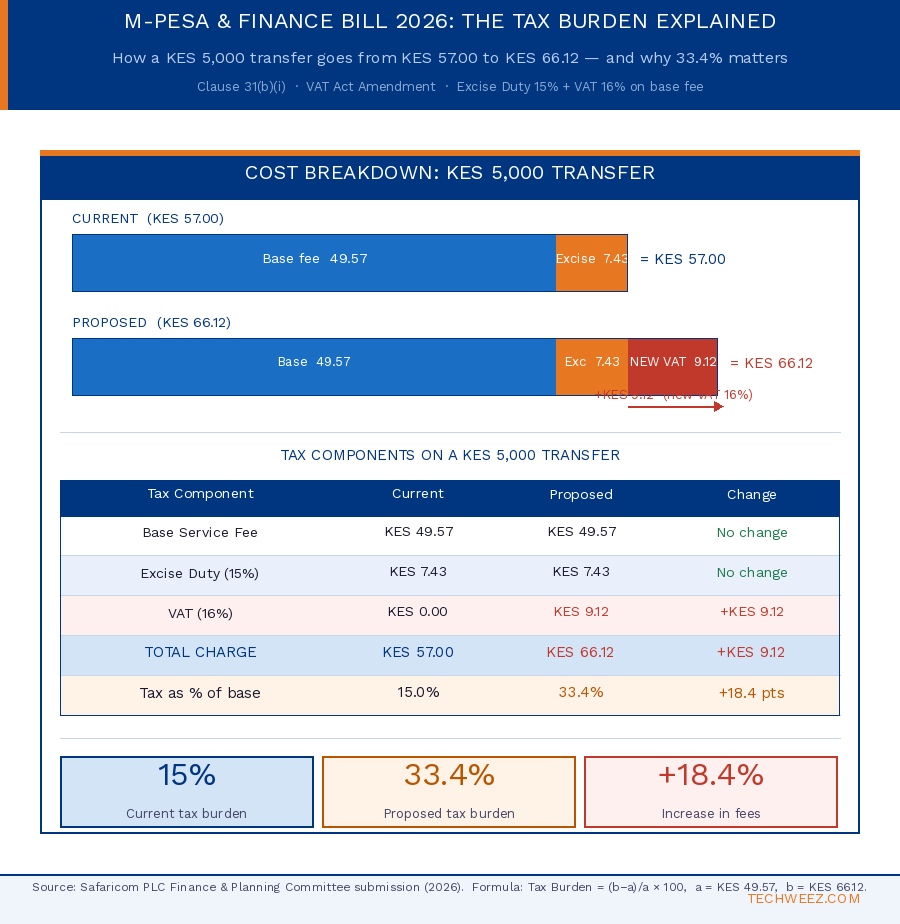
Currently, M-Pesa transfers only attract the excise duty but are exempt from VAT. The Finance Bill 2026 proposes to increase the effective tax burden on Kenya’s 51,356,425 mobile money users from 15% to 33.4%.
Based on what Safaricom submitted, if an M-Pesa user were to send KES 5,000 today, with the current excise duty factored in, they would need KES 5,057. If Clause 31(b)(i) passes as is, the same user would require KES 5,066.12.
While Safaricom’s base service fee remains KES 49.57, this M-Pesa user faces a new total charge of KES 66.12. This increase is driven by KES 16.55 in total taxes, which now represents 33.4% of the original base fee.
The 33.4% represents an 18.4% increase in transaction costs on a single transfer, a sign of the government’s intent on raiding the pockets of taxpayers.
Kenyans are dependent on the platform, with M-Pesa users moving KES 41.7 trillion in the last financial year. Any additional taxation on its cumulative cost could become a meaningful burden to taxpayers.
READ: M-Pesa Visa Users Surge 62%, But Customer Spending Drops
This is especially so as the proposed VAT would apply not only to peer-to-peer transfers but also to agent withdrawal charges. For higher transaction bands, withdrawal fees could increase by double digits in absolute terms, compounding the overall cost of using a service meant to drive financial inclusion.