




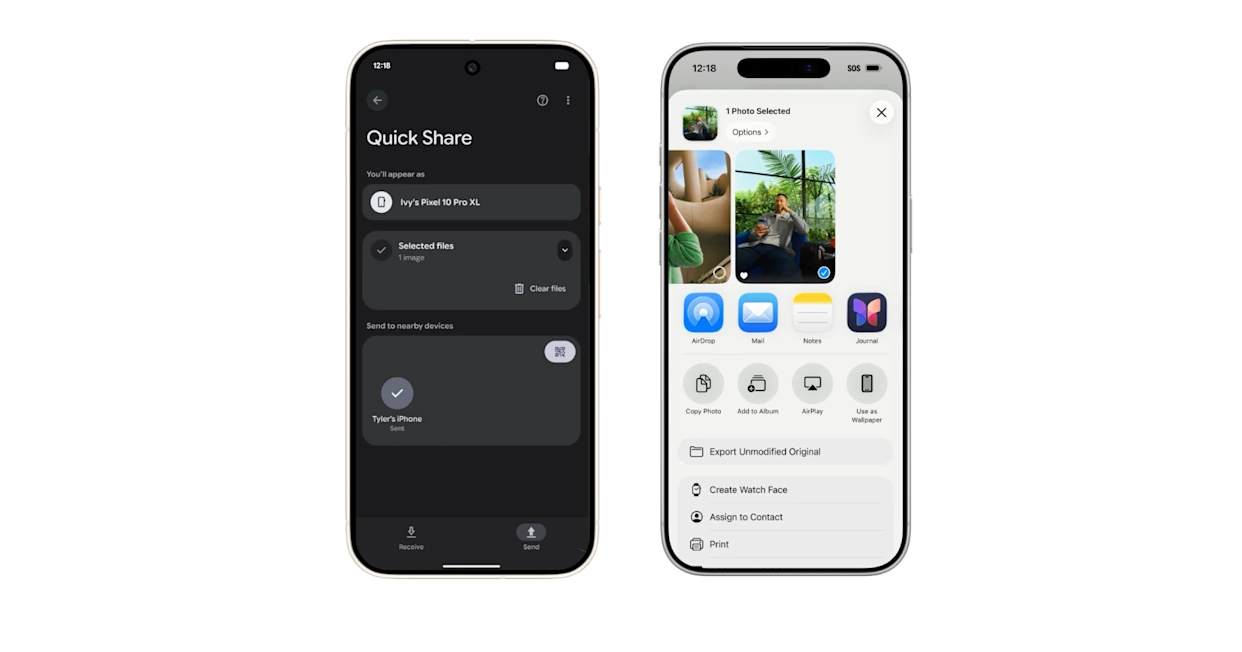
More walls that have been separating Android and iOS users are coming down. Android’s Quick Share has been upgraded to work smoothly with Apple’s AirDrop, allowing for two-way file sharing between Android and iOS devices.
The feature allows fast sharing of photos, videos, and other files with the people you want, regardless of their phone’s platform. However, Pixel 10 users will be the first to access this feature, and Google has not yet confirmed when it will roll out to other Android devices.
This is the latest addition to cross-platform features, coming after RCS support and alerts for unknown trackers.
AirDrop’s “Everyone” Mode
Currently, Android’s Quick Share supports AirDrop’s “Everyone for 10 minutes” mode, using a peer-to-peer connection. User data goes directly peer-to-peer; nothing is recorded, and no extra details are exchanged.
As with any AirDrop transfer to non-contacts, users can verify the correct recipient by checking their device name on their screen while confirming with them directly.
In the future, Google will explore the possibility of working with Apple in order to enable “Contacts Only” mode.
Quick Share Security Features
Google claims that Quick Share’s interoperability support for AirDrop has been done with security at the center of the design.
The secure sharing channel is built using Rust, a memory-safe programming language known for preventing common vulnerabilities like buffer overflow, ensuring a protected connection.
This security is further reinforced by the strong, built-in protections of both Android and iOS, with Android leveraging Rust at the OS level alongside features like Google Play Protect, and iOS providing its own robust defenses against threats.
Additionally, users maintain control over file sharing, as all incoming files require their approval before being accepted, ensuring data safety across platforms.
Google also states that it engaged external experts to further assess security features.
“After conducting our own secure product development, internal threat modelling, privacy reviews, and red team penetration tests, we engaged with NetSPI, a leading third-party penetration testing firm, to further validate the security of this feature and conduct an independent security assessment,” the company wrote in its latest blog.