




Mobile data continues to be the backbone of Kenya’s internet economy, powering everything from social services to digital commerce.
By the end of the first quarter of the current financial year, mobile data subscriptions hit 60.2 million, with 78.3% of them classified as mobile broadband users.
Among these broadband users, 4G remains the undisputed leader, accounting for 84.8% of all mobile broadband subscriptions.
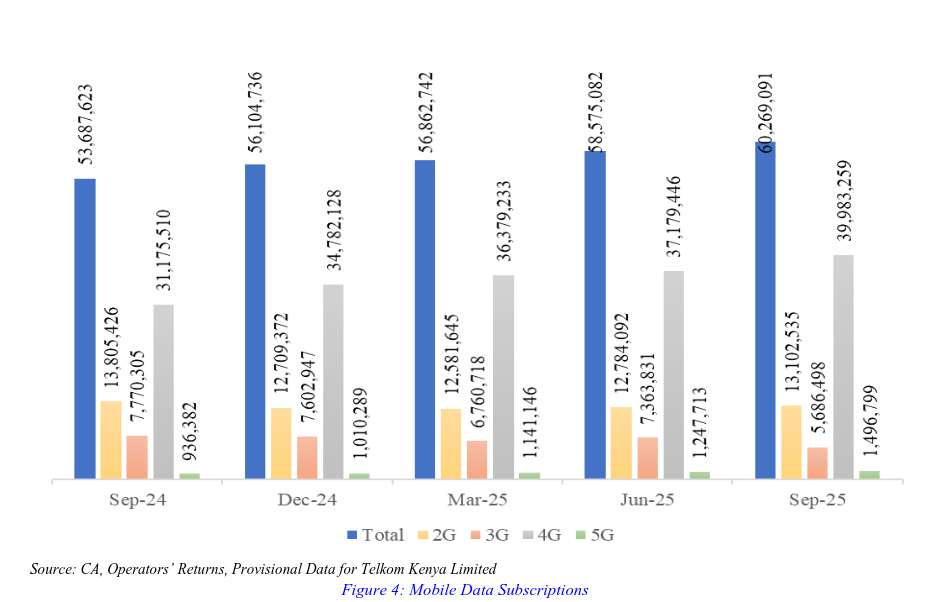
This strong lead is driven by nationwide coverage, affordable devices, and the maturity of 4G infrastructure across both urban and rural regions.
Total mobile subscriptions have consistently risen over the past five quarters, reflecting increased device ownership and expanding digital access. However, the tech split shows a notable shift. 4G subscriptions keep climbing, cementing its position as the primary connectivity layer.
5G subscriptions, though still relatively small, are growing steadily as operators expand coverage and more 5G-enabled phones enter the market.
In contrast, 3G continues to decline, a natural outcome as users migrate to faster and more capable networks offering better user experiences.
5G Users Lead in Data Consumption
While 4G leads in subscriber numbers, 5G users consume the most data by far, showing how advanced network capabilities translate into heavier usage.
According to the Communications Authority, the average mobile broadband user consumes 14.3 GB per month. However, 5G users record a massive 40 GB monthly, far surpassing all other categories.
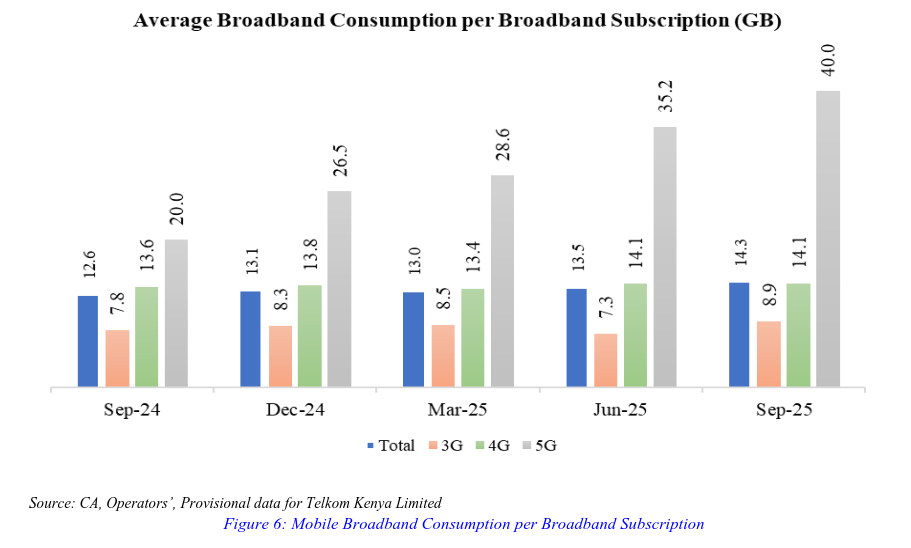
Close behind are 4G users at 14.1 GB, reflecting the network’s central role in daily digital activity. Meanwhile, 3G usage continues to shrink, consistent with declining adoption and its limited bandwidth capacity.
Even with rising interest in 5G, Kenya’s connectivity landscape still leans heavily on 4G. Its dominance is driven by wide national coverage, lower device costs, and broad compatibility with everyday apps and services.
The 4G ecosystem is stable and affordable, making it the default technology for most Kenyans. Conversely, 5G devices and data plans are still relatively expensive, which hinders widespread adoption even though their availability is increasing.