







The Communications Authority of Kenya (CA) is pushing ever harder to control what phones enter the market and how they get here, and the costs of that push are starting to land on ordinary Kenyans.
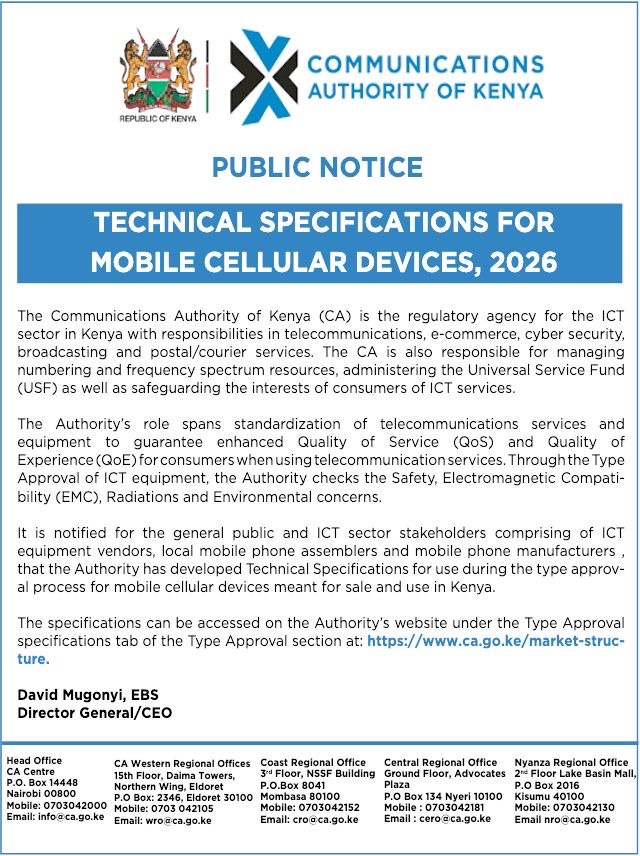
In its Technical Specifications for Mobile Cellular Devices 2026, the CA has laid out the standards every phone must meet before it can legally be sold in Kenya.
The authority checks for safety risks, electromagnetic compatibility, radiation levels, and environmental compliance through a process called type approval.
Devices that skip this process are barred from Kenyan networks, and the CA recently flagged 21 phone brands, including TINSIK, FONROX, QQMEE, and MOMOFLY, for immediate prohibition after market surveillance found them non-compliant.
The stated goals are reasonable enough as the CA wants to keep unsafe devices off the market, protect public health, and prevent smuggled units from bypassing tax obligations.
To that end, the authority has linked its type approval database with KRA’s IMEI registry, so only devices that are both technically certified and tax compliant can connect to local networks.
Compliance, however, comes with a growing price tag. A consultation paper signed by Director General David Mugonyi, dated March 3, 2026, proposes charging KES 15,000 per permit for commercial ICT imports and KES 5,000 for personal use imports.
The authority says the fees are necessary to sustain permit processing operations it currently runs for free. If approved, the charges would apply to all applications processed through the National Electronic Single Window System, the KenTrade-managed TradeNet platform that every ICT equipment shipment must clear before customs release.
The proposal has a proportionality problem since a small retailer importing ten smartphones pays the same KES 15,000 as an operator importing telecommunications infrastructure.
CA has also not disclosed how many permits it processes each year, making it hard for stakeholders to judge whether the proposed fees actually reflect the costs involved.
For consumers, the combined effect is likely to narrow the range of available budget devices and push up prices at the lower end of the market.
Phones from the flagged brands were almost certainly reaching buyers who could not afford certified alternatives. Cutting off that supply without addressing affordability does not make the market safer so much as it makes it more expensive.
That gap is where the black market finds room to grow. The regulations are better designed to clean up the formal market than to kill the informal one.
READ: Kenyan Court Blocks Telcos From Reassigning Phone Numbers Without Original Owner’s Consent
As certified device prices rise, the appeal of cheaper uncertified phones does not go away; it just moves further from plain sight.
The IMEI whitelist is the stronger deterrent since a device that cannot connect to any Kenyan network is effectively a brick, but that pressure has historically pushed traders toward phones with cloned or spoofed IMEIs rather than out of the trade altogether.
Without enforcement that reaches open-air markets and border towns, these rules are most keenly felt by legitimate vendors and least felt by the ones they are meant to stop.
What is taking shape is a system where you need two stamps to sell a phone in Kenya. The CA has to approve the device, and KRA has to clear the import. Miss either one, and the phone cannot legally connect to a Kenyan network.
That is not necessarily a bad thing, but the people who feel it most are not the big importers but the small shop owners, local assemblers, and buyers who were already stretching to afford a basic handset.