







Every year when Kenya’s largest banks release their full-year financial results, they are essentially bringing home their report cards. In 2025, most of them came out looking very healthy.
The “Big Five,” which comprises Equity Group, KCB Group, Co-operative Bank, NCBA Group, and Absa Bank Kenya, all grew their profits despite a challenging economic environment marked by high interest rates and a tight cost-of-living squeeze for ordinary Kenyans.
The combined profit after tax of the seven largest banks was roughly KES 246 billion, a figure that would have been unthinkable a decade ago.

Full Results At a Glance: Who Won and Who Lost
Looking at the profit after tax (PAT), year-on-year growth, total assets, and customer deposits for the seven largest banks for the full year 2025, we can gauge the clearest single measure of performance.
| Bank | PAT (KES B) | Growth | Total assets (B) | Deposits (B) |
|---|---|---|---|---|
| Equity Group | 75.50 | +55.0% | 1,970 | 1,460 |
| KCB Group | 68.35 | +10.6% | 1,960 | 1,320 |
| Co-operative Bank | 29.75 | +16.9% | 827 | 520 |
| NCBA Group | 23.40 | +7.0% | 743 | 506 |
| Absa Bank Kenya | 22.90 | +10.0% | 530 | 380 |
| Stanbic Holdings | 13.72 | +0.02% | 420 | 310 |
| Standard Chartered | 12.40 | -38.0% | 380 | 290 |
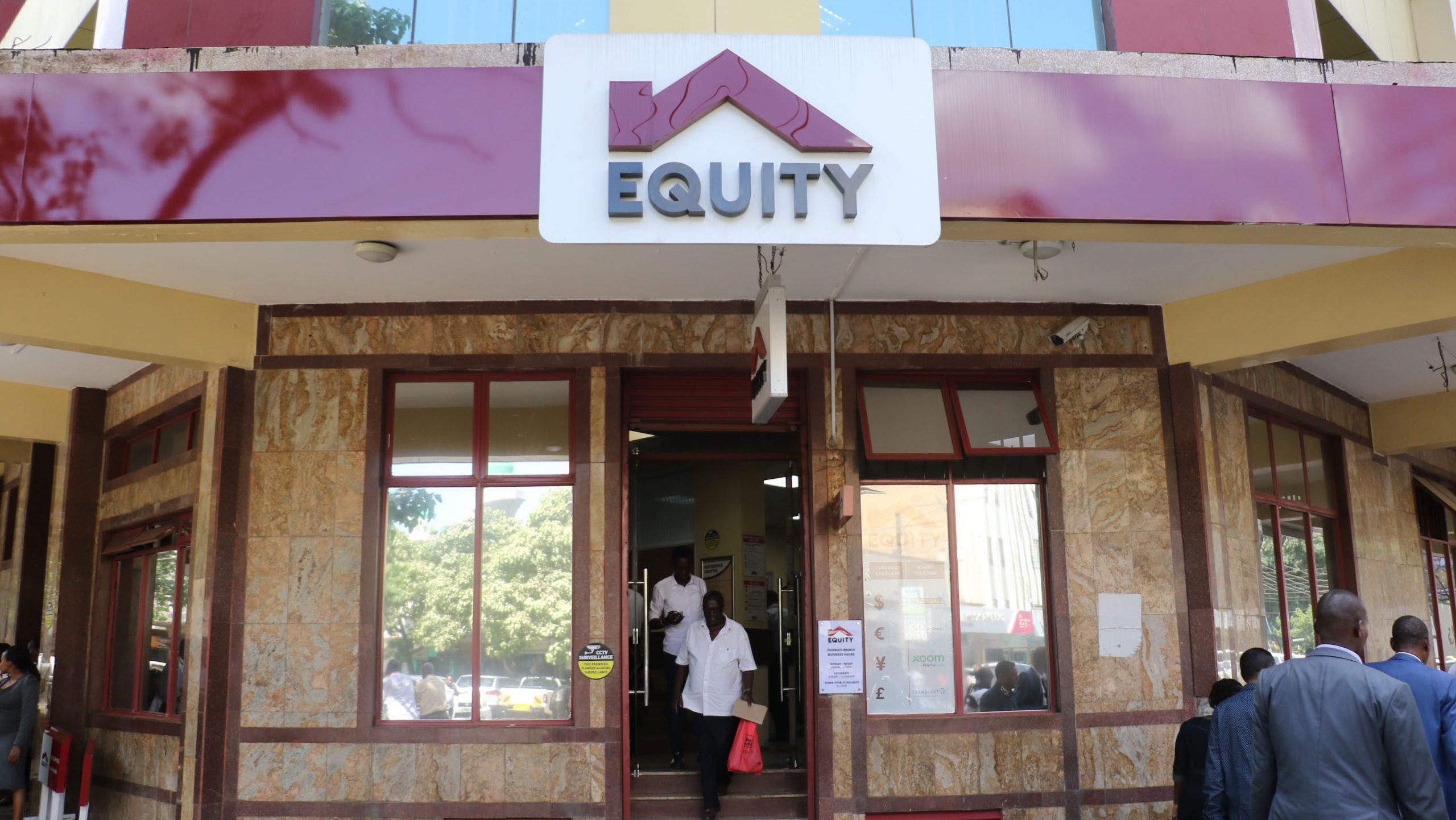
Equity Group’s 55% surge in profit after tax to KES 75.5 billion was the headline result of the year as the biggest growth leap of any large bank and trillion, one of the strongest single-year performances in Kenyan banking history.
The growth was attributed to strong performance from regional subsidiaries (particularly in the DRC and Uganda), heavy investment in digital infrastructure over the past several years paying off in efficiency gains, and a high-interest-rate environment that widened lending margins.
Equity now sits narrowly ahead of KCB in total assets at KES 1.97 trillion versus KES 1.96 trillion, making the two banks co-equal in size. That is a significant shift given that KCB held a comfortable lead as recently as 2023.
KCB Group, on the other hand, posted its strongest-ever profit of KES 68.35 billion, up 10.6%, while simultaneously achieving a milestone where over 99% of its transactions ran through non-branch channels.
The bank was named Best Bank in Kenya 2025 by Euromoney, recognition that reflects both financial performance and operational transformation.
Co-operative Bank grew profit by 16.9% to KES 29.75 billion and raised its dividend per share (DPS) by 67%, which was the largest DPS increase among the large lenders.
For a bank closely tied to Kenya’s cooperative movement and SACCO network, the performance indicates a loyal customer base and disciplined cost management.
Standard Chartered was the clear outlier, with a 38% decline in profit standing in sharp contrast to every other major lender.
The drop came from two directions at once: total operating income fell 16.5% to KES 42.3 billion as the Central Bank’s rate cuts squeezed interest margins, while a KES 2.6 billion charge to settle a 16-year-old pension dispute with former employees pushed costs up sharply.
Standard Chartered is entering a period of transition as CEO Kariuki Ngari retires in April 2026 after a 24-year career at the lender, closing a major era in the bank’s Kenya story.
The Digital Transformation That Changed Banking
One of the most striking trends across these results is not in the profit figures themselves but in how these banks are generating that profit.
Across the board, Kenyans are doing the overwhelming majority of their banking on a phone or computer, rather than walking into a branch.
Think about what a 99% digital transaction rate means in concrete terms: for every 100 transactions KCB customers made in 2025, just one happened at a branch.
The other 99 were on mobile apps, through M-PESA and banking agents, or online. This shift saves banks enormous sums in operational costs, which means fewer tellers, smaller premises, less paper, and that efficiency shows up directly in their profit margins.
| Awards Body | Award | Winner |
|---|---|---|
| Euromoney | Best Bank in Kenya 2025 | KCB Group |
| Euromoney | Best Bank in Kenya (Digital) | KCB Group |
| Global Banking & Finance | Best Digital Bank Kenya 2025 | I&M Bank |
| Think Business Banking 2025 | Best Bank in Digital Banking | Standard Chartered |
| Think Business Banking 2025 | 16 awards across categories | Equity Group |
What Shareholders Received
Strong profits translated into higher payouts for shareholders, which included ordinary Kenyans who own bank shares through the Nairobi Securities Exchange or through SACCOs and pension funds.
| Bank | Dividend-Per-Share (KES) | Change vs 2024 |
| Standard Chartered | 31.00 | Down (from KES 45.00) |
| Stanbic Holdings | 22.35 | +7.7% |
| KCB Group | 7.00 | Includes KES 1 special dividend |
| Equity Group | 5.75 | +35.3% |
| Co-operative Bank | 2.50 | +67% |
| Absa Bank Kenya | 1.85 | Final dividend only |
In total, listed Kenyan banks are set to return KES 111.3 billion to shareholders for 2025, up 30.3% from the previous year.
If you own shares in any of these banks directly, through a SACCO, or via a pension fund, that translates to more cash income from those holdings than a year ago.
Co-operative Bank’s 67% increase in dividend per share was the steepest jump among the large lenders, while Equity’s 35.3% rise came on the back of a record 55% growth in profit.
Standard Chartered is the exception, trimming its payout from KES 45.00 to KES 31.00 per share following the sharp drop in earnings.
NCBA Group raised its DPS by 29%. For retail investors, these increases represent meaningful income growth from their holdings.
Banks vs. M-Pesa: Coexistence and Competition
The record profits Kenya’s banks posted in 2025 cannot be fully understood without accounting for the platform that sits outside the formal banking sector but runs through almost every part of it.
M-Pesa processed transactions worth KES 83.7 trillion in 2025, roughly four times Kenya’s GDP, and counts over 32 million active monthly users in Kenya alone. That scale means no bank operates in isolation from it.
The relationship is not easy to define. M-Pesa and Kenya’s commercial banks compete for the same customers in some areas while depending on each other in others.
M-Shwari, which anchors NCBA’s digital lending business, runs on M-Pesa’s infrastructure. KCB-M-Pesa and Fuliza, which millions of Kenyans use daily, are joint products built in partnership with Safaricom.
The banks that have leaned into that model, rather than resisted it, show up most clearly in the digital lending numbers.
What banks retain that M-Pesa does not offer is the full range of regulated financial services: mortgages, trade finance, term deposits, and access to interbank markets.
M-Pesa moves money and extends short-term credit with unmatched reach. Banks anchor the longer-term financial relationships that generate their most profitable products.
READ: Safaricom Celebrates 40 Million M-PESA Customers in Kenya
For now, the two exist in a complicated but functional balance. The question heading into 2026 is whether that balance holds as M-Pesa continues expanding into products that look increasingly like banking.
The Bottom Line
Kenya’s banking sector in 2025 told two stories simultaneously. The first was one of remarkable success: record profits, surging digital adoption, and growing balance sheets.
Equity and KCB in particular demonstrated that a Kenyan bank can now compete with regional institutions on virtually any measure.
The second story is about the gap between bank profits and the economic pressures most Kenyans faced in the same year. High interest rates that boosted bank earnings were the same rates that made loans more expensive for households and businesses.
That tension between a healthy banking sector and a squeezed economy is the defining challenge for regulators and policymakers heading into 2026.
The Future of Banking
Looking ahead, the results that Kenya’s banks post at the end of 2026 will be shaped by a set of forces already in motion.
The Central Bank of Kenya is pushing banks to hold more capital, with minimum requirements rising to KES 5 billion by the end of this year and KES 10 billion by 2029.
For smaller lenders, that is a tall order, and the banks that cannot raise enough capital on their own will likely be absorbed by larger ones.
The way banks make money is also shifting. The CBK’s rate cuts, which compressed Standard Chartered’s margins in 2025, will continue to squeeze interest income across the sector.
Banks will increasingly look to fees, wealth management, and digital transaction volumes to compensate.
On the digital front, the competition is moving beyond mobile apps. Absa’s embedding of banking services into WhatsApp is an early sign of where retail banking is heading, where the bank becomes something you barely notice because it sits inside tools you already use every day.
READ: Sitoyo Lopokoiyit Could Be the Key to Absa Winning Over Mobile Banking Users
Equity and KCB, with their massive agent networks and mobile infrastructure, are best placed to capitalize on this shift.
Then there is the election. Kenya goes to the polls in 2027, and the pattern from previous cycles is consistent: government spending rises, credit to the private sector tightens, and uncertainty around policy slows some investment decisions.
Banks typically see a mixed picture, with increased public sector activity on one side and cautious lending on the other.
Lenders with the strongest regional diversification outside Kenya, chiefly Equity and KCB, will be better insulated from that domestic uncertainty than those whose business is concentrated at home.