









If you have spent any time on X, you know the drill. A red siren emoji, the word “BREAKING” in capitals, and then a story that turns out to be neither breaking nor particularly newsworthy.
The post has already done its job, racking up clicks and impressions before anyone realizes they have been had. X is now making that trick expensive.
On April 12, Nikita Bier, X’s Head of Product, announced that the platform would begin cutting payouts to accounts that habitually use sensationalist language like “BREAKING” as bait.
Accounts flagged for the practice face permanent deductions from their creator revenue share.
The announcement came alongside a parallel crackdown on aggregators, accounts that essentially hoover up content from other creators and repost it wholesale.
Those accounts have already seen their payouts drop to 60% of the normal rate this cycle, with a further 20% cut planned for the next one. By the time both cuts land, aggregators will be earning less than half of what they made before.
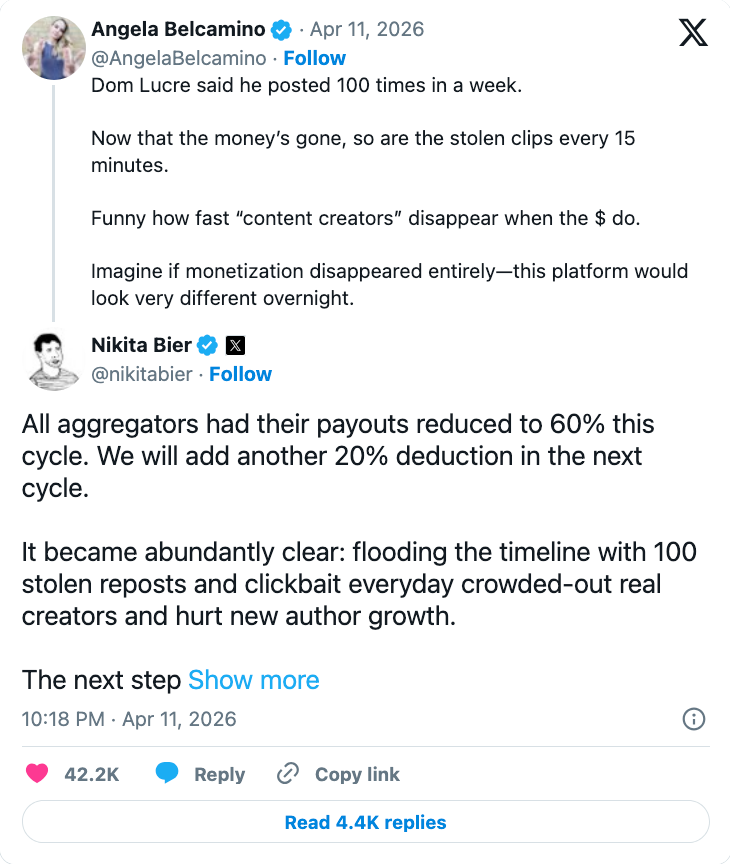
X pays creators based on how many verified users see their posts. Simple enough in theory, but it turned into an open invitation to game the system.
As Bier put it, “Flooding the timeline with 100 stolen reposts and clickbait everyday crowded-out real creators and hurt new author growth.”
The policy is based on X’s Creator Revenue Sharing Terms, updated in August 2025, which allow the platform to adjust payouts and stop paying accounts that try to game the system. So Bier’s announcement was as much a reminder as it was a warning: “X will never infringe on speech or reach – but we will not compensate for manipulation of the program or our users.”
Whether the execution will be as clean as the intention is another matter. Kenyan newsrooms use that word for a reason, and an algorithm cannot always tell the difference between a genuine story and a headline designed to manufacture urgency.
X has not said exactly how many offenses make someone a habitual offender, and that vagueness has already made some legitimate creators nervous.
There is also a subtler irony here when you think about the platform. X has positioned itself, since Elon Musk‘s acquisition, as a free speech platform resistant to heavy-handed content moderation.
This policy does not restrict what anyone can say, which is how X will defend it. However, telling someone their words are fine while quietly making those words unprofitable is its own kind of editorial pressure.
Still, the underlying problem is real. The “BREAKING” reflex became so routine on the platform that the word stopped meaning anything. If X can follow through without penalizing the outlets doing actual journalism, this might be a correction worth watching.