









There is something quietly telling about a prosecution office that loses the same argument twice and decides the solution is to try a third time.
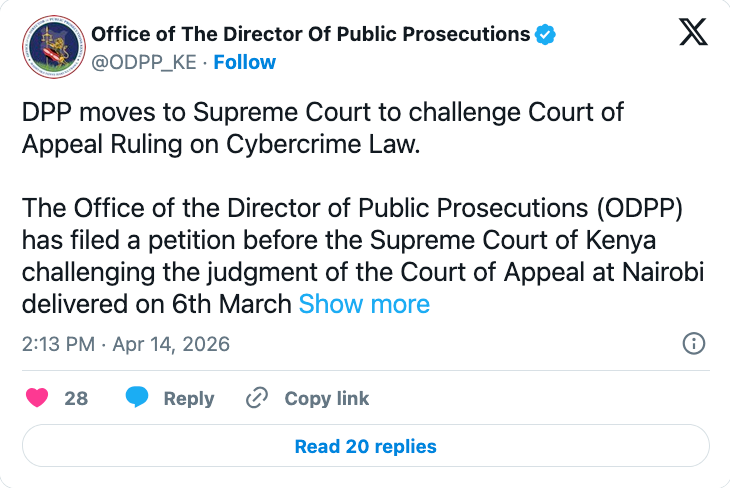
The Office of the Director of Public Prosecutions has now filed a petition before the Supreme Court of Kenya, challenging the Court of Appeal’s March 6 ruling that struck down Sections 22 and 23 of the Computer Misuse and Cybercrime Act.
To understand why this matters, it helps to revisit what Sections 22 and 23 actually did. They criminalized the publication of false or misleading information online, with provisions so loosely drafted that they could, in theory, catch a satirist, a blogger making an honest factual error, or a journalist whose source turned out to be wrong.
The Bloggers Association of Kenya (BAKE), which first challenged the law back in 2018, argued precisely this. Both the High Court and the Court of Appeal agreed even more forcefully, with a three-judge bench describing the provisions as “so broad, wide, and untargeted, akin to unguided missiles, and likely to net innocent citizens.”
That is not mild judicial skepticism. That is a court telling the state that its law was constitutionally indefensible.
What the ODPP hopes to achieve at the Supreme Court is, on its face, simple. It wants the apex court to overturn the appellate decision and restore both sections to life. The office has framed this as fulfilling its constitutional mandate in the public interest.
However, there is a tension and argument in that framing that is hard to ignore. The public interest is not served by laws that punish speech the constitution explicitly protects under Articles 33 and 34.
The public interest is not served by provisions so vague that the line between criminal misinformation and vigorous, imperfect commentary becomes impossible to draw. Two courts have now said as much with considerable clarity.
The ODPP is not alone at the Supreme Court, which adds an interesting dimension. BAKE has also signaled partial dissatisfaction with the Court of Appeal ruling, as have civil society groups, including Article 19 East Africa, the Kenya Union of Journalists and the Law Society of Kenya.
Their grievance runs in the opposite direction. They believe the appellate court did not go far enough in protecting digital freedoms under the broader cybercrime law as reported by the Daily Nation.
So the Supreme Court is now looking at a case being pulled from two sides simultaneously, with the state wanting to tighten the law and civil society wanting it loosened further.
For the ODPP, the strategic logic presumably rests on the hope that the Supreme Court will read the constitutional balance differently, perhaps placing greater weight on the state’s interest in regulating harmful online content against the individual right to expression.
That is a legitimate legal argument, even if it is an uphill one after two consecutive defeats.