





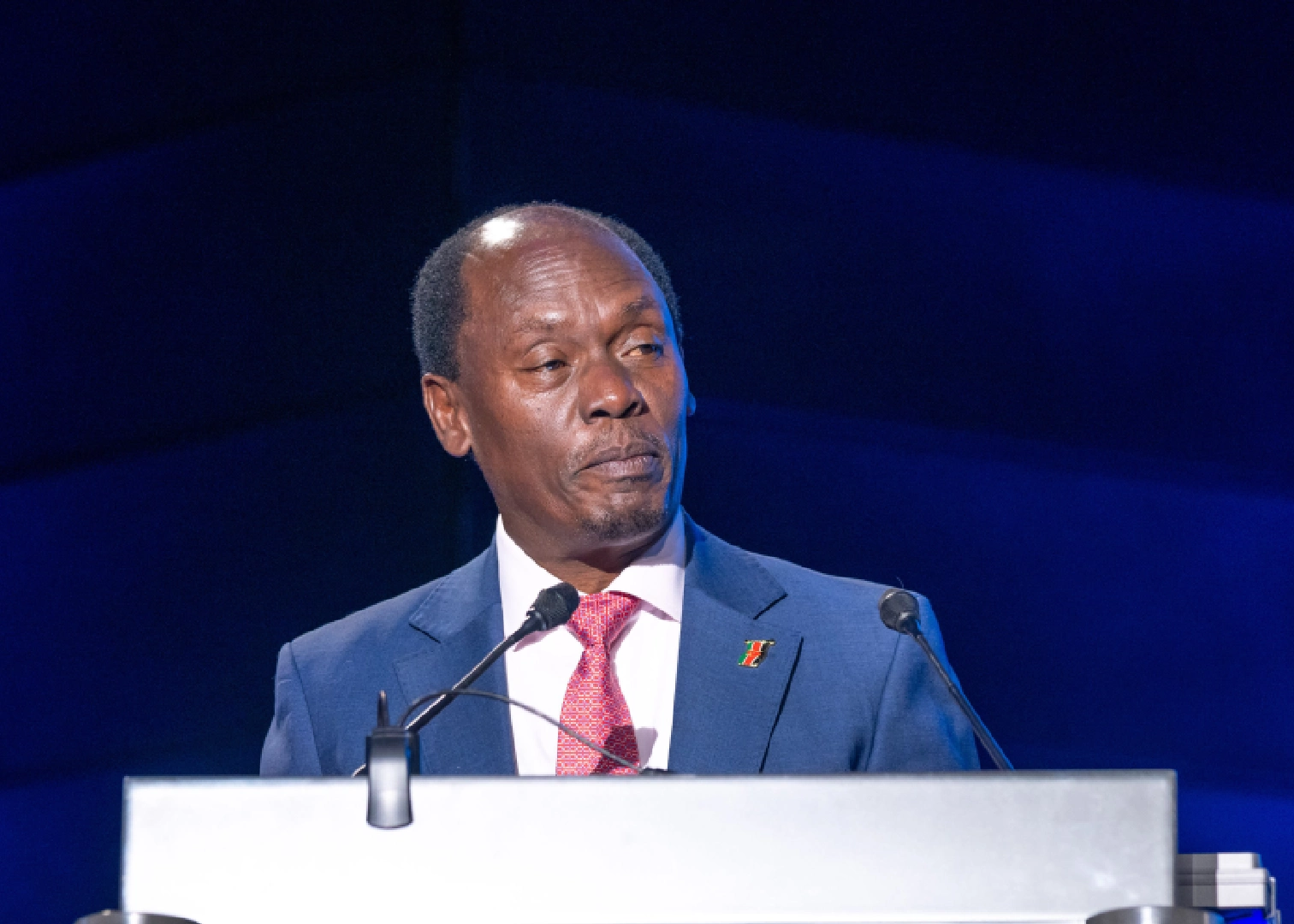
During the WSIS 2026 Forum in Geneva, Kenya’s delegation, led by Cabinet Secretary William Kabogo, alongside the Communications Authority of Kenya (CA) Director General David Mugonyi, pitched the country as Africa’s digital front-runner.
On paper, the results looked strong, with Kenya securing hosting rights for the December 2026 Internet Governance Forum in Nairobi, while the iamtheCODE initiative won a WSIS Prize, and officials showcased the new National AI Strategy 2025–2030.
Measured against Kenya’s own implementation record, though, the gap between the pitch and the reality is considerable.
Take the rural digital-inclusion story anchoring much of Kenya’s messaging. The Digital Master Plan promised 100,000 kilometers of fiber and 1,450 ward-level hubs meant to close the rural-urban divide.
By mid-2026, only around 300 hubs were operational, with 120 stalled in phase one alone, while fiber rollout stood near 10,000 kilometers by mid-2024, a fraction of the eventual target.
The same pattern holds for the AI strategy the delegation used to argue Kenya was shaping global norms responsibly while its roadmap admits design and testing standards remain under deliberation.
It leans on a Data Protection Act, 2019 whose enforcement body has been described as under-resourced, with 2026 only now marked as a “new enforcement phase.” Claiming credible AI governance in Geneva sits awkwardly with enforcement machinery still finding its footing at home.
The same disconnect is evident in child online protection. Officials pointed to the Data Protection Act and the Computer Misuse and Cybercrimes Act as evidence of strong protections.
However, civil society groups argue that parts of the cybercrimes law are too broad and have sometimes been used to limit civic space instead of protecting children.
They also say responsibilities are split across several agencies, enforcement officers do not receive enough training, and the industry guidelines introduced in July 2025 remain largely unfunded and difficult to put into practice.
The biggest contradiction involves the Communications Authority itself. It was one of the regulators leading Kenya’s rights-focused delegation in Geneva, yet Kenyan courts have repeatedly found it responsible for restricting internet access and media freedom.
This includes internet disruptions during the 2024 Finance Bill protests, a June 2025 directive stopping live protest coverage, and the suspension of Telegram, which was later ruled unlawful.
None of this means Kenya’s digital progress is insignificant. Mobile money subscriptions now exceed the country’s adult population, with more than 51 million subscriptions handling transactions worth nearly the country’s annual GDP.
Safaricom and Airtel alone processed more than $300 billion in transactions in a single year.
Kenyan startups also attracted more venture capital funding in 2025 than those in any other African country. The Ajira Digital program has helped connect hundreds of thousands of young people to online work through youth empowerment centers across all 47 counties.
Nairobi’s reputation as the “Silicon Savannah” is backed by a strong fintech and startup ecosystem.
These are genuine achievements recognized around the world. They also make the remaining gaps in digital infrastructure, AI regulation, and rights enforcement harder to dismiss as normal growing pains.
Kenya’s performance in Geneva remains significant, but it also raises difficult questions. Digital hubs are still largely unbuilt, AI regulations are still being developed, child protection enforcement remains weak, and the institution promoting digital rights internationally has been found to have violated those rights at home.
Whether Kenya closes these gaps before the Internet Governance Forum comes to Nairobi this December, or continues to rely on strong international messaging, will say more about the country’s digital future than the statements made in Geneva.